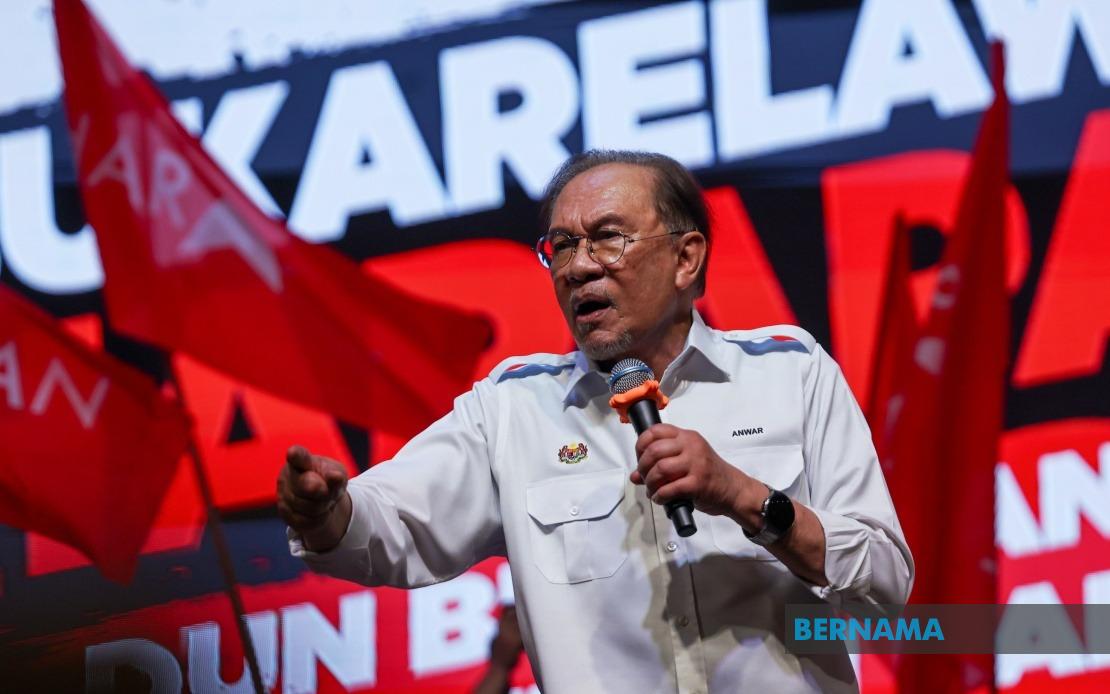
Prime Minister Datuk Seri Anwar Ibrahim mounted a defence of the Democratic Action Party in Muar on Friday, rejecting what he characterized as misleading portrayals of the Chinese-majority party as inherently anti-Malay. Speaking as the head of the ruling Pakatan Harapan coalition, Anwar pointed to concrete evidence of DAP's willingness to accommodate Malay-Muslim interests, most notably the party's non-objection to gazetting 20.23 hectares of land in Bandar Malaysia as Malay Reserve Land, a designation that carries constitutional significance in Malaysia's federal structure.
The Prime Minister's remarks come amid an ongoing political climate where accusations of racial insensitivity have become weaponized by various quarters seeking to undermine the stability of the governing coalition. Anwar's intervention suggests concern that such narratives, if left unchallenged, could erode public confidence in a government that depends on delicate cross-communal support. His emphasis on DAP's practical acceptance of Malay reserve status—a cornerstone of the constitutional settlement underpinning Malaysian federalism—serves to distinguish between legitimate constitutional protections and claims of anti-Malay animus.
Central to Anwar's argument is the assertion that his role as Prime Minister demands impartiality across ethnic and religious lines. He articulated this responsibility by drawing a distinction between targeted community programmes, which he said the government actively pursues, and blanket exclusions based on ethnicity. The government has, he noted, increased allocations to Perbadanan Usahawan Nasional Berhad (PUNB), the state-owned entrepreneurship agency primarily serving Bumiputeras, without facing DAP resistance. This framing suggests that the party is pragmatic enough to support policies aimed at specific communities without viewing such support as threatening to its political interests or principles.
Yet Anwar was equally emphatic that governmental fairness cannot operate selectively. He outlined a vision of inclusive assistance that would benefit impoverished households across all communities—Malay, Chinese, and Indian alike—recognizing that economic hardship transcends ethnic boundaries. This rhetorical move reframes the debate from one centred on zero-sum competition between communities to one focused on shared economic vulnerability and the state's obligation to address it comprehensively. In doing so, Anwar attempts to position the Unity Government as transcending the binary framing of pro-Bumiputera versus anti-Bumiputera politics that has dominated Malaysian discourse.
The Prime Minister extended his argument to encompass the management of Malaysia's current economic momentum. He stressed that growth alone holds no intrinsic value unless its benefits reach ordinary Malaysians in tangible forms—affordable housing, functional public infrastructure, and educational advancement. This pivot toward outcomes rather than ideology reflects awareness that voters across communities share material concerns that supersede identity-based political divisions. The emphasis on translating macroeconomic gains into household-level improvements speaks directly to middle and lower-income Malaysians who have experienced stagnant real wages despite overall GDP expansion in recent years.
Anwar also invoked an ethical dimension to his governance philosophy, articulating a vision of politics as service rather than self-enrichment. This messaging carries particular resonance in a Malaysian context where high-profile corruption scandals involving both established and newer political figures have corroded public trust. By positioning himself against the use of political power for personal accumulation, Anwar seeks to distinguish his administration from predecessor regimes and to set behavioral expectations for the broader coalition. The statement that "power is a trust to be used, not to enrich yourself" functions simultaneously as a normative claim about politics and an implicit criticism of rival factions whose leaders face ongoing legal scrutiny.
The timing of these remarks, delivered during the campaign period for the 16th Johor state election, underscores their immediate political utility. With 56 state assembly seats contested across 172 candidates and polling day scheduled for July 11, Anwar's defence of DAP serves broader coalition interests. Johor, Malaysia's second-largest state by population and economy, represents crucial battleground territory where Pakatan Harapan's 2022 federal electoral gains must be consolidated or expanded. Any erosion of confidence in DAP's respect for constitutional Malay-Muslim protections could translate into significant seat losses, particularly in mixed constituencies where swing voters are sensitive to communal rhetoric.
The remarks also reflect internal coalition management considerations. DAP's participation in the Unity Government has generated persistent criticism from opposition figures and conservative commentators who contend that the party's presence undermines the Malay-Muslim character of governance. By publicly reaffirming DAP's acceptance of constitutional provisions protecting Malay and Bumiputera interests, Anwar shields his coalition partner from such attacks while simultaneously signalling to DAP supporters that the government will not subordinate non-Malay interests entirely to majoritarian demands. This balancing act remains delicate, and Anwar's intervention suggests efforts to stabilize perceptions.
Further context emerges from Anwar's specific reference to government programmes benefiting different communities without triggering DAP objections. By naming PUNB allocations as an example of initiatives advancing Bumiputera entrepreneurship that proceeded without party resistance, Anwar provides measurable evidence supporting his argument. This approach shifts the debate from abstract principles to concrete policy implementation, rendering his defence more empirically grounded. It also implicitly challenges opposition figures to identify specific instances where DAP has actively blocked Malay or Bumiputera-targeted initiatives, setting a higher evidentiary bar for critics.
The vision articulated by Anwar represents an attempt to forge a distinctly Malaysian model of inclusive governance that maintains constitutional commitments to Malay-Muslim interests while rejecting the principle that such protection requires systematic exclusion of other communities. Whether such a synthesis can endure amid competing pressures from within and outside the coalition remains an open question. The upcoming Johor election will provide an early indicator of whether voters accept Anwar's framing or whether demographic and communal anxieties drive electoral behavior toward more exclusive political offerings. For now, the Prime Minister has staked his administration's credibility on the proposition that Malaysia's prosperity depends on prosperity distributed across all communities, and that DAP, whatever its origins or composition, can serve that vision.

