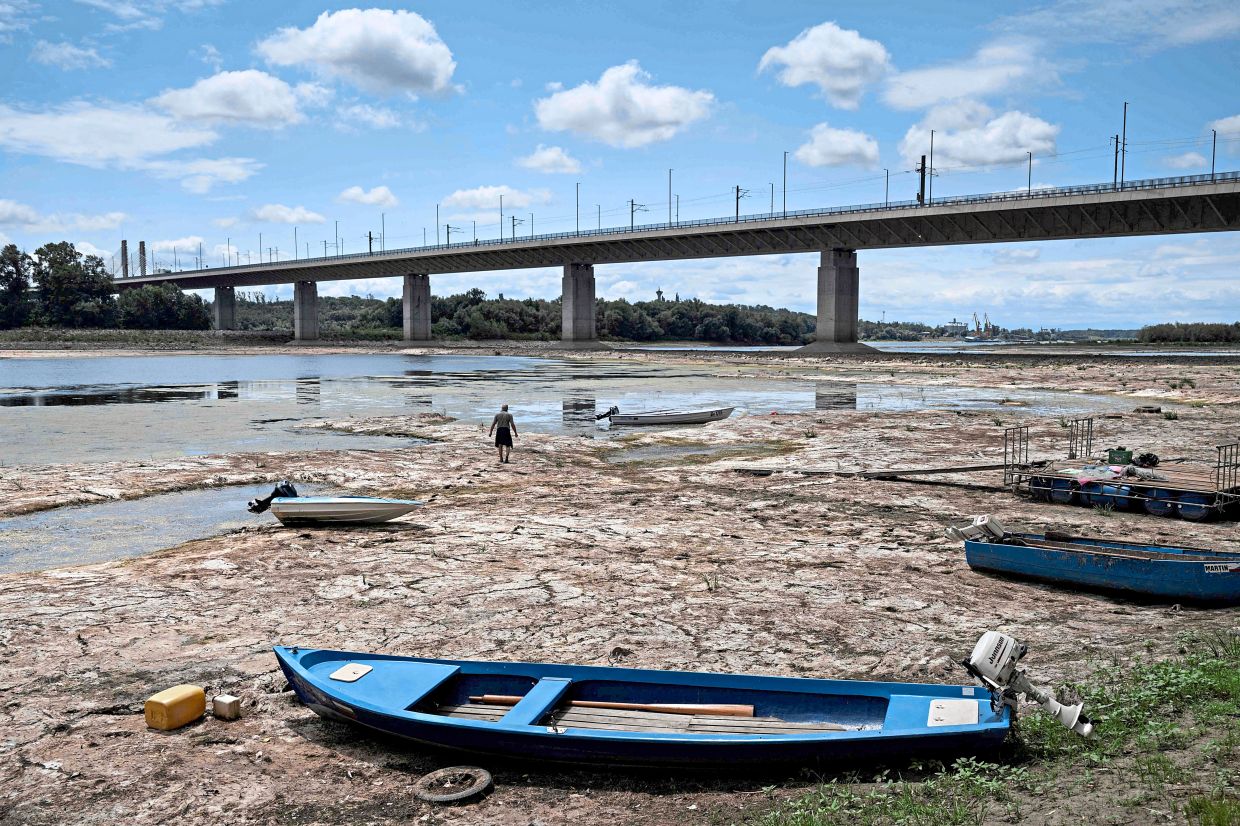
The Danube River, lifeline to ten countries stretching from southwestern Germany to the Black Sea, is experiencing its most severe drought in recorded history. Water levels along much of the 2,860-kilometre waterway have plummeted to levels never documented before, laying bare a landscape that has remained submerged for generations. In Budapest, Hungary's capital, measurements recorded by the national water authority on July 29 showed the river at just 23 centimetres—a figure that shatters the previous record low of 33 centimetres established in 2018, signalling an accelerating trend of water scarcity gripping the continent.
The phenomenon reflects a broader climate emergency engulfing Central and Western Europe simultaneously. Whilst wildfires consume swathes of France and Spain, and another heat wave advances across the region with temperatures forecast to exceed 38°C, the Danube basin has endured months of severely diminished rainfall. Hungary's Meteorological Service reports that cumulative precipitation over the past 90 days lies 80–130 millimetres below historical norms across nearly the entire country. This dual assault of heat and drought has accelerated evaporation and drained waterways at rates that have alarmed scientists and policymakers alike.
The visual transformation of the Danube has become stark and unsettling for residents and visitors. Photographer Gabor Kertesz documented the base of Budapest's Margaret Bridge, typically submerged beneath metres of water, now revealing barren rock formations and sand banks around the bridge's pillars. The exposure prompted immediate historical concerns: authorities were forced to close the Margaret Bridge itself after detecting a World War II-era bomb at its foundation, uncovered by the receding waters. For some, like treasure hunter Zsolt Horvath, the dried riverbed has become an opportunity to retrieve forgotten relics—old radio amplifiers, ammunition casings, and metal debris from decades past—although he acknowledges the grim tradeoff involved.
Commercial shipping, a backbone of Central European logistics and economy, has ground to a halt across much affected stretches of the river. Hungary's Ministry of Transport and Investment reported that cargo operations have virtually ceased, whilst cruise ship operators have been compelled to dock far upstream from their intended Budapest terminals, disrupting passenger sightseeing itineraries and straining tour operators dependent on smooth seasonal operations. The situation deteriorated further when the Viking Ullur, a cruise vessel bound for the Bulgarian port city of Vidin, ran aground on a shallow sandbar on July 28. Bulgarian authorities evacuated 186 tourists from the stranded ship; the vessel's crew of 52 remained aboard whilst awaiting refloating assistance, having exhausted food and water supplies after proving unable to reach Vidin's resupply docks.
Similarly dire conditions prevail in Serbia, where the northern city of Novi Sad has witnessed an extraordinary sight: hundreds of small recreational vessels and dozens of cargo ships abandoned on the exposed riverbank. Local boat operator Radovan Segrt, who operates river excursions for tourists, reported that waters have retreated between 15 and 20 metres from their normal shoreline. He succinctly summarised the crisis facing the summer tourism season: for those dependent on river-based commerce and leisure, the economic consequences are devastating and immediate.
Perhaps most alarming is the threat to Europe's energy infrastructure. Multiple countries rely on Danube water to cool nuclear reactors, and the diminished flow has forced unprecedented interventions. In Romania, where water discharge has slumped to approximately 1,630 cubic metres per second—roughly a third of the typical July average—authorities at the Cernavoda power plant shut down a reactor unit on safety grounds and scheduled another closure. Hungary's Paks nuclear plant, which generates nearly half the nation's electricity, began shutting down a reactor on July 29 as cooling-water supplies fell below operational thresholds. This marked the third successive power reduction across the facility's reactor fleet within consecutive days, raising concerns about Hungary's electricity supply stability during the peak summer demand period.
The convergence of transport disruption, tourism collapse, and energy vulnerability reveals how climate stress is simultaneously attacking multiple sectors of the regional economy. Unlike acute natural disasters that trigger rapid emergency response, prolonged drought operates as a slow-motion crisis, exposing dependencies and bottlenecks that have been obscured by a century of relative hydrological stability. The Danube's crisis is fundamentally a climate change crisis, one that extends beyond Hungary or any single nation to implicate the entire European energy system and transcontinental logistics networks.
For Southeast Asian observers, the Danube situation offers a sobering precedent. Major rivers across the region—the Mekong, Irrawaddy, and Salween—already experience seasonal variability amplified by monsoon patterns and upstream dam operations. As global temperatures rise and precipitation patterns shift, similar scenarios of record-low flows, stranded shipping, and power generation constraints are not hypothetical risks but emerging probabilities. The lesson from Central Europe is that even wealthy, technologically advanced regions struggle to manage the cascading failures that drought induces when multiple sectors depend on a single water source.
Looking forward, the Danube's crisis underscores the need for integrated water management strategies that balance agriculture, industry, tourism, and energy production in an era of climate instability. Policymakers across the region are confronting uncomfortable truths: adaptation to lower baseline water availability may require difficult choices about dam management, reservoir operation, and industrial siting. For Hungary, Serbia, Romania, and neighbouring states, the Danube's historic low-water levels are not merely an inconvenient summer phenomenon but a clarion call that the continent's hydrological security—and by extension, its economic resilience—depends on aggressive mitigation and sophisticated adaptation planning.

