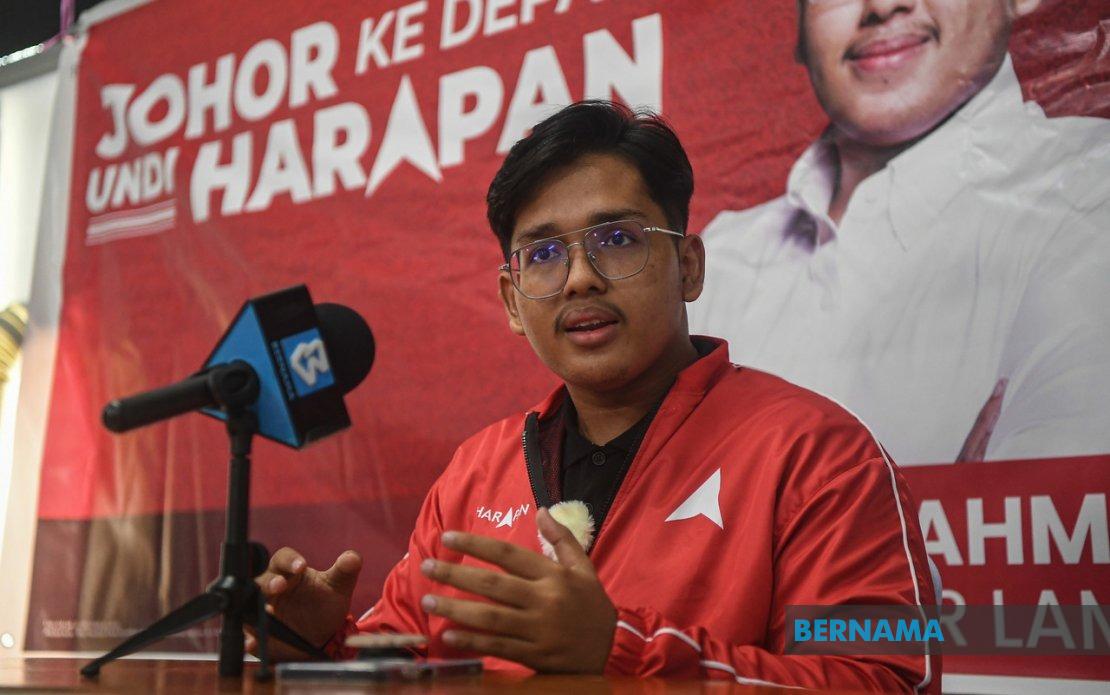
At just 23 years old, Danish Hossman Abd Rahman stands as the youngest candidate in the Johor state election, challenging the conventional political landscape in the Johor Lama constituency with an ambitious platform focused on reversing economic stagnation and alleviating administrative burdens on rural residents. Running as the Pakatan Harapan representative under the campaign slogan "Wajah Baharu, Johor Lama" (A New Face, Johor Lama), Danish has identified a critical gap in the state's development strategy: the persistent neglect of smaller towns and Felda settlements while larger urban centres capture disproportionate government resources and private investment.
The core of Danish's electoral pitch centres on addressing the chronic brain drain affecting Johor Lama and surrounding Felda communities. Young people from these areas have increasingly migrated to Johor Bahru, Kuala Lumpur, or across the border to Singapore in search of employment opportunities unavailable in their home regions. Danish argues that this exodus represents not merely an economic loss but a social fracture, stripping villages of their demographic vitality and human capital. By channelling targeted investment and encouraging high-impact economic projects to Johor Lama, his campaign contends that employment can be generated locally, allowing young families to build lives in their communities rather than pursuing distant, costly alternatives in congested urban areas.
A cornerstone of his platform is the call for stronger coordination between Johor's state government and federal authorities. Danish maintains that siloed policymaking and fragmented implementation have hindered equitable development across the state. Kota Tinggi and surrounding localities have historically received minimal attention compared to corridors focused on Johor Bahru, Tebrau, and Kulai. This imbalance, he suggests, reflects not inevitable geography but policy choices that can be reversed through integrated planning and sustained commitment at both governmental levels. Such coordination would ensure that development projects are not merely announced but delivered with proper oversight and timely completion.
Beyond economic concerns, Danish has identified a seemingly mundane yet practical problem affecting his constituents' daily lives: the absence of an Immigration Department branch office in Kota Tinggi. Residents requiring passport applications, renewals, or other immigration services currently face a significant administrative burden. They must travel to Johor Bahru, Kulai, or Mersing—journeys consuming substantial time, transport costs, and lost working hours. For elderly residents or those with mobility constraints, such trips present formidable obstacles. Establishing a local immigration centre would streamline administrative access, reduce travel friction, and signal that Kota Tinggi residents deserve the same service infrastructure available in larger urban centres. This commitment reflects an understanding that development encompasses not just grand infrastructure projects but the everyday conveniences that define quality of life.
Danish's campaign strategy merges traditional grassroots engagement with digital outreach, recognising that modern electoral success requires presence across multiple platforms and channels. With over 32,000 voters in the Johor Lama constituency, direct face-to-face interaction remains essential for building trust and gathering constituent concerns. Simultaneously, he has invested in social media campaigning, posting regular updates that have reportedly generated positive responses from the electorate. This hybrid approach acknowledges both the preferences of different demographic groups—particularly older voters who value personal interaction and younger constituents who navigate politics through digital networks—and the practical reality that comprehensive coverage demands diversified effort.
The Johor Lama contest itself will be contested among three candidates, creating a genuinely competitive environment. Danish faces incumbent Norlizah Noh, representing Barisan Nasional, and Aisah Esa, the Perikatan Nasional candidate. The three-way split creates unpredictable dynamics; neither traditional coalition dominance nor newcomer disadvantage can be assumed. Voters in Johor Lama will evaluate not merely party affiliation but individual candidates' credibility, local knowledge, and convincingness regarding promised priorities. As the youngest contender, Danish carries both the potential advantage of perceived freshness and energy, and the vulnerability of limited political track record.
The timing of the Johor state election—scheduled for July 11, with early voting on July 7—reflects broader political rhythms in Malaysia. Johor, the nation's second-most-populous state and a traditional Barisan Nasional stronghold, represents significant electoral terrain. Results here often carry implications beyond state-level politics, signalling voter sentiment that reverberates through national political calculations. An unusually competitive performance by Pakatan Harapan or a breakthrough by Perikatan Nasional candidates could reshape perceptions of the country's evolving political alignments.
Danish's candidacy also reflects generational shifts within Malaysian politics. His emergence as a mainstream candidate in a state election, at an age when many peers are still completing tertiary education, suggests that younger figures increasingly perceive pathways into formal politics as viable and necessary. Whether this reflects frustration with incumbent governance, ideological conviction, or opportunism remains an open question for voters. However, his focus on concrete, constituent-level issues—jobs, administrative convenience, equitable development—rather than abstract principles or personality-driven politics suggests a pragmatic orientation potentially appealing to voters weary of rhetorical excess.
The broader context of rural and semi-rural economic marginalisation in Malaysia provides salience to Danish's platform. Felda communities and smaller towns throughout the country face similar challenges: limited private sector investment, dependence on agriculture or government employment, and youth migration to metropolitan areas. If Danish's approach gains traction in Johor Lama, it may influence how other candidates across Malaysia address comparable grievances. Conversely, if voters reject his prescriptions despite their intuitive appeal, such results would suggest that systemic barriers to rural economic revitalisation run deeper than candidate effort or state-level coordination can address.
Danish's campaign ultimately presents voters with a choice between continuity and programmatic change focused on specific, locally-rooted priorities. Whether his youth, energy, and practical platform prove sufficient against entrenched incumbent advantages or competing alternatives will be determined by Johor Lama voters on July 11. The outcome may reveal not just local preferences but broader patterns in how Malaysian voters evaluate candidates and their promises in an era of fragmented party systems and increasingly competitive electoral politics.

