In a quiet village 90 kilometres east of Prague, an unusual monument to Argentine football stands out against the Czech countryside. Miloslav "Curby" Urbanec's three-storey home in Bukovka is painted in the distinctive sky-blue and white of Argentina's national colours, its walls adorned with the iconic sun emblem from the Argentine flag. But the 51-year-old music promoter's devotion to the South American nation's football legacy extends far beyond mere paintwork. A life-size bronze statue of Diego Maradona occupies pride of place in the courtyard, while a sprawling mural of Lionel Messi dominates the rear elevation. Every surface tells a story of a passion forged nearly half a century ago.
Urbanec's infatuation with Argentine football began in childhood, when he watched the 1978 World Cup victory with his father at an age when most children are indifferent to international sports. The tournament's stars, particularly Mario Kempes with his flowing hair, captivated the young Czech boy in ways that would shape the rest of his life. What started as youthful enthusiasm crystallised into an unwavering commitment that would see him dedicate his home, his vehicle, and arguably his identity to honouring the football culture of Buenos Aires and the nation beyond. This is no casual fandom born from a single tournament victory or the exploits of one player, but rather a deeply rooted emotional connection spanning generations of Argentine football.
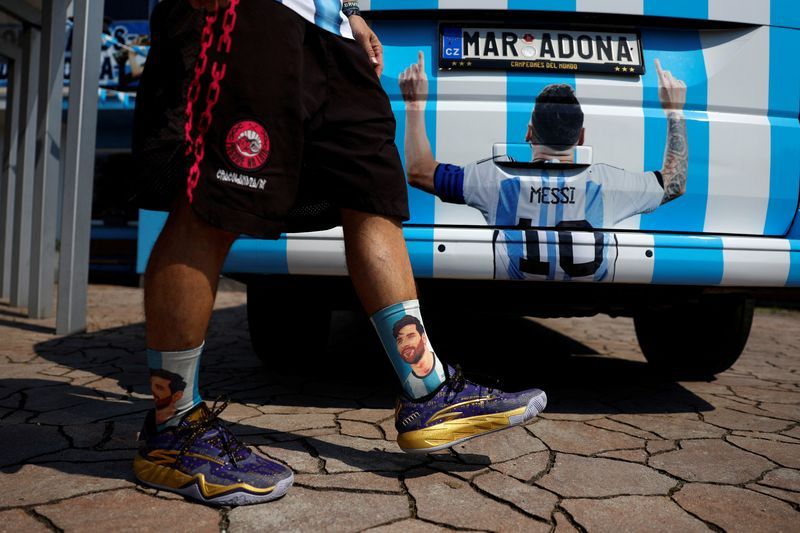
The physical manifestations of Urbanec's devotion are impossible to ignore. His van, painted in the same sky-blue and white livery as his house, declares its allegiance through bold imagery featuring both Maradona clutching the World Cup and Messi in his prime. The custom number plate reads "MARADONA", a dedication to the late legend whose achievements defined Argentine football for decades. Inside the compound, an all-weather football pitch provides Urbanec with a space to engage in his passion, surrounded by placards celebrating players associated with Boca Juniors, the Buenos Aires club that launched Maradona to legendary status. This private stadium transforms the rural Czech property into a complete Argentine football ecosystem, a sanctuary where the visitor steps into a world entirely devoted to the nation's football heritage.
The depth of Urbanec's commitment extends to his family in ways both touching and telling. He named his second son Lionel, convinced seven years ago that the young Messi possessed qualities that would elevate him beyond ordinary talent. For Urbanec, the name choice was not whimsical but rather a calculated investment in his son's future, a blessing bestowed by associating him with greatness. Such decisions reveal how thoroughly Argentine football has woven itself into the fabric of Urbanec's domestic life. His household is not merely influenced by this sporting passion but fundamentally structured around it, with children growing up surrounded by the imagery and ethos of a football culture thousands of kilometres away.
What makes Urbanec's story resonate beyond the quirky human interest angle is what it reveals about football's transcultural power. In an era of globalisation, where satellite television and streaming services make any match accessible anywhere, enthusiasts can develop profound connections to teams and nations far removed from their own geography. Czech football culture, while respectable, cannot compete with the romance and historical weight of Argentine football. Urbanec's shrine represents a conscious choice to align himself with a narrative of triumph, beauty, and footballing philosophy that he finds lacking in his own sporting tradition. His home becomes a pilgrimage site for those who share similar convictions about which football deserves admiration.
Urbanec's faith in the current Argentine national team borders on religious devotion. He speaks of "La Selección" with absolute certainty, declaring that the squad will achieve victory and deliver "beautiful football" to the world. This optimism, whether justified by tactical analysis or pure emotional investment, defines the relationship between a superfan and his chosen team. For Urbanec, supporting Argentina transcends rational assessment of odds or player rosters; it represents a covenant made in childhood and renewed daily through the rituals of his shrine-like home. When the national team performs, he performs alongside them through the intensity of his faith.
The phenomenon of international football fandom extending into such elaborate domestic tributes has become increasingly common yet remains striking when encountered. Urbanec's Bukovka property represents an extreme but honest expression of what millions feel at more subtle levels. He has simply chosen not to hide his passion or apologise for its intensity. Instead, he has transformed his private space into a public declaration of allegiance, inviting anyone who passes to understand that within these walls, Argentine football occupies a sacred place. For a Czech farmer-turned-music-promoter, this is not eccentric behaviour but rather the logical conclusion of a lifelong devotion.
The broader context matters here too. Argentina's football tradition, stretching from earlier World Cup triumphs through the Maradona era and into the contemporary Messi epoch, provides legitimacy to Urbanec's faith. Argentina's contributions to world football—the attacking flair, the development of technically gifted players, the production of consecutive generational talents—create an objective basis for his subjective emotional investment. Urbanec is not simply choosing a random nation to support but rather pledging allegiance to one with genuine claim to footballing excellence. His choice to honour both Maradona and Messi specifically reflects an understanding that Argentina's greatness flows through its individual talents, the rare players who transcend their sport.
As Argentina prepares for upcoming international competition, Urbanec will watch with the intensity of someone whose identity is invested in the outcome. His home, his vehicle, his family naming choices, and his sporting philosophy all coalesce around the fortunes of a team thousands of kilometres distant. For him, football is not merely entertainment but rather a lens through which to understand loyalty, excellence, and the possibility of beauty existing in the world. Whether Argentina ultimately vindicates his faith remains uncertain, but Urbanec's commitment to his chosen nation appears immutable, fixed as permanently as the sky-blue paint covering his Bukovka shrine.

