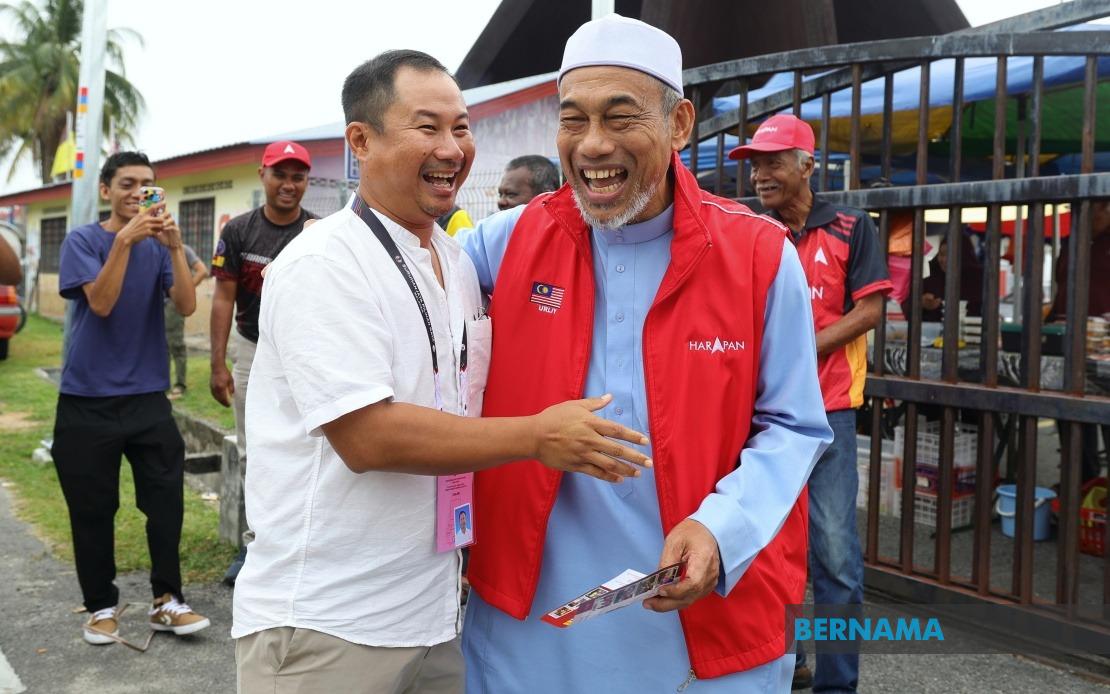
The Negeri Sembilan State Election campaign took on a notably personal dimension when two family members found themselves on opposing sides of the political divide in the Klawang constituency. Incumbent Datuk Bakri Sawir, representing Pakatan Harapan, and his challenger Danni Rais, fielded by Perikatan Nasional, both canvassed voters at Kuala Klawang weekend market simultaneously as the campaign entered its second day, drawing considerable public interest as residents witnessed the unusual political contest unfold.
The dual presence at the bustling market generated organic attention from visitors and traders, who seized the moment to engage with both candidates in ways that underscored the competitive yet cordial nature of their encounter. Members of the public were observed taking photographs and exchanging pleasantries with each candidate as they navigated through similar market sections, creating a striking visual representation of Malaysia's multi-party democratic process in action.
Despite representing Pakatan Harapan and Perikatan Nasional respectively—coalitions that have fundamentally different political trajectories and policy outlooks—the cousins managed to maintain decorum throughout their interactions. Rather than allowing family ties to complicate party loyalty or encouraging supporters toward confrontation, both candidates demonstrated restraint and professionalism. Observers noted exchanges of light-hearted banter between the two, suggesting that personal relationships and political differences need not descend into acrimony.
Bakri, when commenting on the unusual dynamic of contesting against a relative, characterised the situation with philosophical composure. He reframed the contest not as an extraordinary personal challenge but rather as an opportunity for both candidates to demonstrate their respective capabilities and commitment to serving constituents. This perspective emphasises that electoral competition, while intense, remains fundamentally rooted in offering voters a genuine choice of governance and leadership philosophies.
The incumbent stressed the paramount importance of adhering to established electoral protocols and maintaining order throughout the campaigning process. He illustrated this principle through a concrete example, noting that when the Jelebu District Council objected to flag installations on stadium premises, his campaign apparatus promptly complied with the directive. This willingness to respect administrative boundaries and legal constraints serves as a barometer for how political leaders intend to govern should they assume office—suggesting that respect for institutional rules must commence during the electoral period itself.
Bakri's emphasis on lawful conduct carries particular significance in the Malaysian context, where election integrity and orderly campaigns contribute to strengthening democratic institutions and public confidence in electoral outcomes. His exhortation that political actors cannot demand public adherence to law whilst simultaneously flouting regulatory requirements represents a foundational principle of democratic governance that transcends individual party interests.
The Klawang constituency presents a competitive three-way contest, with the addition of Muhammad Adib Musa from Bersatu introducing further complexity to voter calculations. With 13,355 registered voters distributed across this state seat, the fragmentation of support across three candidates rather than two creates unpredictable electoral arithmetic. This configuration requires each candidate to develop distinct messaging and targeted constituency engagement strategies rather than relying on simple binary choice dynamics.
The Election Commission has structured the voting timeline strategically, scheduling early voting for July 28, allowing voters with mobility constraints or scheduling conflicts to participate, with general polling designated for August 1. This phased approach reflects international best practices in electoral administration while accommodating diverse voter circumstances. The compressed campaign timeline, typical for state-level elections, intensifies candidate activities and voter engagement density compared to federal election cycles.
The civility demonstrated between Bakri and Danni at Kuala Klawang market represents a refreshing counterpoint to increasingly polarised political environments observable across numerous democracies. Their approach—maintaining principled political disagreement whilst respecting personal relationships and procedural norms—offers a valuable model for how competitive democratic politics can function without descending into destructive personal animosity. For Malaysian voters and observers elsewhere in Southeast Asia, such demonstrations of political maturity serve broader democratic health.
Negeri Sembilan's election results will carry implications extending beyond the state itself, as they provide indicators of voter sentiment regarding coalition performance and the relative appeal of competing political frameworks in contemporary Malaysia. The Klawang result specifically will reflect constituent assessment of incumbent performance against alternative options, thus informing national political calculations regarding coalition stability and voter preferences heading toward federal electoral cycles.
The broader campaign environment in Negeri Sembilan will ultimately determine whether such civility pervades the entire election or whether this particular instance represents an exception to increasingly heated political engagement elsewhere. The demonstrated capacity for cousins to contest genuinely whilst maintaining mutual respect suggests that Malaysian democracy retains institutional and cultural resources for managing intense political competition without sacrificing social cohesion—a capability that differentiates the country within a sometimes volatile regional political landscape.

