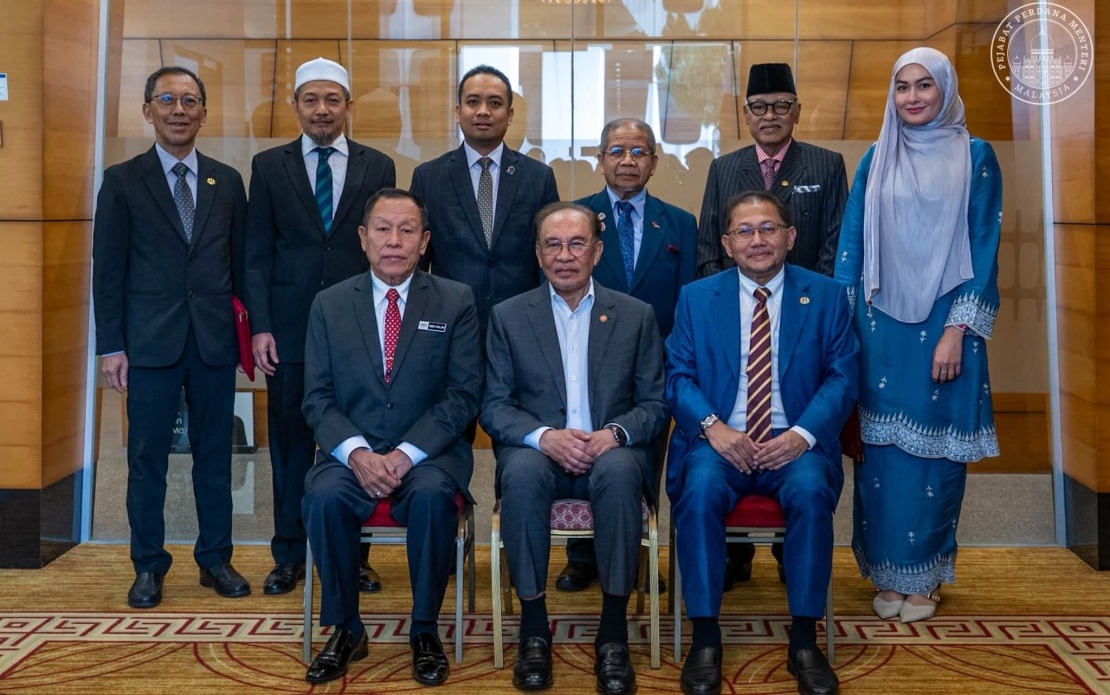
Prime Minister Datuk Seri Anwar Ibrahim has underscored that the fight against corruption in Malaysia cannot rest on the shoulders of any single institution, emphasising instead the critical need for a coordinated, whole-of-society approach that brings together law enforcement, regulatory bodies, Parliament, and the broader business and civil communities. Speaking at Parliament on June 30, Anwar highlighted the interconnected nature of anti-corruption work, arguing that lasting progress depends on sustained collaboration across multiple fronts and sectors, each contributing its own expertise and authority to reinforce the system.
In a significant move, Anwar formally presented appointment instruments to newly appointed members of two key oversight committees: the Special Committee on Corruption (JKMR) and the Anti-Corruption Advisory Board (LPPR), following approval from the Yang di-Pertuan Agong. These bodies function as institutional checks and balances within Malaysia's anti-corruption architecture, charged with offering independent scrutiny and constructive criticism to sharpen enforcement strategies and policy direction. The reconstitution of these committees signals a fresh commitment to revitalising oversight mechanisms at a time when public confidence in governance remains a central political and social concern.
Anwar conveyed a message to the incoming committee members, urging them to strengthen their personal commitment to advancing the country's anti-corruption agenda. Despite the diverse professional and personal backgrounds represented among the new appointees, he stressed that they share a unified mission: to fortify Malaysia's defences against corrupt practices across government and business. This unity of purpose, the Prime Minister suggested, transcends partisan considerations and sectoral differences, anchoring all members to a common benchmark of integrity and national interest.
The JKMR operates under the legal framework established by Section 14 of the Malaysian Anti-Corruption Commission Act 2009 (Act 694). Its composition deliberately bridges the political divide, incorporating members drawn from both the Government and Opposition benches within the Senate and Dewan Rakyat. This cross-party structure embeds a principle of democratic accountability and prevents any single political faction from monopolising the committee's direction, theoretically enabling it to challenge all levels of government with equal scrutiny regardless of which coalition holds power.
The LPPR, similarly mandated under Section 13 of Act 694, takes a different recruitment approach, drawing its membership from individuals of established integrity who have demonstrated exceptional service in public administration or achieved recognised excellence in their professional fields. Rather than being explicitly political appointees, LPPR members are selected primarily on the basis of their track record and standing within Malaysian society, creating a layer of civilian expertise and moral authority that complements the formal governmental and parliamentary dimensions of anti-corruption governance.
The emphasis on institutional plurality in anti-corruption work reflects growing international consensus that single-agency models prove insufficient. Malaysia's approach of distributing responsibility across the MACC, Parliament, these two oversight committees, and broader civil participation mirrors lessons learned in other regional democracies. When enforcement power concentrates in one place without robust external checks, agencies themselves become vulnerable to pressure, politicisation, or mission drift. By design, the current structure requires multiple independent voices to align before major anti-corruption strategy shifts.
The appointment announcement carries particular resonance given Malaysia's complicated recent history with corruption allegations spanning multiple levels of government and involving figures from both ruling and opposition parties. Public scepticism about anti-corruption sincerity has risen periodically when prosecutions have appeared selective or when high-profile cases have stalled. Reconstituting oversight committees with visible diversity and new personnel represents a practical attempt to restore institutional credibility, though effectiveness ultimately depends on these bodies exercising genuine independence rather than serving as rubber stamps for predetermined enforcement decisions.
For Malaysian business and civil society, these institutional developments matter considerably. The private sector increasingly faces pressure to adopt robust compliance frameworks, and clarity about anti-corruption enforcement priorities helps companies calibrate their governance investments. NGOs and watchdog organisations monitoring government transparency find the existence of visible oversight mechanisms somewhat reassuring, even if their actual power remains contested. The two committees' composition signals which professional constituencies the government considers important voices in anti-corruption dialogue, potentially opening space for greater engagement between formal enforcement and civil society networks.
Regionally, Malaysia's multi-layered anti-corruption governance structure positions it within a peer group of ASEAN nations attempting more institutionalised rather than episodic responses to graft. Thailand, Indonesia, and the Philippines have similarly experimented with specialised commissions, parliamentary committees, and advisory boards, though with varying degrees of operational independence and political protection. The effectiveness of such bodies often hinges less on their legislative mandate than on whether political leadership actively defers to their recommendations and shields them from retaliatory pressure when they challenge inconvenient truths.
Anwar's emphasis on collective effort also hints at recognition that corruption cannot be decisively defeated through enforcement alone. Prevention, deterrence, and cultural shift require sustained messaging from business associations, professional bodies, universities, and community leaders emphasising integrity as a competitive advantage and reputational necessity. When the private sector, civil society, and government enforcement agencies pull in the same direction—treating anti-corruption not as a compliance burden but as foundational to legitimate economic activity—the cumulative impact shapes behavioural incentives more effectively than enforcement action alone could achieve.
Looking forward, the real test of these newly appointed committees will come during their operational phase. Can they generate findings and recommendations that surprise stakeholders, challenging both Government and Opposition where evidence warrants? Will their members demonstrate willingness to recommend prosecution of politically connected figures regardless of factional affiliation? Can they maintain credibility with a Malaysian public increasingly accustomed to selective justice narratives? These questions will determine whether the committee reconstitution represents substantive institutional renewal or incremental reshuffling of the existing apparatus.

