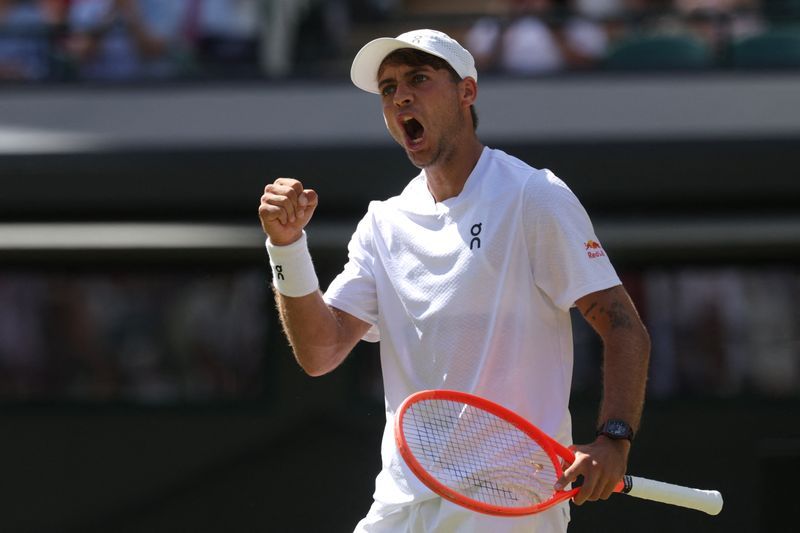
Flavio Cobolli extended his remarkable Grand Slam campaign on Monday by dispatching Australian fifth seed Alex de Minaur with a commanding 7-5 7-6(4) 6-3 victory on Court One, securing his passage to the Wimbledon quarter-finals for a second successive year. The achievement marks the continuation of the 24-year-old Italian's breakthrough season, which saw him reach the French Open final just weeks prior. Seeded ninth at the All England Club, Cobolli's performance demonstrated the kind of mental resilience and tactical acumen that has propelled him into the sport's upper echelon.
Cobolli's progress through the opening set exemplified his capacity to seize control against elite opposition. Breaking De Minaur's service in the eleventh game proved decisive, allowing the Italian to close out the set in 50 minutes. The match itself represented a significant milestone—the first clash between top-ten ranked players in the men's draw during this year's tournament, underscoring the calibre of opposition Cobolli has navigated. His willingness to dictate play and force mistakes on the backhand flank created the platform upon which he would build his advantage.
The second set witnessed a dramatic shift in playing conditions and match dynamics. Heat-induced stoppages interrupted proceedings when spectators suffered ill effects from the intense weather conditions that have characterised the tournament. Rather than allowing these disruptions to derail his focus, Cobolli engaged in relaxed conversation with De Minaur during the breaks, an exchange that revealed mutual respect between the competitors. De Minaur warned his opponent that such interruptions might recur given the oppressive temperatures. Recovering from a precarious 2-5 deficit, Cobolli's explosive hitting and tactical flexibility enabled him to reel off three consecutive games and force a tiebreak. He ultimately claimed the set at 7-6, effectively extinguishing any hope of a comeback from his Australian rival.
The physical and mental toll of managing extreme weather conditions became increasingly evident as the match progressed into its final set. Cobolli faced another break deficit while serving at 0-2, but his capacity to raise his game in critical moments reasserted itself. Rather than capitulating, he recovered the break in the sixth game and continued to build pressure on De Minaur's service games. The accumulation of pressure, combined with Cobolli's superior movement and ball-striking, ultimately proved too much for the fifth seed to withstand. The clinical 6-3 conclusion to the third set underscored the Italian's growing command and confidence at the All England Club.
Post-match, Cobolli acknowledged the physical demands of competing in such oppressive conditions. He expressed satisfaction at progressing through the round while conserving energy, a tactical consideration that assumes heightened importance given his demanding schedule throughout the season. His gratitude toward spectators who endured the heat to witness the encounter reflected an awareness of the challenging environment in which the tournament was unfolding. The acknowledgment that only two stoppages occurred—fewer than might have been anticipated—suggested a genuine appreciation for the resilience of both players and supporters alike.
Cobolli's quarter-final opponent will emerge from the fourth-round clash between British prospect Arthur Fery and Bulgarian veteran Grigor Dimitrov, both of whom have demonstrated strong form at Wimbledon during the week. This pairing presents intriguing possibilities for the Italian's advancement prospects. A meeting with Dimitrov would pit Cobolli against an experienced former Grand Slam finalist and a player whose tactical repertoire extends across multiple surfaces. Conversely, a clash with Fery would see him face a home player motivated by patriotic fervour and the backing of a partisan crowd. Either outcome would present substantial obstacles, though Cobolli's recent trajectory suggests he possesses the tools to navigate further rounds.
When queried about his intentions to prepare for the quarter-final, Cobolli demonstrated a pragmatic approach to recovery. Rather than engaging in intensive study of potential opponents, he opted for a measured programme centring on rest, nutrition, and modest physical activity. His reference to ice cream consumption during the rest day reflected both a need for cooling down amid the heat and the lighter approach some athletes employ to manage tournament stress. The mention of his father preparing traditional pasta—a simple combination of tomato and onion—provided insight into his grounded family support system and reliance on conventional nutrition rather than complex dietary interventions.
Cobolli's decision to potentially watch football rather than tennis analysis highlighted the importance of mental disengagement during tournament runs. The reference to Spain and Portugal suggested his attention might turn toward concurrent sporting events rather than remaining fixated on his own Grand Slam campaign. This compartmentalisation reflects a mature approach to managing the psychological pressures inherent in Grand Slam competition, where continuous tension and focus can prove counterproductive. By consciously shifting his mental focus, Cobolli appears to recognise the value of psychological detachment in maintaining optimal performance levels.
The broader context of Cobolli's Wimbledon campaign assumes particular significance within the European professional tennis landscape. His runner-up finish at Roland Garros earlier in the summer positioned him as a genuine contender at subsequent major tournaments. The All England Club, traditionally considered an unpredictable venue where conditions and surface characteristics can favour unexpected challengers, has proven particularly receptive to Cobolli's game. His combination of aggressive baseline hitting, solid serve, and improving mental fortitude suggests he possesses the attributes necessary for a deep run in the latter stages of the draw. Should he continue to manage the physical demands of the tournament effectively, a semi-final appearance remains within the realm of possibility.

