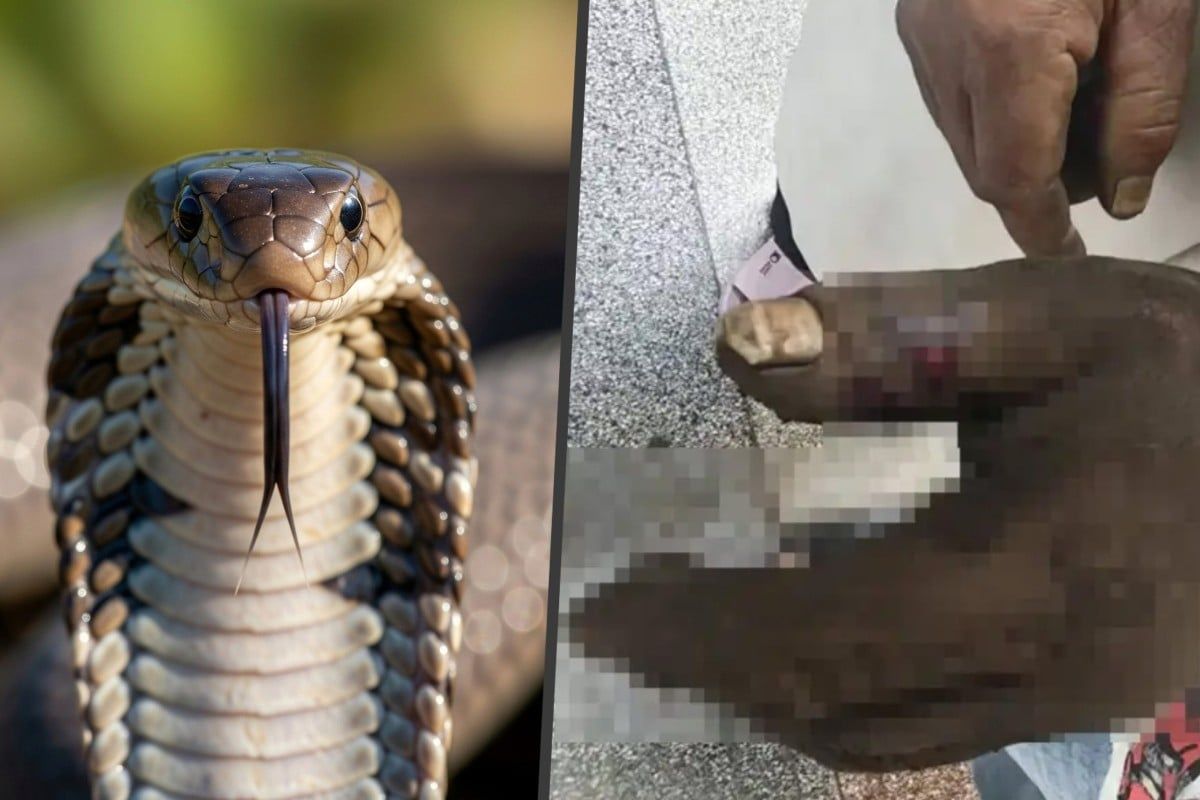
A farmer's act of misplaced self-defence in Yuanyang county, Yunnan province, has become a cautionary tale about the hazards of improvised medical interventions. The man was working in his field when a cobra delivered a bite to his finger, triggering an immediate and well-intentioned but ultimately harmful response from his wife. Witnessing her husband's rapid physical decline—swelling, dizziness, and weakness—his wife drew upon a technique she remembered from television dramas and directly placed her mouth on the wound to extract the venom. What followed was a double poisoning that has since drawn scrutiny from medical professionals across China and sparked debate about common misconceptions surrounding snakebite treatment.
The farmer was rushed to hospital following the incident, where medical teams at Honghe Prefecture No 3 People's Hospital confirmed he had been envenomated by a local cobra species. Yet his ordeal was eclipsed when his wife began exhibiting her own symptoms hours later. She experienced progressive numbness spreading through her mouth, tongue, face and limbs, followed by debilitating fatigue the next morning. Her family, recognizing the severity of her condition, transported her to the same hospital where her husband was receiving treatment. Both patients received antivenom serum injections and supportive care, eventually stabilising over several days before discharge.
The incident has provided hospital physicians in Yunnan with a platform to address a persistent and dangerous myth in public health perception. According to doctors treating the couple, the belief that venom can be effectively extracted through suction represents a fundamental misunderstanding of human physiology and the nature of snakebite injuries. The oral cavity contains an exceptionally rich network of capillary blood vessels within its mucosal lining, a characteristic that makes it ideally suited for rapid absorption of toxins. When venom contacts this sensitive tissue, toxins traverse into the bloodstream with remarkable speed, poisoning the would-be rescuer rather than preventing poisoning in the victim.
Beyond the physiological problem lies a practical reality that undermines the suctioning approach entirely. Snakebites typically produce wounds that resemble nothing more than tiny puncture marks, often compared to pinpricks. The venom does not remain localized near the surface but rather disperses rapidly through subcutaneous tissue layers and into the circulatory system within minutes of the bite. This rapid dissemination makes it virtually impossible for any mechanical suction technique, whether performed by mouth or device, to recover meaningful quantities of poison. Medical professionals emphasize that the window for mechanical extraction, if it were even theoretically possible, closes almost immediately after envenomation occurs.
Doctors have also identified several other dangerous practices that persist in public consciousness, many similarly derived from entertainment media portrayals of first aid. The impulse to cut open the wound and allow bleeding, while superficially logical, actually compounds the medical emergency by risking excessive blood loss and creating a portal for infection in an already traumatized area. Similarly, applying extreme heat to the wound through burning or using ice therapy at the site creates additional tissue damage without providing therapeutic benefit. These interventions transform what might be a treatable envenomation into a complex multi-system medical crisis.
The medical guidance that physicians now emphasize represents a stark departure from dramatized first aid scenes. When someone sustains a snakebite, the appropriate response involves immediately contacting emergency medical services rather than attempting field interventions. The victim should remain as motionless as possible, as physical exertion increases circulation and accelerates venom distribution throughout the body. Limb immobilization using makeshift slings or bandaging can help slow systemic toxin spread. If feasible, observers should attempt to identify or photograph the snake responsible, noting distinguishing features such as coloration, scale patterns, and head shape. This information proves invaluable to hospital personnel in determining which antivenom sera will provide the most effective treatment.
Snakebite incidents continue to generate significant public attention in China, with social media amplifying awareness of both the dangers themselves and the misconceptions surrounding treatment. A recent case from Guangdong province underscores the life-or-death stakes involved. A 14-year-old student was bitten by an unidentified creature while in a school grassland area, initially dismissing the incident as trivial since he experienced no pain and could not see what had attacked him. Several hours elapsed before he reported developing numbness in his limbs and blurred vision to his teacher. Hospital physicians treating him determined that had medical intervention been delayed by merely one to two additional hours, respiratory failure would have occurred—a scenario that would likely have proven fatal.
The Yunnan couple's incident has resonated across Chinese social media platforms, where observers have drawn various conclusions from the episode. Many commenters recognized the case as an indictment of relying on television dramatizations for medical knowledge, noting sardonically that entertainment productions frequently prioritize narrative drama over medical accuracy. Others took a more sentimental view, praising the wife's desperate commitment to her husband's survival despite the tragic outcome. The incident demonstrates how popular culture shapes medical perceptions across entire populations, creating persistent myths that actively endanger those who attempt to apply them during genuine emergencies.
For Malaysian and Southeast Asian readers, the case carries particular relevance given the region's prevalence of venomous snakes and the corresponding likelihood of snakebite incidents. The cobra, monocled cobra, king cobra, and various viper species inhabit much of Southeast Asia, creating genuine risks for agricultural workers, outdoor enthusiasts, and residents in rural areas. Healthcare systems throughout the region would benefit from public education campaigns emphasizing proper snakebite response protocols, potentially preventing the compound medical emergencies that occur when well-intentioned bystanders apply dangerous interventions. The Yunnan case serves as a powerful illustration of how individual decision-making during crisis moments, when guided by misinformation rather than medical science, can transform a treatable medical emergency into a multi-casualty disaster.

