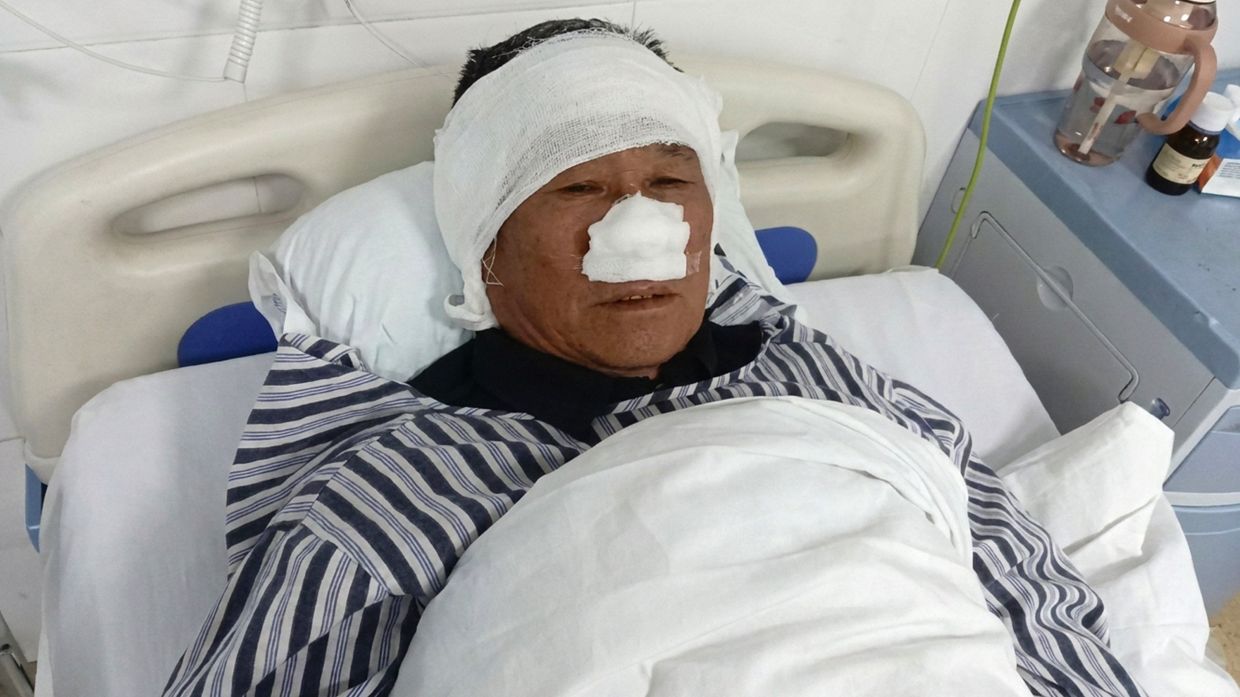
Zeng Fanlin, a 69-year-old resident of Chenzhou in Hunan province, has become the face of civilian heroism in central China after intervening in a violent street attack that left him permanently disfigured. His actions in April, when he rushed to protect a woman from an aggressor who was attempting to strangle her, demonstrated the kind of spontaneous moral courage that Chinese authorities have sought to celebrate through formal recognition. Last month, the Chinese government named Zeng among 86 people designated as "national heroes for a just cause", an honour that reflects both his bravery and the state's desire to promote civic responsibility and community protection.
The incident unfolded when a man in his twenties suddenly arrived in the village and began a chaotic assault, attacking random pedestrians and forcibly kicking at residential doors. Witnesses to this rampage, frightened by the aggressor's unpredictable violence, chose the safer option of contacting police rather than confronting him directly. When the attacker then targeted a woman riding an electric bicycle, grabbing her around the neck in what appeared to be a life-threatening assault, the bystanders faced a moral dilemma between self-preservation and intervention. It was at this critical moment that Zeng, who happened to be in the vicinity, made the split-second decision to act.
Zeng's intervention was not a solitary effort but rather initiated a chain reaction of civic response. Upon seeing him tackle the attacker, two other villagers overcame their own hesitation and joined him in subduing the increasingly dangerous assailant. The struggle was intense and brutal. During the physical confrontation, the attacker bit off a significant portion of Zeng's nose, inflicting an injury that would permanently alter his appearance and quality of life. Despite experiencing severe pain from this traumatic wound, Zeng maintained his grip on the attacker until police officers arrived at the scene. The suspect was subsequently arrested and taken into custody, while Zeng was transported to hospital for emergency treatment.
The medical challenge facing Zeng's treatment team proved substantial. Doctors assessed that the majority of his nose had been lost in the attack, making surgical reconstruction exceptionally difficult from both technical and aesthetic perspectives. Medical professionals warned the family that recovery would be protracted, potentially extending beyond six months, with additional risks including chronic pain, permanent scarring, and possible long-term complications. The financial burden of treatment was considerable, with medical expenses exceeding 70,000 yuan, equivalent to approximately US$10,000. However, Zeng's situation attracted government assistance and philanthropic support that helped alleviate the family's financial stress.
Zeng has undergone two surgical procedures to date as part of his reconstruction journey. Surgeons employed a skin graft harvested from his own scalp to rebuild the damaged nasal structure, and they successfully restored the nasal wings to restore basic respiratory function. While Zeng can now breathe normally again, he remains subject to daily pain from his injuries, a constant physical reminder of his sacrifice. Despite these ongoing challenges, Zeng has maintained a philosophical perspective on his suffering. In statements to local media, he has emphasised that saving another person's life far outweighs any personal loss or hardship he has endured.
Zeng's character appears shaped fundamentally by his early life experiences and the community support he received. Orphaned as a child, he grew up in relative vulnerability but benefited from the collective care of villagers and later from government educational assistance that allowed him to attend school without financial burden. This background of receiving help during his most vulnerable years seems to have instilled in him a deep commitment to reciprocity and community obligation. He has spent his later years channelling this sense of responsibility through formal village mediation work, helping to resolve disputes among residents before his retirement from official duties.
Zeng's willingness to act had not emerged suddenly on the day of the attack. His family describes him as a man possessing an acute sense of justice who could not remain passive when witnessing wrongdoing. Historical records of his conduct reveal a consistent pattern of civic engagement. In 2016, Zeng actively assisted police in apprehending a thief, demonstrating that his instinct to support law enforcement and protect community safety predated the April incident by several years. These prior actions suggest that his dramatic intervention was the culmination of a lifelong approach to community membership rather than an isolated act of impulse.
The attacker himself now faces serious legal consequences under China's criminal statutes. Under Chinese law, the intentional infliction of serious bodily injury carries prison sentences ranging from three to ten years, depending on the severity of harm and surrounding circumstances. The investigation into the April incident remains ongoing, though authorities have attributed the attacker's violent behaviour to a loss of emotional control. The suspect's motivation and mental state will likely feature in the eventual legal proceedings and sentencing determination.
Zeng's recognition came through multiple channels beyond government honour. The Alibaba Foundation and local media outlets jointly presented him with an additional 20,000 yuan as recognition of his bravery, providing further material acknowledgment of his sacrifice. The woman whose life he saved, however, has chosen to remain out of the public eye, declining to make any formal statements about her experience or her rescuer. This privacy decision contrasts sharply with the extensive public attention that Zeng's case has attracted and the philosophical reflections his story has generated among online commentators.
The broader significance of Zeng's recognition extends beyond individual heroism to encompass questions about community responsibility and the social contract in Chinese society. Online observers discussing his case have emphasised that Zeng represents an "everyday hero", suggesting that extraordinary moral courage can emerge from ordinary citizens in their regular environment. These commentators have also insisted that the attacker deserves severe punishment, reflecting a belief that those who inflict serious violence on protectors should face proportional legal consequences. For Malaysian and Southeast Asian readers observing from neighbouring regions, Zeng's story raises parallel questions about civic duty, the willingness of communities to intervene in emergencies, and the recognition systems societies establish to honour those who sacrifice personal safety for others' protection.

