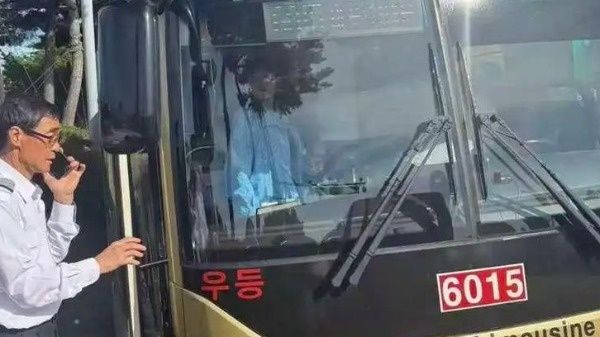
A group of Chinese visitors earned widespread acclaim across East Asia after demonstrating extraordinary composure during a medical emergency aboard an airport shuttle near Seoul on Saturday afternoon. The incident unfolded rapidly when the driver of No 6015 airport bus, heading from central Seoul toward Incheon International Airport, suddenly lost consciousness while navigating heavy traffic, putting the safety of more than twenty passengers — predominantly tourists from China — at immediate risk.
Sun Qian, a healthcare professional in her mid-thirties from Nanjing in Jiangsu province, was seated directly behind the driver when she noticed the vehicle beginning to veer dangerously across lanes. Recognising the gravity of the situation, she immediately moved to take action. "I thought he might have fallen asleep or fainted," she explained to China Daily. "The bus was veering badly, so I rushed forward and grabbed the steering wheel to try to stabilise it." Her prompt intervention prevented what could have been a catastrophic collision with the roadside guardrail that the vehicle was already scraping against as it lost direction.
Sun's actions, however, represented only one facet of a coordinated emergency response that unfolded within seconds. Simultaneously, another female passenger sprang into action to locate and engage the braking system. The challenge proved formidable — the large steering wheel of the coach-style vehicle presented unfamiliar challenges for someone attempting to manage it under extreme stress. "I do know how to drive, but the steering wheel of that coach was huge — I was really nervous. Still, I'm relieved we steadied it," Sun recalled of those frantic moments.
Du He, aged 33 and also travelling from Nanjing, was positioned adjacent to Sun and immediately recognised that steering control alone would be insufficient. When she attempted a traditional first-aid technique — pinching the driver's philtrum to stimulate consciousness — she quickly discovered that the situation was far more severe. "I tried to pinch the driver's philtrum — a traditional first-aid measure — but I quickly realised he had stopped breathing, and his whole face was turning purple," she recounted. The passengers shifted their focus toward cardiopulmonary resuscitation, with multiple individuals taking turns administering chest compressions in a desperate bid to restore the driver's heartbeat and breathing.
Communication proved critical during this period of crisis management. Sun, who possesses fluency in Korean, utilised the driver's mobile telephone to contact emergency services, providing dispatch operators with crucial details about the unfolding situation in their native language. This linguistic capability ensured that responders understood the severity and specifics of the medical emergency without delay. Meanwhile, her companions maintained continuous chest compressions, their collective efforts representing a textbook example of civilian emergency response during a life-threatening medical event.
Despite the passengers' intensive resuscitation efforts, the driver's condition deteriorated beyond recovery. "Within one or two minutes, he had no pulse and no breath — it might have been a heart attack," Sun explained. When ambulance personnel arrived at the scene, they transported the driver to hospital, where he was pronounced dead following approximately two hours of emergency medical treatment. South Korean authorities subsequently opened an investigation to determine the precise medical cause of his collapse, though the circumstances strongly suggest acute cardiac failure.
The successful containment of the crisis prevented secondary disasters that might have easily compounded the tragedy. Du reflected on how fortune favoured the group's escape: "Luckily, there wasn't much traffic on the highway at that time, so no other accident occurred." Had the incident unfolded during peak travel hours, or had other vehicles been struck by the out-of-control bus, the death toll and injury count could have been substantially higher. The passengers, all bound for Incheon International Airport to continue their journeys, eventually flagged down an alternative bus to reach their destination.
What renders this incident particularly notable is the emotional distance the heroines maintained between the immediate moment of crisis and the psychological reckoning that followed. Du described a peculiar dissociation during the emergency itself: "At the moment, I didn't really feel anything — but after I arrived at the airport, I was terrified." The full weight of their actions, the life-and-death stakes involved, and the knowledge that they had navigated the boundary between tragedy and prevention seemed to strike them only once the adrenaline subsided and they had reached safety. Sun similarly noted the dreamlike quality of the experience: "Looking back, I feel quite scared — it was just like a scene from a TV drama. I barely had time to think."
Both women have expressed genuine sadness regarding the driver's death, emphasising their disappointment that despite their efforts, they could not reverse his medical catastrophe. Sun stressed that the successful vehicle control represented a collective rather than individual achievement: "It wasn't just one person — another passenger helped find the brake, many joined in the CPR, and everyone cooperated. In a crisis, the support of compatriots is truly heartwarming." This emphasis on teamwork reflects a broader cultural perspective on how communities respond to emergencies, with the passengers operating not as isolated individuals but as a unified group focused on collective survival.
When confronted with the substantial online recognition and praise that has accumulated across Chinese and South Korean social media platforms, Du maintained a characteristically humble perspective. "I think this was something I was capable of doing. If it hadn't been me, someone else would have done the same thing — it's only natural," she stated. Her comment gestures toward a philosophy that positions such heroic action not as exceptional but as a natural extension of human decency and social responsibility. "Chinese people are united and always ready to help. That's our nature," she added, reflecting on the broader values she believes motivated her and her companions' rapid response.
The incident has generated significant cross-cultural admiration, with South Korean social media users expressing particular appreciation for the tourists' composure despite language barriers and unfamiliar circumstances. One South Korean commenter wrote: "In a foreign country with a language barrier, staying so calm and acting so fast is remarkable." Chinese netizens, meanwhile, have extensively shared accounts of the rescue across platforms including Xiaohongshu, celebrating the actions as exemplifying values of community, quick thinking, and humanitarian instinct. The story represents a rare instance where tragedy prompted by medical misfortune transformed into a narrative of human resilience and international goodwill, with ordinary travellers demonstrating extraordinary capability under circumstances demanding immediate and coordinated action.

