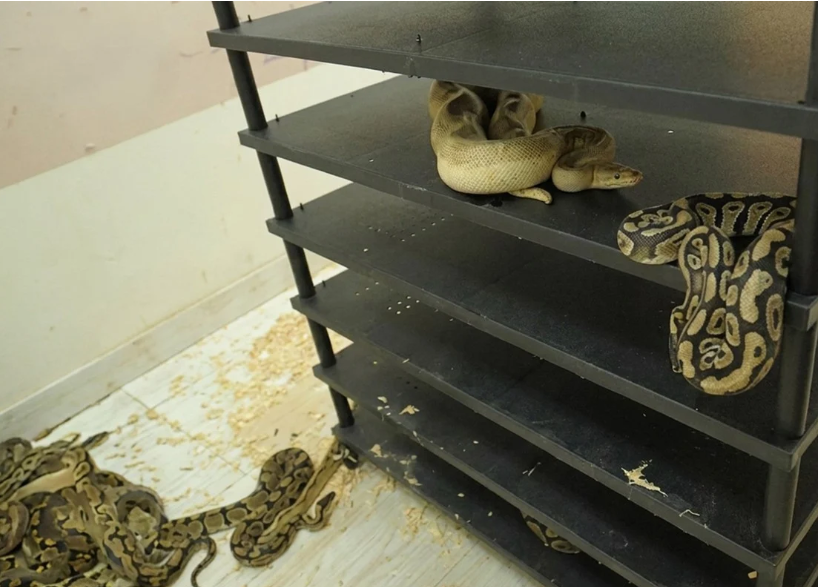
A resident of Taizhou in Zhejiang province has been sentenced to prison for illegally breeding and selling more than 300 pythons from his residential flat, according to a case highlighted by state media CCTV in late June. The operation, which involved a total of 436 snakes across multiple locations, represented one of the more brazen violations of China's protected wildlife regulations in recent years, with the entire haul valued at over 30 million yuan (US$4.4 million).
The investigation began unexpectedly when an elderly resident discovered a large python at the base of a local mountain in Taizhou during March 2024. The sizeable reptile, described as being as thick as an adult's arm, prompted the senior citizen to alert authorities, who initially found the sighting unusual given that pythons are not naturally occurring in the region and typically remain inactive during the spring months. Rather than dismiss the report as a one-off incident, police theorised that the snake had likely escaped from a captive breeding facility nearby, setting in motion a chain of investigative work that would eventually expose a substantial illegal operation.
The breakthrough came through an unconventional investigative technique. Police consulted with professional snake handlers who explained that pythons require carefully controlled environments with consistent warmth and humidity to thrive in captivity. Maintaining such conditions necessitates maintaining temperatures between 20 and 30 degrees Celsius year-round, which would result in noticeably elevated household electricity consumption. Using this insight, authorities systematically reviewed electricity usage patterns among nearby residents, eventually identifying a man surnamed Guo as their primary suspect. The approach reflects how modern detective work increasingly draws on technical expertise and data analysis to identify wildlife trafficking networks that might otherwise evade detection.
Guo's household profile made him appear an unlikely criminal at first glance. Living alone and unemployed, he nevertheless maintained what investigators would discover was an elaborate commercial operation. Police monitoring of his activities noticed frequent visits from an associate named Di, who regularly collected parcels from courier stations. Upon investigation, authorities discovered these packages consistently contained live white mice purchased from online sellers. The mice were not for personal consumption but served as food for maintaining a large reptile population. Online vendors confirmed that bulk orders of small rodents are a reliable indicator of reptile breeding operations, providing police with additional corroborating evidence of Guo's activities.
Further investigation revealed Guo's own careless digital footprint. He had shared photographs of snakes on social media platforms and occasionally made veiled references to selling pythons from his collection. Transaction records indicated that Guo and Di had already successfully sold at least eighty pythons through various channels, with at least two snakes moving through Di to another buyer for 1,000 yuan per animal. These sales demonstrated that the operation was not merely a hobbyist's personal project but a functioning commercial enterprise generating substantial revenue through illegal wildlife trafficking.
When police executed a search warrant at Guo's residence, officers were visibly taken aback by the scale of the breeding operation. The flat had been completely repurposed as a dedicated python facility. Guo had consolidated all his personal furniture and living space into a single bedroom, freeing the remaining bedrooms and the living room for stacked plastic containers, each housing multiple pythons. In total, authorities seized 309 pythons from Guo's address, which were subsequently transferred to a local zoo for care. The sheer number of animals crammed into a standard residential unit raised serious animal welfare concerns alongside the legal violations.
During questioning, Guo displayed neither remorse nor fear regarding his activities. He explained that his fascination with snakes extended back a decade, beginning in 2014 when he first acquired four pythons and commenced his research into breeding techniques. Guo expressed considerable pride in his technical achievements, claiming he had developed the ability to cultivate pythons displaying various colour variations. "I feel like a creature creator," he remarked to investigators, revealing a mindset in which he viewed himself as engaged in scientific endeavour rather than illegal wildlife trafficking. This perspective underscores how some perpetrators of wildlife crimes rationalise their actions through technical accomplishment rather than acknowledging the legal and conservation implications of their behaviour.
The investigation expanded beyond Guo to include his associate Di and another individual named Deng, a shop owner who had originally sold four pythons to Guo back in 2014 and continued supplying the operation. Police discovered an additional 47 pythons at Deng's residence, bringing the total number of animals involved across all three defendants to 436. The broader network revealed that what appeared initially as one individual's hobby had evolved into a multi-person enterprise with established supply chains, retail transactions, and substantial accumulated inventory.
A local court in Taizhou convicted all three defendants—Guo, Di, and Deng—with custodial sentences imposed, though the precise terms were not disclosed in available reports. Under China's Criminal Law, violations involving Grade Two protected animals carry a maximum penalty of five years imprisonment. Pythons hold this protected status in China, meaning their purchase, sale, breeding, and transportation are strictly prohibited without official governmental authorisation. The operation therefore represented not merely a violation of wildlife trafficking statutes but a deliberate circumvention of protections designed to safeguard a regulated species.
This case carries particular significance for Southeast Asian readers given the region's endemic role in the global reptile trafficking ecosystem. Many python species originating from or passing through Southeast Asia encounter similar illegal breeding and trafficking networks. The investigation methodology employed in Taizhou—using unusual utility consumption patterns as an investigative lead—may provide a template for authorities across the region seeking to identify clandestine breeding operations. As global demand for exotic reptile pets continues rising, understanding how enforcement mechanisms can effectively disrupt supply chains becomes increasingly relevant for conservation efforts throughout Asia.
The seizure of 436 pythons demonstrates the substantial scale that illegal wildlife operations can achieve within single cities. Each snake represents not only a legal violation but also a contribution to demand that drives wild-capture operations elsewhere, threatening natural populations across Asia and Africa. The financial valuation of over 30 million yuan indicates the commercial incentive structure driving such criminal enterprises. For Malaysia and neighbouring countries with significant reptile diversity, the case underscores the importance of building technical expertise among enforcement personnel and developing intelligence-sharing mechanisms that can identify trafficking networks before they reach the scale observed in Taizhou.