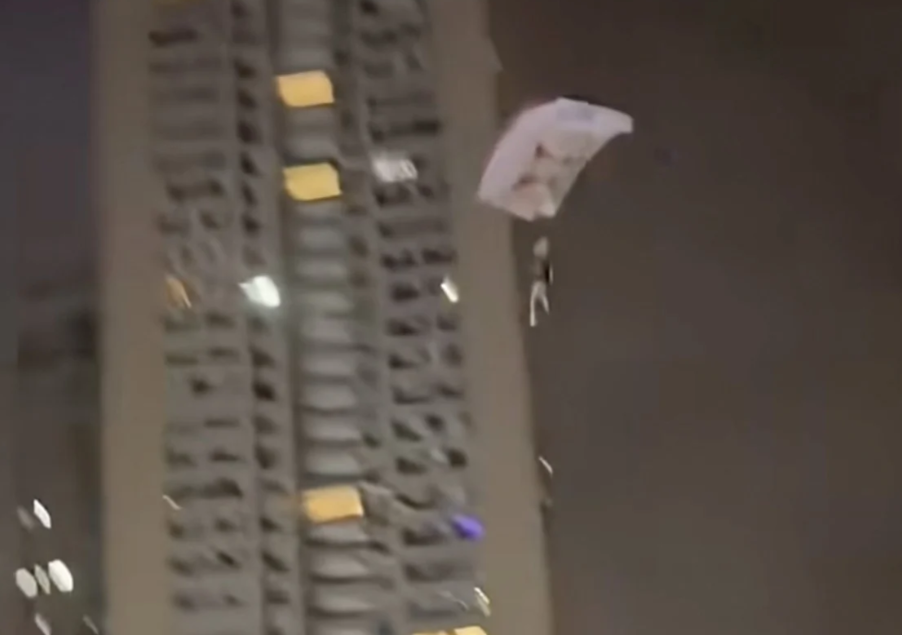
A 23-year-old man identified as Ren has been detained in southwestern China following an unauthorized skydiving stunt performed from the roof of a high-rise residential building, an incident that has reignited concerns about influencers pursuing dangerous activities for online engagement. The parachute jump took place at 11pm on June 30 from a tall residential structure in a Chenghua district community in Sichuan province. Ren documented the jump and shared video footage online the following day, images that subsequently circulated widely across Chinese social media platforms and captured public attention.
The footage revealed alarming details about the execution of the stunt, showing Ren descending in proximity to nearby residential buildings and trees, raising immediate questions about the calculation of risks and the viability of safe landing zones. Authorities in the Chenghua district have characterized the action as constituting a serious disruption to public order and a direct threat to the safety of residents in the area. Following investigation, Ren was placed under administrative detention for a period of up to fifteen days, a standard enforcement mechanism in China's legal system for public order violations.
Investigation uncovered that Ren operated an influential online presence under the persona "Parachute Coach Kakaxi" and had accumulated approximately 60,000 followers across a major social media platform. Despite his public presentation as a parachute instructor, police verification confirmed that Ren had not obtained the requisite coaching licence required by Chinese regulatory authorities. The discovery added another layer of concern, as it suggested that unqualified individuals were promoting extreme activities to large audiences without proper credentials or training endorsements.
Further review of Ren's content revealed that this was not an isolated incident of reckless behaviour. Authorities identified video evidence of a previous skydiving jump conducted from a residential building in May 2024, demonstrating a pattern of repeated violations rather than a singular lapse in judgment. As a consequence of the detention and investigation, Ren has been prohibited from accessing social media platforms, effectively removing his ability to continue broadcasting such activities to his followers.
China's law enforcement agencies have issued explicit reminders to the general public about the strict parameters governing skydiving activities within their jurisdiction. According to official guidelines, parachuting operations can only proceed with explicit authorization from relevant government authorities and must be confined to designated zones specifically approved for such extreme sports. The prohibition extends comprehensively across all densely populated urban environments, expressly forbidding jumps from downtown buildings, bridges, or any structure located in high-population-density areas.
The incident has generated substantial discussion across Chinese social media platforms, with commentators expressing alarm about both the immediate physical danger posed by such activities and their potential to inspire copycat behaviour among other content creators. One online observer noted that the proximity of the descent to ground-level pedestrians meant that Ren endangered not only his own life but potentially the lives of innocent residents below. Another social media user criticized the motivation underlying the stunt, questioning why anyone would pursue such extreme measures solely for the sake of generating online traffic and viewer engagement.
Some commentators have advocated for more severe consequences, arguing that lighter punishments might not create sufficient deterrent effect against future violations. This reflects a broader anxiety within Chinese society about the escalating willingness of content creators to cross legal and safety boundaries in pursuit of viral moments and audience growth. The case illustrates a troubling pattern in which the economic incentive structure of social media—where larger follower counts translate into influence, sponsorships, and income—can override rational risk assessment.
China has documented multiple instances of content creators pursuing dangerous activities in recent years. In June, a motorist in eastern Zhejiang province was apprehended after uploading video footage showing him driving at 152 kilometers per hour on an expressway whilst operating a mobile phone to record. His actions violated national speed regulations and endangered other road users, resulting in nine demerit points being deducted from his annual twelve-point driving licence allowance and a 250 yuan fine, equivalent to approximately 35 US dollars.
The most tragic illustration of how far some extreme content creators will push boundaries occurred in 2017, when prominent blogger Wu Yongning died from physical exhaustion whilst climbing an unprotected 260-metre building in central Hunan province during a live-streaming session. Wu had built his online reputation through scaling skyscrapers without safety equipment, claiming publicly that he pursued these dangerous endeavours to earn money for his mother's medical treatment. His death served as a stark reminder of the potentially fatal consequences when the pursuit of online fame eclipses personal safety and personal responsibility.
The detention of Ren and the enforcement actions taken against similar offenders reflect Chinese authorities' determination to establish clearer boundaries around what constitutes acceptable risk-taking behaviour in the age of social media. As platforms continue to reward extreme and sensational content, regulators face mounting pressure to prevent activities that endanger not only the performers themselves but also bystanders and public order. The challenge lies in balancing individual freedoms with collective safety and in finding enforcement mechanisms that effectively discourage future violations without driving such activities entirely underground or into less regulated jurisdictions where they might proceed with even greater danger to participants and the public alike.

