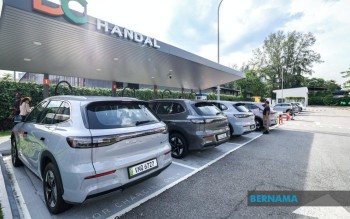
The influx of Chinese electric vehicle charging technology into Malaysia reflects growing recognition that the country's nascent EV market will demand substantial infrastructure investment over the next three to five years. Xi'an LINCHR New Energy Technology Co Ltd, a major player in China's charging solutions sector, is positioning itself as a key partner in this expansion, but the company's leadership is cautioning against a straightforward transplant of technology developed for the Chinese market.
Chairman Yuan Qingmin articulated this nuanced position at the Global Automotive and Technology Expo in Kuala Lumpur this week, emphasising that electric vehicles and their charging networks operate as interdependent systems. The growth trajectory of either will be constrained if the other lags, he explained, creating an urgent imperative for coordinated infrastructure development rather than piecemeal adoption. This insight carries particular weight in Malaysia's context, where vehicle electrification targets depend critically on the availability of reliable, accessible charging points.
Yuan's core argument challenges a common assumption in technology transfer arrangements: that proven solutions from more advanced markets can be deployed wholesale elsewhere. Instead, he contends that successful localisation demands deliberate adaptation rooted in understanding each market's unique operating environment. China's early leadership in both EV adoption and charging infrastructure deployment does not automatically make its technical approaches optimal for Malaysian conditions. The distinction matters substantially for local manufacturers and policymakers designing charging networks intended to serve the nation for decades.
LINCHR's own experience demonstrates this principle concretely. The company holds commanding market share in China—more than 70 per cent of the testing technology solutions sector—yet recognises that overseas expansion cannot rely solely on this domestic dominance. Yuan indicated that successful international growth requires technology partnerships with local entities and dedicated research and development efforts tailored to regional requirements. Without such commitment, imported solutions risk performing adequately by minimum standards while remaining suboptimal for genuine market needs.
One revealing example underscores this approach. LINCHR has modified its charging station designs to employ oil-immersed insulation for printed circuit boards specifically to combat the salt spray corrosion that Malaysia's hot, humid coastal climate produces. This modification emerged not from theoretical analysis but from understanding the material degradation patterns unique to Southeast Asia's environmental conditions. Such adaptations accumulate across multiple components and systems, fundamentally reshaping how imported technology performs over its operational lifetime.
The company's collaboration with Swift Bridge Technologies Sdn Bhd, a domestic EV charger manufacturer, operationalises this philosophy of adapted partnership. Their joint efforts address charging infrastructure standards, product development, technology specifications, and engineering design—the full spectrum of considerations necessary for market viability. This partnership structure allows LINCHR to contribute its technical expertise while Swift Bridge supplies local market knowledge and manufacturing capabilities, creating a genuinely integrated approach rather than a vendor-customer arrangement.
Standardisation and testing protocols emerged as another crucial area where localisation proves essential. LINCHR, Swift Bridge, and the Standards and Industrial Research Institute of Malaysia (SIRIM) formalised a tripartite cooperation agreement in March of the previous year, reflecting recognition that Malaysia's charging infrastructure must meet testing and certification standards appropriate to local conditions and applications. The groups have subsequently worked on developing these standards and upgrading laboratory testing equipment, establishing the regulatory foundation that permits confident deployment of charging networks.
Yuan's vision extends beyond stationary charging points, anticipating an evolution toward bidirectional charging architectures as vehicle connectivity and intelligence advance. Within this emerging paradigm, electric vehicles would no longer function solely as electricity consumers but could operate as mobile energy storage units, drawing power when convenient and returning excess capacity to the grid during peak demand periods. This transformation requires charging technologies designed from inception for two-way power flow, grid interaction protocols, and the voltage stability considerations that bidirectional systems demand.
The implications for Malaysia's energy sector are substantial. Coordinated EV and charging infrastructure development, undertaken with genuine attention to local conditions rather than generic replication, positions the nation to avoid costly infrastructure mistakes or premature obsolescence. As vehicle electrification accelerates across Southeast Asia, Malaysia's approach—emphasising partnership, localised adaptation, and collaborative standard-setting—provides a potential model for neighbouring countries confronting identical challenges of rapid technology adoption.
GATE 2026, where LINCHR showcased its approach, created a forum for dialogue among government agencies, energy utilities, infrastructure operators, and industry participants—precisely the cross-sectoral engagement that effective charging network development demands. This convening role matters as significantly as the specific technologies on display, facilitating the coordination necessary when power generation, grid distribution, vehicle manufacturing, charging infrastructure, and consumer behaviour must align.
The broader context shaping these discussions involves recognition that EV market acceleration in Malaysia depends on solving infrastructure challenges before they become bottlenecks. The next three to five years represent a critical window during which decisions about charging standards, network architecture, and technological pathways become embedded in physical infrastructure and regulatory frameworks. Choices made now will influence Malaysian EV adoption patterns for a generation, making the question of how to thoughtfully adapt proven technologies to local conditions far more than an academic concern.

