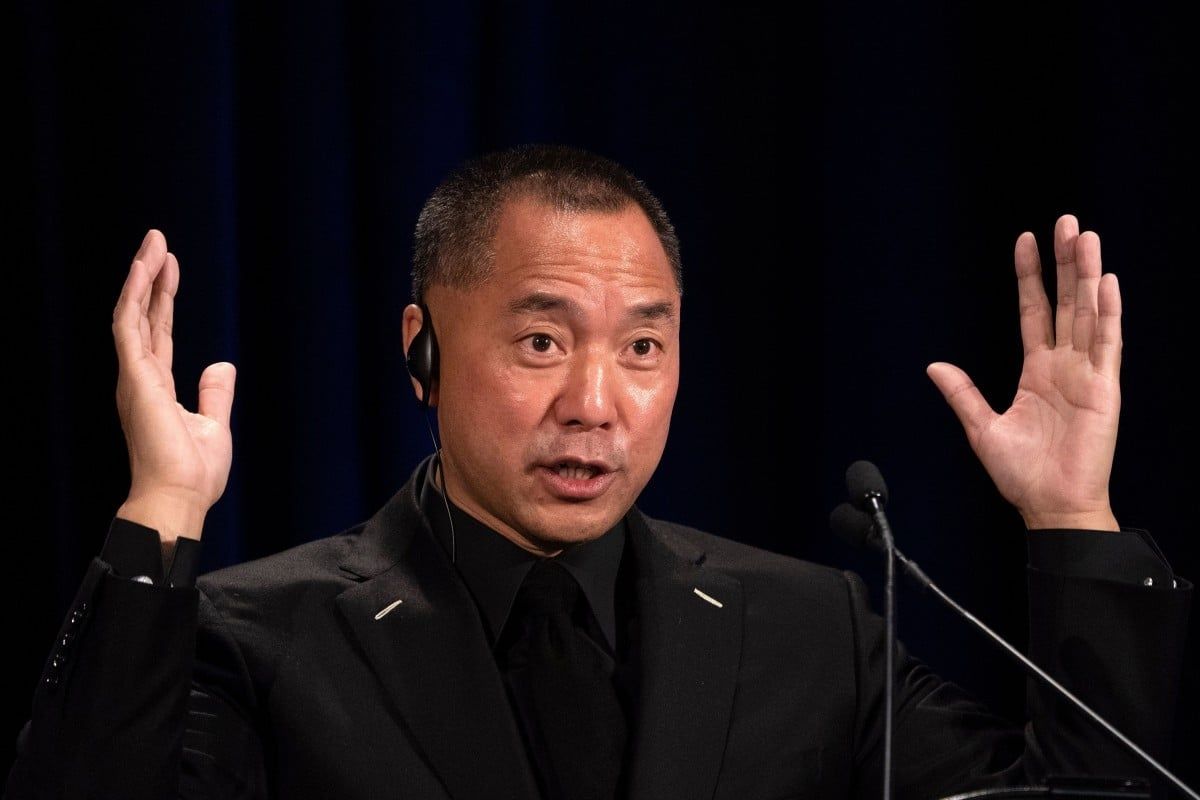
A self-exiled Chinese billionaire once counted among his nation's wealthiest entrepreneurs faces three decades in a US federal penitentiary following his conviction for orchestrating one of the country's most elaborate financial fraud schemes. Guo Wengui, who reinvented himself as a critic of Beijing's Communist Party after fleeing China a decade ago, was sentenced in Manhattan on Monday by Judge Analisa Torres, who condemned his predatory behaviour toward individuals seeking to advance democratic change in China. The fraud operation, which prosecutors characterised as "astonishing" in its scope and brazenness, siphoned hundreds of millions of dollars from more than 1,000 victims globally, leaving countless families financially devastated and emotionally scarred.
Judge Torres delivered a scathing assessment of Guo's conduct and character during Monday's sentencing hearing, reading excerpts from victim impact statements that detailed the human toll of his scheme. Participants described losing life savings they had accumulated over decades, experiencing profound anxiety and shame, and enduring fractured family relationships after loved ones blamed them for poor investment decisions. The judge found that Guo's modus operandi specifically targeted vulnerable individuals—exiles, dissidents, and those sympathetic to democratic causes in China—exploiting their idealistic motivations and trust. She declared that Guo "takes no responsibility for his actions" and has instead deflected accountability while calling upon his supporters to intimidate and harass victims who dare speak publicly against him. The court ordered him to forfeit approximately USD889 million in restitution, a figure that underscores the scale of economic destruction his schemes inflicted.
The fraud operation spanned from 2018 to 2023, during which Guo controlled multiple entities that became vehicles for his deception. Through his media company GTV Media Group Inc., a venture called the Himalaya Farm Alliance, and the Himalaya Exchange, he solicited investments from hundreds of thousands of people, eventually accumulating over USD1 billion in illicit funds. Prosecutors detailed how these ill-gotten riches fueled an extravagant lifestyle characterised by mansions, luxury yachts, high-performance vehicles, designer wardrobes, and opulent furnishings that reflected his contempt for legal boundaries and moral obligations. Guo's ascent within conservative American political circles before his arrest exemplified his capacity for deception and social manipulation; his close association with strategist Steve Bannon included a joint 2020 initiative explicitly aimed at overthrowing China's government, and his membership at President Donald Trump's Mar-a-Lago golf club demonstrated his successful penetration of elite American society.
During the seven-week trial, Guo was convicted on nine of twelve criminal charges, with prosecutors presenting comprehensive evidence demonstrating his systematic deception of thousands of investors through fraudulent schemes. One victim, Wei Chen, testified emotionally that Guo's fraud "destroyed my life" and that of her entire family, a sentiment echoed throughout the proceedings by others who had surrendered their financial security based on false promises. The prosecution's case illustrated how Guo weaponised the aspirations of pro-democracy advocates, cynically exploiting their political convictions and ideological commitments to generate capital for personal enrichment rather than advancing any genuine political agenda. His defence team's assertions that prolonged imprisonment would validate China's characterisation of him as a criminal worthy of extradition rang hollow against the overwhelming evidence presented and the magnitude of documented victimisation.
Guo's legal representatives mounted a vigorous defence centring on allegations that he represented a target of the Chinese Communist Party's persecution. They contended that Beijing had orchestrated an international campaign to eliminate him, recruiting influential figures across American business, entertainment, and political spheres to conspire against him. The defence documentation referenced a probation officer's report detailing scars and disfigurements Guo allegedly sustained from physical torture in China between 1993 and 2022, arguing that such historical victimisation should mitigate his sentencing. His lawyers maintained that Guo's initial wealth accumulated legitimately when his family became the largest shareholder of China's largest publicly traded securities company, and that his subsequent persecution by Chinese government officials allegedly stemmed from his exposure of official corruption. According to their narrative, Guo progressively relocated from Hong Kong to London before establishing himself in New York in 2017 as he fled intensifying pressure from Beijing.
However, the judge and prosecutors rejected these arguments as fundamentally incompatible with the facts of the criminal case. Guo's claim that his conduct caused no loss and harmed no one contradicted not only the convictions secured against him but the extensive testimony from aggrieved victims and comprehensive financial documentation. Prosecutors characterised his defence narrative as wholly unrepentant opportunism, arguing that Guo deliberately exploited what he perceived as lax United States asylum and financial regulations to flourish while perpetrating systematic fraud. The sentencing reflected an assessment that regardless of any historical persecution Guo may have experienced, the commission of massive financial crimes against vulnerable populations could not be excused or minimised by reference to his status as a political dissident or asylum seeker. The judge's decision to impose the prosecution's recommended 30-year sentence demonstrated that American jurisprudence holds even high-profile international figures accountable when they abuse the nation's legal protections for personal criminal gain.
Guo's behaviour at the sentencing hearing itself further illustrated his apparent inability or unwillingness to acknowledge the gravity of his actions. Before entering the courtroom, he complained of physical ailments, claiming he had repeatedly vomited and required bathroom access, though prosecutors had previously characterised such complaints as malingering tactics. When offered the opportunity to address the court directly, Guo devoted minimal attention to substantive discussion of the criminal charges and instead reiterated his professed motivations regarding opposition to the Communist Party. His statement that "the reason I came to the U.S. was to destroy the CCP" appeared designed to redirect the narrative toward grand political ideology rather than confront his documented exploitation of fellow dissidents and democracy advocates who trusted him with their financial resources. His supporters in the courtroom responded to his departure with applause and shouts of encouragement, suggesting that elements of his network remain emotionally committed to his cause despite the legal determination of systematic fraud.
The implications of Guo's prosecution extend beyond the particulars of his individual case to encompass broader questions about accountability for financial crimes committed within international and diaspora communities. The case demonstrated that investment schemes targeting politically marginalised populations—in this instance, Chinese exiles and pro-democracy advocates—warrant rigorous investigative and prosecutorial attention. Guo's ability to maintain support and accumulate vast resources while operating fraudulently for years before facing consequences suggests that enforcement mechanisms protecting vulnerable investor populations require strengthening. For Southeast Asian readers and policymakers, the case underscores the risks posed by unvetted international business figures with grandiose political claims, and the importance of maintaining vigilant regulatory oversight of financial schemes marketed to diaspora communities across the region.
China's Ministry of Foreign Affairs acknowledged the sentencing and noted that Guo remains wanted by Beijing on allegations of rape, kidnapping, bribery, and other crimes—accusations Guo has consistently denied. An Interpol Red Notice requesting law enforcement worldwide to apprehend Guo pending potential extradition remains in force, though his 30-year US prison sentence means extradition appears unlikely absent completion of his American sentence. This diplomatic dimension adds complexity to the case, as Guo's supporters may continue characterising his imprisonment as politically motivated persecution rather than legitimate criminal accountability. Nevertheless, the conviction and sentencing represent a decisive determination by the American legal system that regardless of Guo's political claims and historical grievances, his systematic defrauding of vulnerable individuals constitutes serious federal crime warranting substantial punishment.
The sentencing concludes a remarkable chapter in the narrative of a figure who oscillated between billionaire businessman, international dissident, and federal convict—roles that seemed incompatible until evidence revealed their interconnection through systematic deception. Guo's case serves as a cautionary reminder that charismatic individuals with compelling political narratives can exploit idealism and trust for personal aggrandisement, and that thorough financial investigation protects populations vulnerable to sophisticated fraud schemes irrespective of perpetrators' claimed political motivations or historical victimisation. As the implications of his conviction ripple through diaspora communities and international business networks, the case reaffirms that American legal institutions maintain the capacity to hold powerful international actors accountable when they abuse asylum protections and exploit vulnerable populations through fraudulent enterprise.

