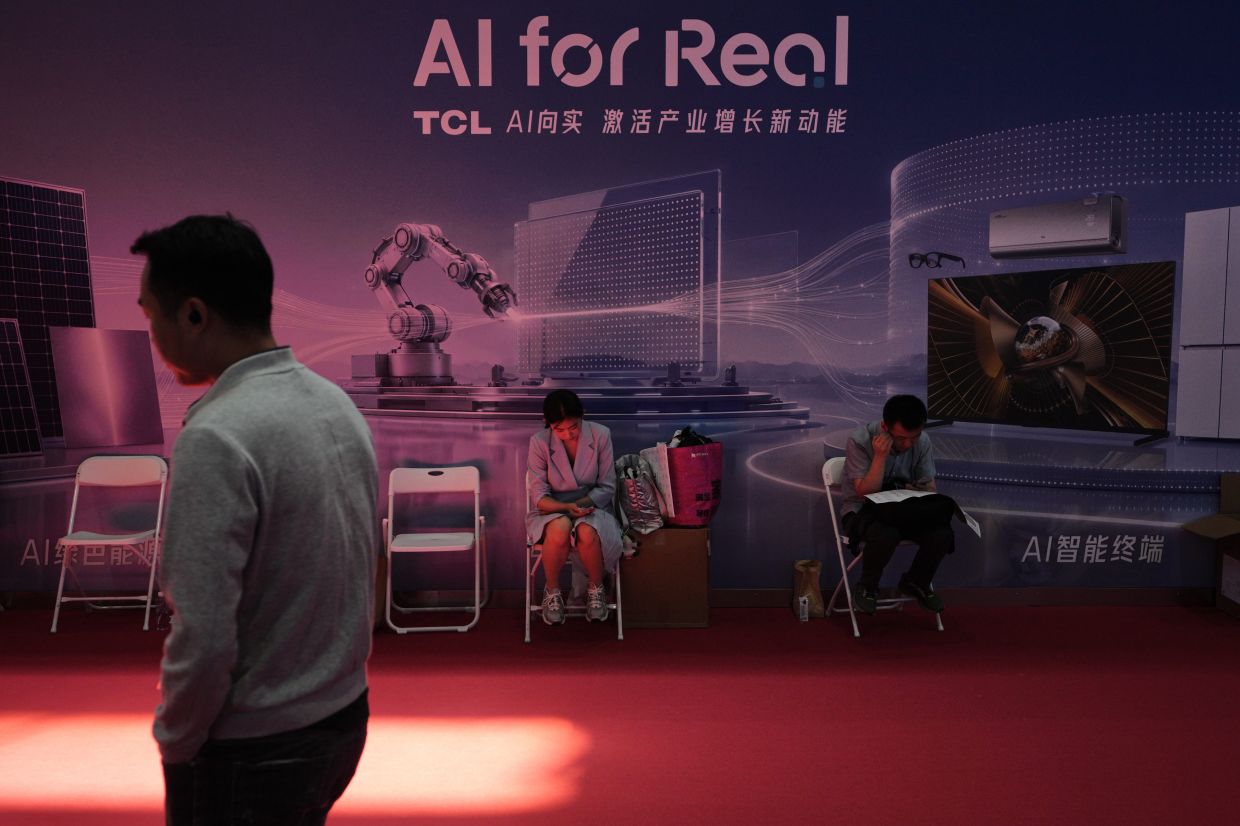
China's embrace of artificial intelligence is reshaping its labour market at unprecedented speed, creating a population of anxious workers caught between technological inevitability and economic survival. From software engineers forced to reskill to translators watching their fees halve, the world's second-largest economy is experiencing the frontline of AI-driven employment disruption—a challenge that extends far beyond individual job losses to threaten the nation's broader economic resilience.
The acceleration is striking. Industrial enterprises deploying AI models jumped from just 9.6 per cent in 2024 to 47.5 per cent last year, according to market intelligence firm IDC, reflecting how thoroughly government policy is catalysing this shift. Under China's "AI Plus" initiative and its five-year development plan through 2030, Beijing is deliberately spreading AI across sectors to maintain technological dominance over the United States. Unlike more cautious Western approaches, this top-down strategy is compressing what might otherwise be a decades-long transition into mere months, leaving workers and policymakers scrambling to adapt.
What distinguishes China's situation is the relative absence of organised resistance. Unlike Western countries where AI displacement triggers fierce debate, Beijing-based analyst Shujing He from advisory firm Plenum observes that most Chinese workers display either enthusiasm or passive acceptance. Those losing traditional employment are often pivoting aggressively toward AI-enabled ventures and independent businesses, demonstrating a pragmatic resourcefulness that masks deeper anxiety. This apparent calm should not be mistaken for contentment; it reflects instead a cultural acceptance of rapid change and limited alternative pathways.
The human cost manifests differently across professions. Mid-career programmer Fei, 40, exemplifies this adjustment: while acknowledging that his position has become largely replaceable, he recognised that refusing to adopt AI tools would only accelerate obsolescence. He now produces short-form videos during a career break, hoping to build something sustainable outside traditional employment. Meanwhile, translator Du Qinchun in Chengdu initially benefited from training AI translation models, gaining temporary work volume—only to watch industry-wide compensation plummet by more than half. College enrolment in foreign language programmes has declined noticeably as students recognise that AI translation threatens their career prospects before they even graduate.
Concrete examples of displacement are multiplying across the economy. Humanoid robots now sort parcels in postal facilities and direct traffic, while food delivery robots proliferate across major cities, threatening the livelihoods of millions of workers in gig economy roles. The short-form drama industry, a major employer in creative production, has contracted dramatically: live-action vertical videos designed for mobile phones fell approximately 75 per cent in the first quarter compared to the previous year. Generative AI now handles creation, production, and distribution tasks that previously required specialised creative teams.
The displacement risk, however, is not evenly distributed. According to research from the International Labour Organization, women face disproportionate employment vulnerability because they concentrate in roles particularly susceptible to automation, such as electronics assembly, while remaining underrepresented in technology and science fields where new opportunities typically emerge. This gender dimension of AI disruption has received insufficient policy attention in Beijing's rollout strategy, potentially exacerbating inequality during the transition.
The economic implications extend beyond individual unemployment figures. China's overall urban joblessness hovers around five per cent, but youth unemployment for those aged 16 to 24 reaches roughly 15 per cent—triple the headline rate—suggesting that AI disruption compounds an existing youth employment crisis. More ominously, consumer spending has weakened as households grow reluctant to purchase discretionary goods and services, fearing potential job loss. This retrenchment compounds difficulties stemming from the prolonged housing market downturn, creating a self-reinforcing cycle of economic stagnation.
Economists including Cornell University's Eswar Prasad warn that while AI will boost productivity across industries, the employment consequences could prove severe. Chinese technology giants have already cut or restructured tens of thousands of positions partly due to AI implementation. Without sufficient job creation to offset displacement, Prasad argues, the employment crisis could destabilise social cohesion—a risk that concerns Beijing deeply. The Chinese Communist Party's legitimacy rests substantially on delivering rising living standards; persistent joblessness among prime working-age adults could test that social contract.
Yet some experts identify a counterintuitive silver lining. China's population of 1.4 billion is ageing and declining rapidly. By 2050, demographers project fewer than two working-age adults will support each retiree, compared with more than 2.5 in the United States. San Francisco Bay University researcher Xuenan Cao argues that automation could partially offset this demographic squeeze rather than representing purely destructive disruption. If AI and robotics can sustain productivity as the workforce shrinks, China might avoid the fiscal catastrophe of supporting an enormous retired population with insufficient workers. This perspective suggests that current displacement pain could yield longer-term stabilisation—provided policymakers manage the transition successfully.
Workers themselves demonstrate adaptive creativity. Scriptwriter Wang Zheng, 32, recognised that AI-generated scripts often felt formulaic and repetitive despite efficiency gains, so he pivoted toward independently producing illustrated children's books, treating AI as a brainstorming tool rather than a replacement. High school chemistry teacher Yang Zheng dismisses AI as a professional threat despite students using the technology for homework assistance, confident that human judgment and relationships remain irreplaceable in education. These examples reveal that displacement is not universal; certain roles requiring human judgment, emotional intelligence, and creative originality may prove more resilient than feared.
The Malaysian and broader Southeast Asian context is worth noting. If China's AI deployment pattern accelerates labour displacement, neighbouring economies heavily dependent on exports to China or integrated into Chinese supply chains could experience ripple effects. Additionally, if Chinese workers struggle with income insecurity, regional tourism and trade patterns will shift. Southeast Asian nations with their own large workforces in manufacturing and services should observe China's experience closely, as similar automation pressures will eventually reach their borders. The government-led acceleration in China offers both a cautionary tale and a test case for managing technological transition in a region where manufacturing employment remains economically and politically crucial.
Ultimately, China's AI transformation hinges not merely on technological capability but on whether Beijing's policymakers can simultaneously pursue productivity gains and employment stability. The current approach prioritises diffusing AI across the economy as rapidly as possible—a rational competitive strategy in the technology rivalry with America. Yet without concurrent investments in retraining programmes, social safety nets, and job creation in complementary sectors, this relentless acceleration risks leaving millions of workers economically stranded. The coming years will reveal whether a government-orchestrated AI rollout can maintain social cohesion during profound labour market upheaval, or whether the pursuit of technological supremacy exacts an unsustainable human cost.

