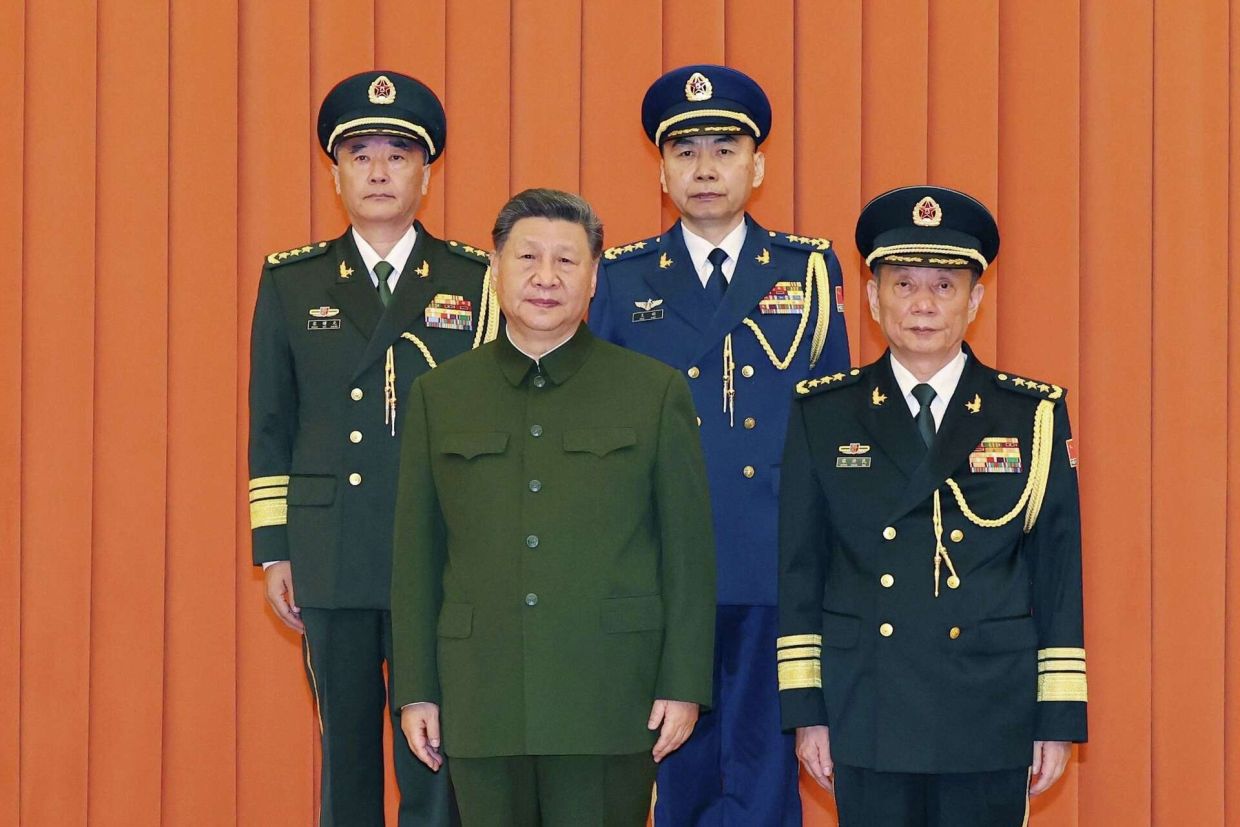
China's military establishment has elevated two senior officers to the rank of general in a development that analysts suggest may foreshadow significant organisational restructuring at the highest levels of the armed forces. The promotions of Zhang Shuguang and air force commander Wang Gang, announced at a formal ceremony on Friday, come as part of an extended anti-corruption initiative that has systematically dismantled the upper echelons of military leadership and left several key positions vacant.
The timing and nature of these appointments carry broader implications for how China's leadership under Xi Jinping intends to exercise control over its military apparatus during a period of substantial institutional flux. By orchestrating these promotions personally—Xi Jinping presented the promotion orders himself—the party leadership demonstrates its determination to place trusted figures in positions of influence as older guard commanders are either removed or sidelined. The anti-corruption campaign, which has been running for an extended period, appears less motivated by fiscal accountability in isolation and more fundamentally concerned with ensuring unwavering loyalty to the Communist Party and its paramount leader.
Zhang Shuguang's elevation carries particular significance beyond the promotion itself. His concurrent appointment as head of the investigative division within the Central Military Commission—the military's supreme governing body—places him at the centre of the very process through which other senior officers have been removed. This arrangement effectively grants Zhang substantial authority over the mechanism of internal discipline and oversight, positioning him as a critical figure in determining which officers face scrutiny and potential removal. Such consolidation of promotional and investigative powers within a single trusted individual reflects a deliberate strategy to ensure that the anti-corruption efforts remain aligned with party objectives.
The state of the Central Military Commission itself underscores the scale of disruption caused by the ongoing purge. Constitutionally designed as a seven-member body responsible for directing China's armed forces, the commission has been effectively hollowed out through removals and investigations. Currently, only two members remain in active service: Xi Jinping himself, who chairs the body, and Vice Chair Zhang Shengmin. This radical reduction in functional membership creates urgent vacancies that the newly promoted generals may be positioned to fill, either immediately or following the announcement of a reconstituted commission expected in autumn of next year when the current term concludes.
The removal of two former vice chairs, including the military's highest-ranking operational general, represents a dramatic reconfiguration of power relationships within the defence establishment. These were not peripheral figures but rather individuals who previously held significant command authority and influence. Their departure, whether through formal removal or through effective sidelining via investigation, signals the depth of Xi Jinping's determination to reshape the military leadership according to his vision of institutional loyalty and party control. For international observers and regional powers monitoring China's military posture, these leadership transitions carry implications for policy continuity and decision-making in security matters.
The broader context of these promotions extends beyond internal military administration. For Malaysia and other Southeast Asian nations engaged in regional security dynamics, shifts in Chinese military leadership carry potential consequences for bilateral relationships, strategic posturing, and the stability of regional arrangements. Military-to-military relationships, arms sales, and security dialogues often depend significantly on the continuity and predictability of command structures. When senior leaders are unexpectedly removed or when new figures suddenly ascend to prominence, established communication channels and understandings may require recalibration.
The anti-corruption campaign itself warrants deeper analysis regarding its actual purposes and mechanisms. While ostensibly focused on fiscal impropriety and abuse of office—genuine problems within any large bureaucracy—the campaign's scope and intensity suggest additional motivations. The Chinese military, like militaries worldwide, contains factions with potentially divergent views on strategic priorities, resource allocation, and party authority. By systematically removing experienced commanders and replacing them with newly promoted officers of demonstrated loyalty, Xi Jinping appears to be consolidating personal control over the military apparatus in ways that extend beyond simple anti-corruption governance.
The question of succession and institutional arrangements deserves particular attention as the Central Military Commission approaches its five-year term limit in autumn next year. The expected announcement of a new commission composition will reveal how many of the newly promoted generals advance to these influential positions and which other senior officers retain or gain membership. This transition point will demonstrate whether the current anti-corruption campaign has fundamentally reoriented military power structures or whether it represents a more limited reshuffling within an essentially stable institutional framework. The composition of the reconstituted commission will indicate the trajectory of Chinese military leadership for the subsequent five-year period.
For regional observers, the institutional stability of China's military command structure carries significance beyond internal Chinese politics. A military leadership that is unified around clear strategic priorities and civilian party control operates differently from one experiencing internal tension or uncertainty about authority relationships. The extended purge and promotional process currently underway may ultimately produce a more cohesive military institution, or it may create lingering grievances and instability among officers who perceive the process as unjust. Either outcome carries potential implications for regional security and the predictability of Chinese military behaviour.

