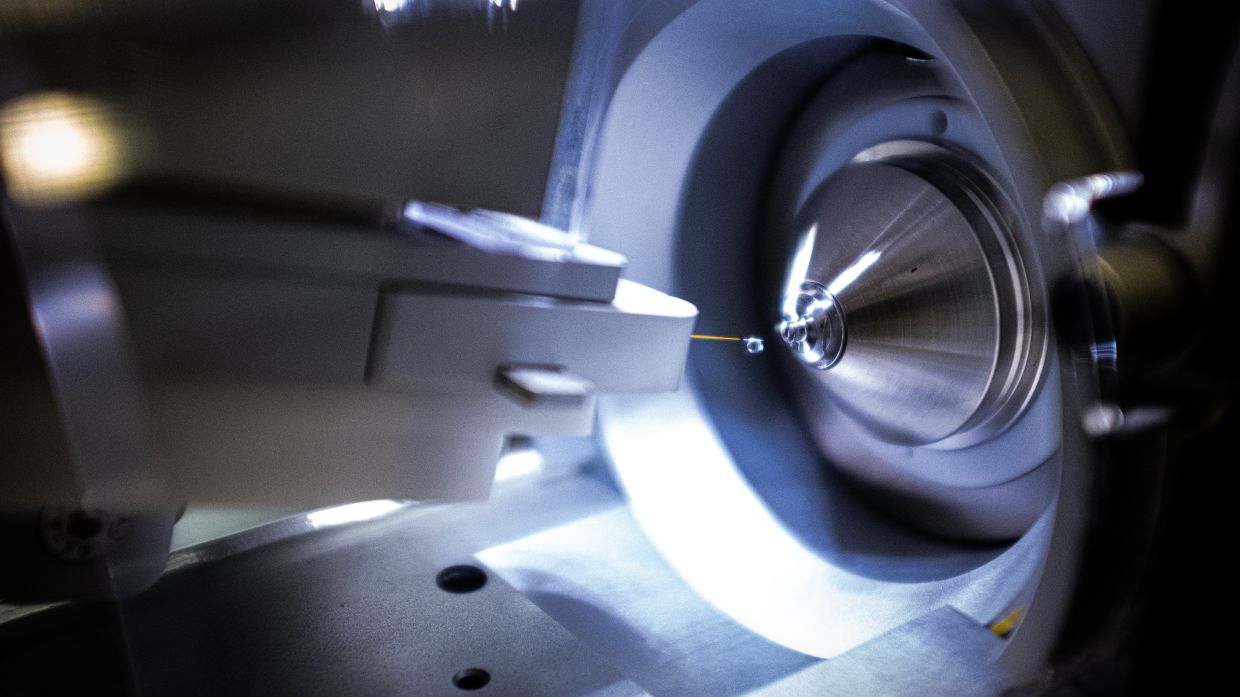
China's advancement in artificial intelligence and scientific discovery faces a fundamental constraint: the country's overwhelming dependence on imported high-precision instruments for generating the experimental data that underpins modern research. Weinan E, a professor at Peking University's mathematical sciences school and member of the Chinese Academy of Sciences, articulated this vulnerability at an "AI for Science" conference in Shanghai last week, using a striking metaphor to describe the predicament. Without domestically produced precision equipment such as mass spectrometers, E warned, China's AI capabilities resemble "cooking without rice"—capable of sophisticated theoretical work but lacking the essential raw material needed to feed the system.
The scale of China's equipment dependency is striking and raises questions about the sustainability of the country's scientific independence. In 2024 alone, China imported nearly US$17 billion in scientific equipment, with more than three-quarters of major research instruments currently in use across the nation sourced from abroad. A report released in December by Beijing-based consulting firm Puhua Policy documented this reality in detail, while a separate analysis by consultancy LeadLeo earlier this year revealed even more granular vulnerability: China relies on imports for 83 per cent of its mass spectrometers and chromatographs, and 75 per cent of its spectrometers. These instruments are not peripheral to scientific work—they form the backbone of modern research, with mass spectrometers identifying molecules, chromatographs separating chemicals for analysis, and spectrometers using light to illuminate the properties of materials. The dependency extends to optical instruments and biological tissue analysis equipment, where China is almost entirely reliant on foreign suppliers.
Beyond the immediate constraints of availability, this dependence imposes substantial operational and financial burdens that ripple through China's research ecosystem. High acquisition costs place imported equipment beyond the reach of many institutions, while lengthy maintenance cycles and slow after-sales support frustrate researchers already struggling to compete with international counterparts. These frictions undermine research efficiency and create bottlenecks that compound over time, potentially pushing Chinese scientists toward less ambitious projects when equipment unavailability becomes a limiting factor. The broader concern extends to supply-chain resilience—a strategic vulnerability that becomes increasingly apparent as geopolitical tensions reshape the landscape of global scientific collaboration.
The United States has deliberately weaponised this vulnerability, tightening export restrictions on the very technologies China desperately needs. During Donald Trump's first presidency, more than 42 per cent of all China-related entries on the US export control list concerned scientific and precision equipment by December 2020. These restrictions have not loosened with Trump's return to office; instead, the administration has intensified its approach. In January of this year, the US Department of Commerce announced fresh export controls targeting high-parameter flow cytometers and certain mass spectrometry equipment, explicitly acknowledging that such technologies could "generate high-quality, high-content biological data, including that which is suitable for use to facilitate the development of AI and biological design tools." The logic is transparent: Washington views advanced research equipment as a potential enabler of China's military modernisation and the development of new weapons systems augmented by artificial intelligence.
The gap extends beyond hardware to the fundamental algorithms and models that power AI systems themselves. E highlighted critical weaknesses in China's foundation models—the large language models and deep learning systems that form the basis of contemporary artificial intelligence. Compared to their international counterparts, Chinese foundation models lag significantly, a deficit that E characterised as one of the top risks facing China's scientific AI ambitions and "a reality that must be confronted." Chinese researchers have attempted to address this by simply grafting scientific capabilities onto existing open-source models, but E dismissed this approach as resting on a "false premise." Solving genuinely complex scientific problems requires stronger underlying models rather than superficial post-training adjustments, he argued, pointing to a more fundamental architectural issue.
The divergence between American and Chinese approaches to scientific AI reveals a strategic mismatch that compounds China's equipment disadvantage. The United States has pursued a path centred on continuously improving general-purpose foundation models while simultaneously integrating these systems with automated research infrastructure, creating a virtuous cycle where stronger models drive more sophisticated automation, which in turn generates better data and refines the models further. China, conversely, has adopted a more narrowly application-driven strategy, building scientific AI infrastructure that bundles data, software, computing resources and automated equipment into integrated packages aimed at specific research fields and scientific tasks. While this approach has produced results in targeted domains, it lacks the generalising power and flexibility of the American model, leaving Chinese researchers potentially locked into narrow specialisations.
Conframing these technological and strategic challenges, E has proposed a comprehensive restructuring of China's research system designed to accommodate the realities of the AI era. He identifies three critical "breaks" that the scientific community must achieve: dissolving disciplinary boundaries to enable cross-field research; bridging the divide between theoretical work and experimental validation; and dismantling barriers separating academia from industry. Each of these reforms addresses real friction points within contemporary Chinese research, where institutional silos and traditional hierarchies often prevent the kind of fluid collaboration that characterises leading scientific ecosystems internationally. Additionally, E advocates for an overhaul of how research contributions are evaluated and recognised, arguing that traditional emphasis on academic publications should expand to encompass the development of data, software and research infrastructure—areas where China's weaknesses are particularly acute.
For Southeast Asian nations and other regional partners observing these dynamics, the implications are significant. China's struggle to achieve scientific autonomy and its exposure to US export controls demonstrate the precarious position of countries pursuing advanced technological capabilities while remaining dependent on Western supply chains. Malaysia and other ASEAN members increasingly view scientific collaboration with China as strategically important, yet China's current vulnerabilities suggest that such partnerships may themselves encounter friction if they become entangled in broader US-China technological competition. The calculus becomes more complex: collaborating with a technologically advancing China offers potential benefits, but that collaboration also exposes partners to the same supply-chain risks and export control restrictions that constrain Beijing itself.
The path forward for China requires simultaneous progress on multiple fronts that cannot be pursued in isolation. Developing domestically manufactured precision instruments demands sustained investment in Chinese manufacturing capabilities and engineering expertise, but such instruments will only be fully utilised if China simultaneously closes the gap in foundation models and research infrastructure. Structural reforms to China's research system are essential, yet they face institutional resistance and require convincing academic communities to abandon established hierarchies and publication metrics. The timeline for achieving these objectives remains uncertain, but the urgency is unmistakable. Without rapid progress, China risks finding itself in a position where theoretical AI capabilities outpace the ability to generate the experimental data needed to validate and refine those systems—a dangerous gap in an era where scientific and technological advantage translates directly into strategic power.

