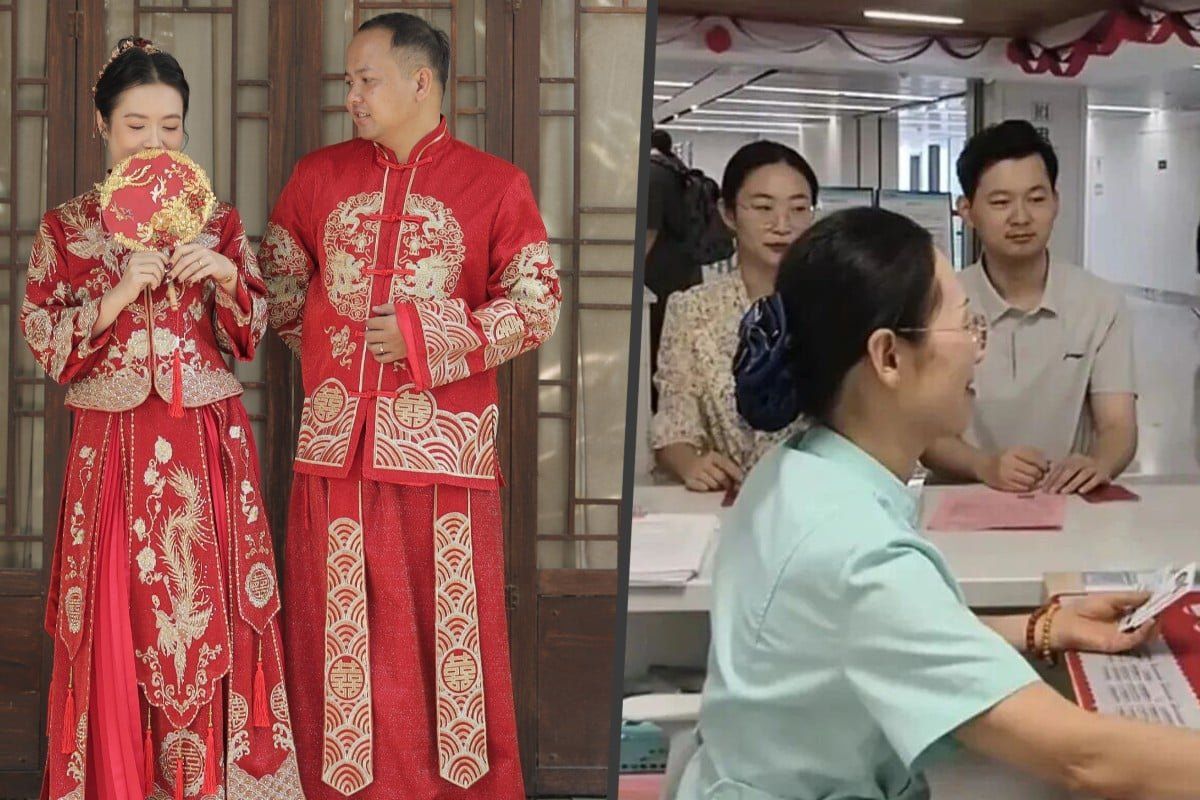
China's battle against plummeting marriage rates has taken an unconventional turn, with authorities partnering with hospitals, financial institutions, and entertainment venues to make tying the knot more accessible. This month, the Maternal and Child Health Hospital of Linzi District in Zibo City, Shandong province became the latest unexpected location to offer marriage registration services, following the Postal Savings Bank of China's launch of similar services in Tianjin earlier this year. The trend reflects Beijing's growing alarm over a demographic crisis that threatens economic growth and social stability, prompting policymakers to explore creative solutions beyond traditional bureaucratic channels.
The proliferation of marriage registration venues stems from significant regulatory reforms introduced in May last year, which fundamentally restructured how Chinese couples formalize their unions. Under the previous system, couples were required to register marriages at civil affairs bureaus in their hukou, or household registration location—a restriction that often forced people to travel considerable distances and present extensive documentation including their household booklets. The updated regulations eliminated these geographic constraints and simplified paperwork requirements, deliberately designed to remove friction from the marriage process. This legislative shift opened the door for local governments and private enterprises to explore partnerships, transforming marriage registration from a purely administrative function into a service that could be embedded within spaces people already frequent.
The creative venue expansion has accelerated rapidly since these regulatory changes took effect. Guangzhou Baiyun International Airport in Guangdong province became the nation's first airport to issue marriage certificates, sweetening the offer with complimentary access to its observation deck so newlyweds could celebrate while watching aircraft operations. In Shanghai, a nightclub partnered with the local civil affairs bureau to host elaborate certification ceremonies within the venue itself, transforming the marriage registration experience into an entertainment event. Beijing and Nanjing have converted centuries-old temples into marriage registration points where couples can solemnize their unions while dressed in traditional attire, blending ceremonial significance with bureaucratic formality. A metro station in Hefei, Anhui province joined the roster as the first transportation facility nationwide to offer such services.
By May this year—exactly one year after the regulatory overhaul—the scale of this decentralization had become remarkable. China reported over 500 dedicated marriage registration sites established outside the standard civil affairs bureaus, with an additional 1,300 outdoor locations collaborating with local authorities to issue marriage certificates. These venues span tourist attractions, public parks, temples, metro stations, and commercial establishments, creating an ecosystem designed to minimize barriers to marriage formalization. The hospital in Zibo positioned its service as particularly efficient, promising to integrate marriage registration with premarital medical examinations and preconception health guidance, allowing couples to complete multiple essential steps in a single location rather than navigating different institutions.
The initial impact of these accessibility improvements appeared promising, at least temporarily. During the third quarter of last year, China recorded 1.61 million marriage registrations nationwide, representing an impressive 22.5 percent increase compared to the same period the previous year. For the full year, the country saw 6.76 million marriage registrations—an increase of 657,000 marriages versus the prior year. These statistics suggested that removing procedural obstacles could meaningfully stimulate marriage rates, providing ammunition for officials who believed that inconvenience, rather than deeper social factors, deterred young people from formalizing relationships.
Yet this optimism proved short-lived and potentially illusory. The first half of this year shattered assumptions about the durability of these gains, with marriage registrations declining by 7.5 percent compared to the same period in 2023, with only 3.28 million couples formalizing their unions. This dramatic reversal undermines the theory that simple procedural convenience could fundamentally reshape marriage behavior among younger Chinese generations facing far more existential concerns about economic security and life satisfaction.
Online discourse reveals the skepticism animating public response to these initiatives. Social media commentators have questioned whether accessibility improvements address the genuine obstacles preventing marriages. One widely circulated remark sardonically asked whether people truly avoid marriage because they cannot locate a registration office, essentially dismissing the government's underlying assumption. Another jest suggested placing divorce services atop Mount Everest, mocking what critics perceive as a superficial approach to a structurally complex problem. The darker observations cut closer to sociological reality: young people fear the financial burdens accompanying marriage, potential family conflicts arising from spousal relationships, and the loss of personal autonomy that traditional matrimony historically entailed.
The deeper issue, according to social observers, centers on how contemporary Chinese youth perceive marriage's role within modern life. Younger generations increasingly reject the historical assumption that matrimony represents an inevitable life milestone that provides meaning and social validation. Instead, marriage appears as an optional arrangement laden with risks—economic vulnerability, interpersonal tension, and circumscribed individual freedom—that may deliver uncertain emotional rewards. Against this recalculation of marriage's value proposition, expanding the number of convenient registration venues cannot persuade people already convinced that the fundamental commitment itself presents an unattractive bargain.
This impasse reflects broader demographic anxieties afflicting East Asian societies more generally, patterns increasingly visible in Japan, South Korea, and Taiwan where marriage and birth rates have similarly collapsed despite government interventions. China's experience suggests that governmental focus on administrative efficiency misses the underlying drivers of marriage decline: economic anxiety about housing and childcare costs, gender dynamics and evolving expectations around domestic labor, educational opportunities drawing young women away from early marriage, and the simple availability of fulfilling alternatives to matrimony that previous generations never possessed.
The expansion of unconventional marriage registration venues nonetheless demonstrates Beijing's commitment to treating demographic decline as a policy priority requiring experimentation and innovation across multiple institutional domains. Whether hospitals, banks, and nightclubs can serve as effective venues for formalization matters less than what their proliferation symbolizes: official acknowledgment that marriage rates represent a critical challenge demanding urgent attention. The question facing policymakers remains whether convenience-oriented solutions can meaningfully shift behavior when the underlying calculus driving young adults away from marriage involves fundamental anxieties about financial stability, gender relations, and personal autonomy that no registration venue can address.

