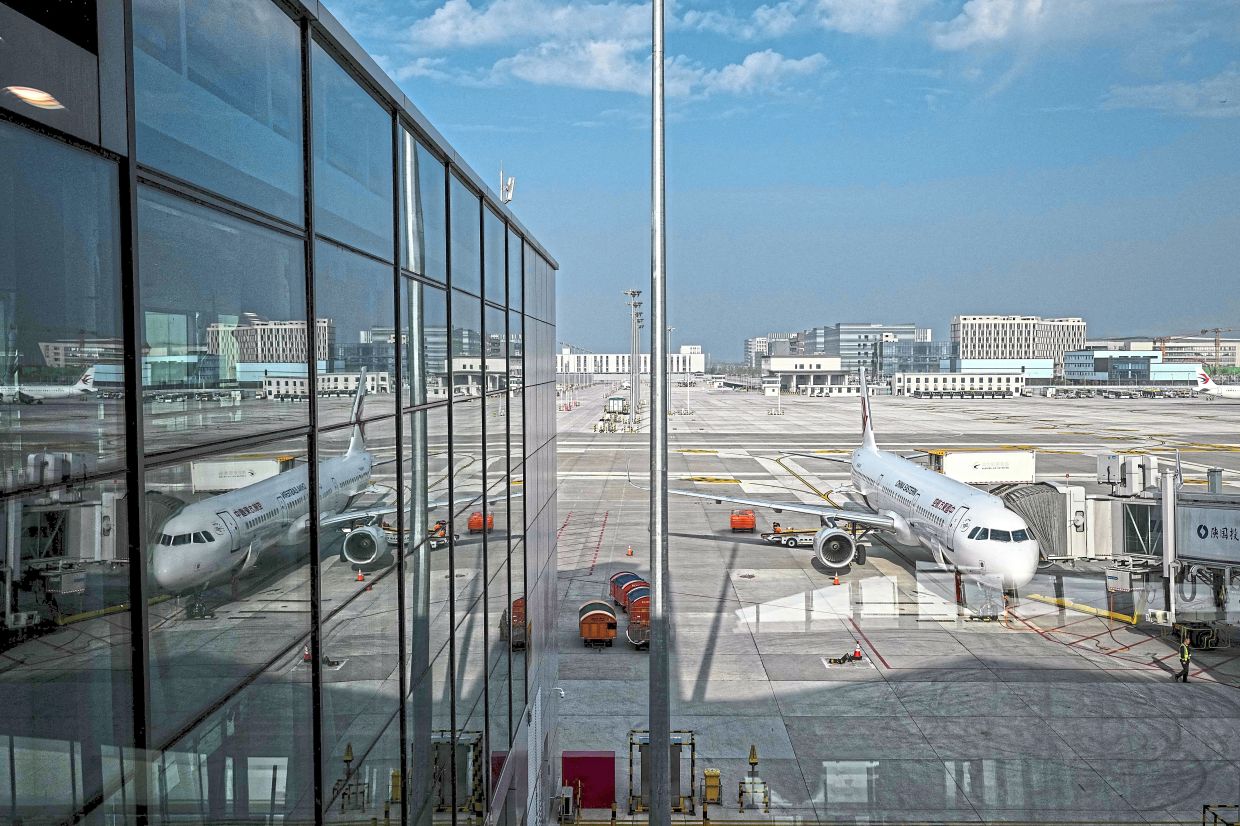
China's aviation sector is sliding deeper into financial distress as the country's three largest state-owned carriers reported first-half combined losses of approximately 8.2 billion yuan, extending a dismal streak that has now persisted for seven consecutive years. Air China, China Eastern Airlines and China Southern Airlines disclosed the shortfall on Monday, rattling investor confidence and dragging their share prices lower across both mainland and Hong Kong exchanges. The magnitude of the losses—approaching 9 billion yuan before final accounting adjustments—represents a dramatic swing from the carriers' combined first-quarter profit of 4.82 billion yuan, which had benefited from robust Lunar New Year travel demand. This volatility underscores the fragile state of China's post-pandemic aviation recovery and raises serious questions about the sector's ability to return to sustainable profitability.
The deterioration in financial performance was particularly acute at China Southern, which reported a loss of 3.7 billion yuan compared with 1.53 billion yuan in the same period last year—more than doubling its deficit. Air China's net loss expanded to 2.3 billion yuan from 1.81 billion yuan annually, whilst China Eastern's position weakened to 2.2 billion yuan from 1.43 billion yuan. What makes these figures especially troubling is that they occurred despite the carriers managing to grow revenues substantially. Air China expanded its top line by 10.5%, China Eastern by 11.1%, and China Southern by 9.7%, driven primarily by strong international demand as some travellers rerouted away from Middle Eastern hubs disrupted by regional conflict. This disconnect between growing revenues and deepening losses points to a structural profitability crisis centred on cost management rather than demand generation.
The primary culprit is jet fuel, which has become an increasingly unmanageable expense burden. Fuel costs climbed between 35 and 38 percent at each of the three carriers during the first half of the year, far outpacing any revenue growth. Unlike their international peers in Asia and Europe, Chinese airlines have historically hedged little of their fuel purchases, leaving them perilously exposed to oil price volatility. China Southern acknowledged this vulnerability explicitly in its regulatory filing, stating that there are currently no effective mechanisms available to mitigate exposure to jet fuel price fluctuations. This lack of hedging represents a strategic weakness that distinguishes Chinese carriers unfavourably from competitors who have developed more sophisticated risk management frameworks. Even though jet fuel prices have retreated from their second-quarter peak, they remain elevated more than 50 percent above pre-conflict levels, suggesting that high fuel costs will continue constraining profitability well into the future.
The structural challenges facing these carriers extend beyond commodity price shocks. Domestic competition within China presents formidable headwinds that limit pricing power. Unlike American carriers, which have successfully imposed substantial fare increases, Chinese airlines confront resistance from both weaker macroeconomic conditions and the persistent popularity of high-speed rail networks and driving holidays among leisure travellers. Raising domestic fares substantially risks simply pushing price-sensitive passengers toward alternative transportation modes rather than filling seats. International routes, though growing robustly, cannot compensate sufficiently for this domestic constraint. The European routes have attracted particular demand as travellers avoid disrupted Middle Eastern hubs, but this represents a temporary advantage rather than a structural improvement in the competitive landscape.
Meteorological conditions have compounded the carriers' difficulties during what should normally be their most profitable quarter. An unusually intense typhoon season has ravaged the northwestern Pacific and South China Sea, generating 21 storms thus far—nine more than the historical average for the equivalent period. These weather disruptions have sabotaged domestic route schedules precisely when Chinese airlines rely most heavily on traffic volumes to generate seasonal profits. Aviation data firm Flight Master projects that Chinese carriers will transport 142 million passengers on domestic and international routes during July and August, representing a 3.6 percent year-on-year decline. This would constitute the first contraction in peak summer season traffic since 2022, when nationwide lockdowns paralysed the economy. The combination of demand softness, weather disruption, and high fuel costs has created a near-perfect storm for airline profitability.
Analysts have grown distinctly pessimistic about near-term recovery prospects. HSBC strategists anticipate that the Big Three will post combined losses of approximately 16.8 billion yuan throughout 2026, substantially worse than the market consensus expecting combined profits of 1.3 billion yuan. This forecast revision reflects deepening concern about the trajectory of both costs and demand. Consequently, share prices have collapsed, with all three carriers' Shanghai-listed shares falling at least 36 percent through 2026. The sustained share price weakness and gloomy outlooks have also prompted all three carriers to forgo interim dividend distributions, preserving capital and signalling management's caution about near-term cash generation. For Malaysian and Southeast Asian investors holding exposure to Chinese aviation through regional equity funds, this deterioration has significant portfolio implications.
Despite these formidable headwinds, the carriers are pressing forward with fleet expansion focussed on domestically manufactured aircraft. China Eastern has enlarged its fleet of narrow-body COMAC C919 jets to 17 aircraft after accepting three deliveries during the first half. Both Air China and China Southern operate 11 C919s each, having taken two and three deliveries respectively. This emphasis on domestic aircraft procurement reflects broader strategic policies prioritising national industrial development and reducing dependency on foreign manufacturers. However, the financial strain is affecting even these plans. China Eastern has revised downward its expected C919 deliveries between 2026 and 2028 by 13 aircraft relative to previous forecasts, signalling either tighter capital discipline or revised confidence in demand outlook. Air China maintained its earlier delivery schedule, whilst China Southern declined to disclose updated forecasts in its interim report.
The broader implications for the Chinese economy and regional aviation dynamics deserve careful consideration. China's state-owned carriers carry symbolic and strategic importance beyond simple commercial metrics, functioning as instruments of national policy and prestige. Their prolonged financial weakness signals underlying softness in both international and domestic travel demand, serving as a barometer for China's economic health. For Southeast Asian countries, deteriorating Chinese airline profitability has contradictory implications. Weaker Chinese carriers mean reduced competition and potentially more attractive pricing for travellers using Southeast Asian hubs and carriers, but it also suggests reduced Chinese tourism flows and business travel to the region. Airlines throughout Southeast Asia may find themselves competing more intensely for limited growth in regional aviation demand.
The structural vulnerabilities revealed by this crisis—inadequate fuel hedging, limited domestic pricing power, vulnerability to weather disruption, and overcapacity relative to demand—are not quickly remedied. Management at these carriers faces a multi-year challenge requiring simultaneous cost reduction, strategic route network optimisation, and technological modernisation through fleet upgrades. The investment in COMAC aircraft may eventually yield efficiency gains and lower operating costs, but the near-term financial trajectory appears uniformly bleak. For Malaysian readers and regional observers, these travails remind that even massive state-owned enterprises with implicit government backing remain vulnerable to conjoint shocks of commodity price volatility, demand weakness, and adverse weather. The coming 12-24 months will reveal whether Chinese policymakers are willing to implement fundamental restructuring or instead opt for incremental support measures.

