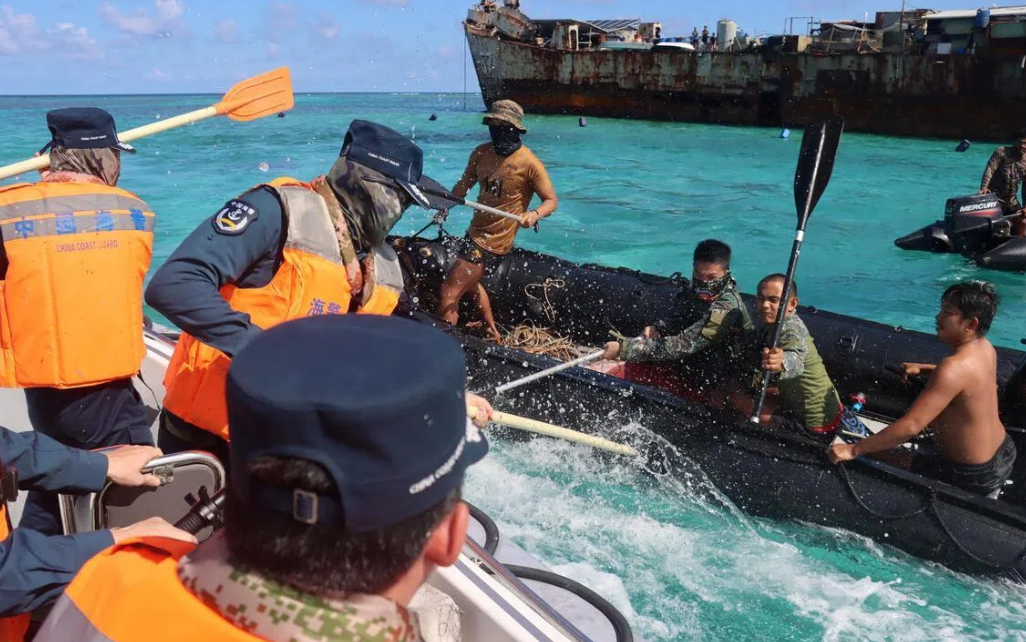
China has formally summoned the Philippine ambassador to Beijing following a confrontation at a flashpoint in the South China Sea that has reignited tensions in one of the world's most sensitive maritime zones. The diplomatic summons came in response to an incident on Monday at Ren'ai Reef, also known as the Second Thomas Shoal, where Philippine military personnel reported that a Chinese Coast Guard vessel approached a grounded warship that serves as a longstanding Philippine military outpost. According to Manila's account, a Filipino sailor sustained injuries after being struck with a baton during the encounter, prompting an immediate diplomatic response from Beijing's foreign ministry on Tuesday.
China's foreign ministry characterised the Philippines' actions as deliberate provocation, insisting that Manila bore responsibility for the confrontation and had subsequently distorted the sequence of events to its advantage. The official statement rejected what Beijing characterised as a misrepresentation of circumstances, asserting that the Philippine side "provoked first, yet it has turned the blame upside down, distorted the facts, and maliciously hyped the issue." This rhetorical posture reflects the hardening positions of both nations at a location that has become increasingly emblematic of broader geopolitical competition in Southeast Asia's maritime domain.
The Second Thomas Shoal represents one of the most sensitive flashpoints in the sprawling territorial disputes that define South China Sea relations. China maintains an extensive territorial claim encompassing nearly the entire sea, despite a 2016 international arbitration ruling that found these claims to lack legal foundation under international maritime law. Multiple Southeast Asian nations, crucially including the Philippines, Vietnam, and Brunei, possess overlapping claims that directly conflict with Beijing's expansive position. The result is a densely contested waterway where military and coast guard vessels regularly encounter one another, sometimes leading to physical confrontations that threaten to escalate regional tensions beyond their immediate contexts.
The incident at Second Thomas Shoal occurred against the backdrop of the ongoing Philippines-China rivalry over maritime sovereignty, a competition that has intensified notably in recent years. The grounded vessel that prompted Monday's confrontation has functioned for decades as a de facto Philippine military garrison, symbolising Manila's commitment to maintaining a physical presence within the disputed area. China views such deployments as unlawful occupations and has increasingly sought to dislodge or isolate these Philippine outposts through aggressive coast guard operations that stop short of direct military confrontation.
The clash has swiftly become a matter of international concern, with Manila's principal security partners mobilising diplomatic responses. Australian Foreign Minister Penny Wong characterised China's conduct as "destabilising and dangerous," reflecting Canberra's growing alignment with Washington's position on South China Sea security matters. The US State Department similarly condemned Beijing's actions as "dangerous and aggressive," signalling that Washington views the incident as symptomatic of broader patterns of coercive behaviour in the region. These pronouncements underscore how localised maritime incidents have become proxies for larger geopolitical contestation between Beijing and the Western alliance system.
The timing of the confrontation carries particular significance given that US Secretary of State Marco Rubio arrived in Manila on Tuesday to participate in an Association of Southeast Asian Nations (Asean) summit bringing together the bloc's 11 member states. Rubio's presence amplified Washington's messaging regarding freedom of navigation and regional security, with the timing of the Chinese incident potentially designed to underscore American commitment to Philippines security. His visit also created the possibility of bilateral engagement with Chinese Foreign Minister Wang Yi, though such a meeting had not been publicly confirmed at the time the incident occurred, potentially complicating diplomatic choreography surrounding the gathering.
Rubio used the occasion of his Manila visit to publish an opinion article in Philippine media outlets reaffirming Washington's strategic commitment to Southeast Asian security and freedom of navigation principles. The op-ed articulated a fundamental American interest in maintaining an open maritime environment rather than permitting any single power to exercise hegemonic control over the region's crucial waterways. Rubio's formulation implicitly referenced China without naming it directly, warning that permitting Beijing to monopolise these waters would expose both the United States and Asean member states to "serious new threats to their sovereignty, security, and economic future." The article framed freedom of navigation not merely as a technical maritime principle but as foundational to broader regional stability and prosperity.
The escalating pattern of incidents at Second Thomas Shoal and other contested locations reflects structural tensions built into the current South China Sea security architecture. China maintains that its interests in regional stability are compatible with its territorial claims and coast guard operations, viewing assertions of Philippine and American counter-claims as provocative intrusions into areas it considers within its rightful sphere. The Philippines and its Western supporters, conversely, maintain that unimpeded access to these waters represents a non-negotiable principle of international law and that accepting Chinese assertions of control would establish dangerous precedents for maritime governance globally.
The incident illustrates the vulnerability of the South China Sea to miscalculation, despite decades of diplomatic efforts to establish mechanisms for managing tensions. Both China and the Philippines have repeatedly pledged commitment to resolving disputes through negotiation and to avoiding military escalation, yet tactical incidents involving coast guard and military personnel continue to puncture these diplomatic assurances. The injury to a Filipino sailor introduces a humanitarian dimension that personalises the confrontation and may constrain Beijing's ability to dismiss the incident as routine maritime policing.
Looking forward, the convergence of the Asean summit, the Philippines-China diplomatic escalation, and the presence of senior American officials creates opportunities for both de-escalation and further entrenchment of positions. How Asean as a collective body responds to the incident will significantly influence whether the episode becomes a contained bilateral dispute or a symbol of broader regional alignment patterns. The association has historically preferred to avoid taking explicit positions on such disputes, instead emphasising consensus-building and dialogue mechanisms, but mounting pressure from members directly affected by Chinese assertiveness may strain this traditional approach.
The South China Sea confrontations ultimately reflect competing visions for Southeast Asian geopolitical order. Beijing envisions a region where its economic and military preponderance translates into acknowledged primacy in regional affairs, while Manila and its allies seek to preserve space for diplomatic autonomy and rules-based international governance. The incident at Second Thomas Shoal, while tactically limited, therefore carries significance beyond the immediate encounter, representing the ongoing negotiation of these fundamental questions about regional order and the distribution of power in one of Asia's most economically vital and geopolitically significant maritime zones.

