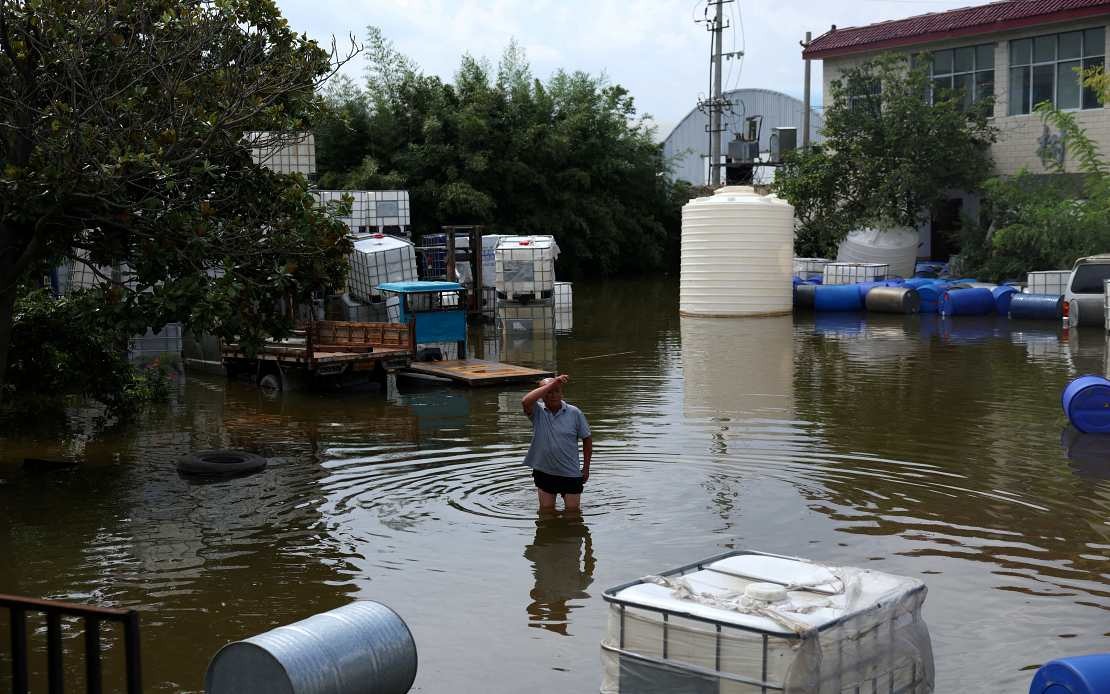
China's Ministry of Emergency Management has launched a major response to flooding in Henan Province's Zhoukou City following a catastrophic levee failure triggered by Typhoon Dolphin, the 13th typhoon of the year. The breach occurred shortly before midnight on Thursday after torrential rainfall from the typhoon's remnants swelled rivers across the region. Rescue teams arrived the following day to coordinate emergency operations with local authorities, marking an aggressive mobilisation typical of China's centralised disaster management system.
The initial wave of reinforcements included 200 specialised engineering rescue personnel from China Anneng Group, accompanied by 110 sets of large-scale engineering equipment. These assets were deployed to the affected area on Friday and immediately integrated into ongoing relief and recovery efforts. The scale of this deployment underscores the severity of the breach and the government's determination to prevent further catastrophic flooding or dam failures, which could devastate downstream communities.
The National Commission for Disaster Prevention, Reduction and Relief escalated its response to a Level-IV emergency status on Friday, placing Henan under the highest tier of national disaster relief protocols. This classification reflects the extraordinary nature of the situation and enables the rapid mobilisation of resources typically reserved for the most severe national emergencies. The decision to activate this level of response demonstrates official recognition that the flooding poses threats not merely to individual municipalities but to the broader stability of the region.
Central authorities coordinated the distribution of 30,000 essential relief supplies destined for Zhoukou, Xuchang, and surrounding areas affected by the typhoon and subsequent flooding. The relief packages, dispatched through coordination between the commission's office, the Ministry of Emergency Management, and the National Food and Strategic Reserves Administration, included folding beds, lightweight quilts suited to summer conditions, and comprehensive family emergency kits. This logistical effort represents the institutional machinery of China's state apparatus functioning at scale, ensuring that affected populations receive basic necessities during the critical post-disaster period.
For regional observers, particularly in Southeast Asia where tropical cyclones regularly threaten populations and infrastructure, the Chinese response model offers both lessons and contrasts. Unlike many Southeast Asian nations where disaster response remains fragmented across multiple agencies with inconsistent coordination, China's centralised approach enables rapid resource mobilisation. However, this efficiency must be weighed against questions about the adequacy of prevention measures—the levee failure itself suggests potential vulnerabilities in infrastructure maintenance or design that warrant broader scrutiny.
Typhoon Dolphin represents the thirteenth tropical cyclone recorded during the 2024 season, reflecting broader climatic patterns that increasingly affect the region. The storm's progression from coastal areas toward Henan demonstrates how inland provinces, despite lacking direct coastal exposure, remain vulnerable to precipitation-driven disasters. The levee breach exemplifies infrastructure stress points where climate variability intersects with built environment limitations, a concern extending throughout Asia where ageing water management systems face mounting pressure.
The speed of central dispatch to Zhoukou highlights China's pre-positioned disaster response capability, with specialised rescue units and equipment maintained at readiness across multiple provinces. This forward-deployment strategy enables rapid arrival of critical resources before local capacity becomes overwhelmed. For Malaysia and other Southeast Asian nations with growing urbanisation and expanding riverside settlements, the infrastructure investment accompanying such preparedness represents a significant undertaking requiring sustained political commitment and budgetary allocation.
The activation of Level-IV response status carries implications beyond immediate relief operations. It signals to provincial and local administrators that Henan's flooding situation qualifies for extraordinary financial support and resource prioritisation, ensuring that regional governments do not bear the full reconstruction burden independently. This burden-sharing approach reflects the Chinese central state's integration of disaster response into broader fiscal federalism frameworks, contrasting with systems where local governments shoulder disproportionate financial consequences.
The involvement of multiple national-level agencies in coordinating relief distribution illustrates bureaucratic coordination mechanisms that, while sometimes cumbersome, enable comprehensive coverage of affected populations. The National Food and Strategic Reserves Administration's participation ensures that supply chains remain functional and that strategic reserves can supplement immediate local resources without depleting stockpiles needed for other contingencies. This institutional layering, though appearing redundant, creates resilience against single-point failures in disaster response logistics.
For Malaysian policymakers monitoring typhoon preparedness and flood response protocols, the Henan situation offers cautionary reminders about infrastructure vulnerability. Levee systems protecting agricultural regions and populated areas require not merely initial construction but continuous maintenance and periodic reinforcement. The breaching of what were presumably well-maintained systems suggests that even developed nations' infrastructure faces stress under extreme weather, underscoring the necessity for Southeast Asian governments to prioritise ongoing investment in water management infrastructure even during periods when immediate disasters seem distant.
Looking forward, the aftermath of this levee breach will likely generate intense scrutiny regarding infrastructure standards and weather preparedness measures. Chinese authorities may commission investigations into whether the breach resulted from design inadequacy, maintenance deficiencies, or simply unprecedented hydrological conditions. Such assessments carry implications for infrastructure confidence throughout the region, particularly in areas dependent on similar embankment systems for flood control and water management. The scale of the response, while demonstrating governmental capacity, also underscores the magnitude of challenges posed by extreme weather events in increasingly urbanised and densely populated landscapes throughout East and Southeast Asia.

