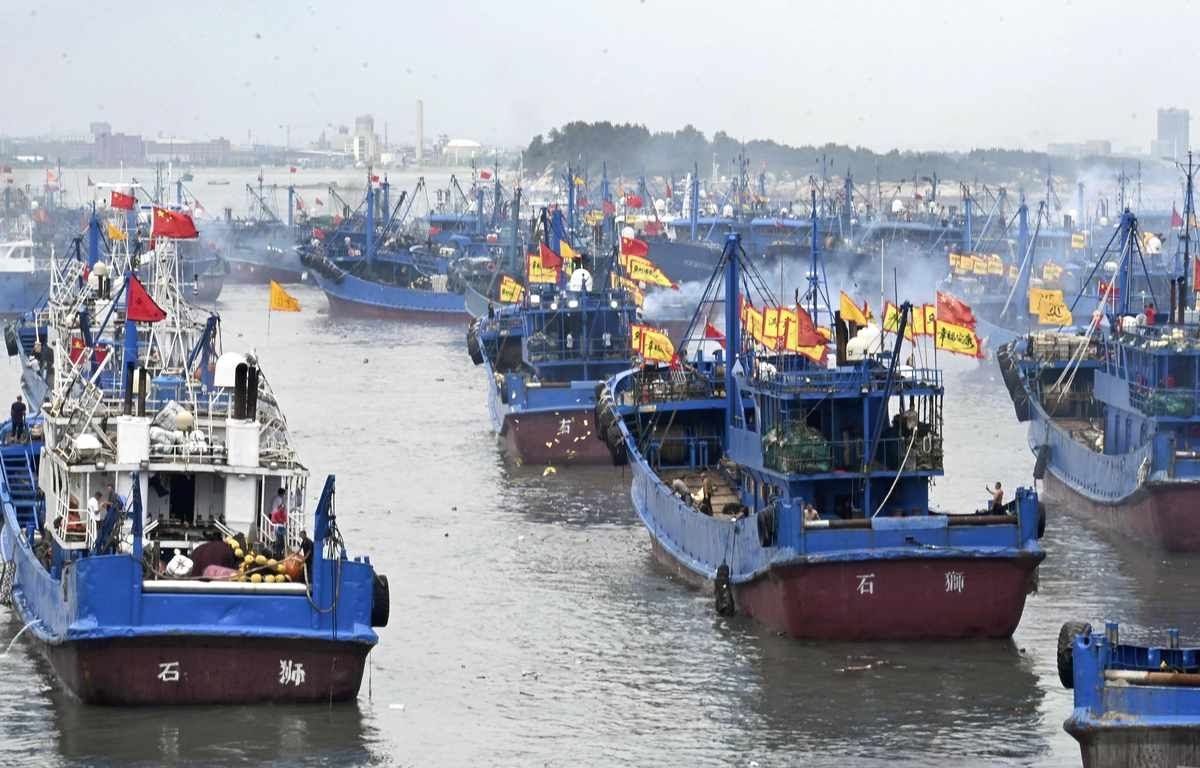
China's termination of its East China Sea fishing moratorium on August 15 has triggered renewed concern in Tokyo, with hundreds of Chinese vessels immediately departing from Fujian Province ports to resume operations in contested waters, including the disputed Senkaku Islands region and Taiwan Strait. The development arrives at a particularly fraught moment in Japan-China relations, with analysts watching carefully for signs of escalatory behaviour from Beijing and potential maritime incidents that could further strain already fragile diplomatic ties across the region.
The scale of the resumption was immediately evident. A single port in Shishi city released 654 fishing vessels on Sunday morning, August 16, in a ceremonial display of national intent. The boats departed amid festive scenes, with crews flying Chinese national flags alongside traditional red and yellow banners symbolizing hopes for abundant catches and safe voyages. The coordinated deployment, complete with firecrackers sounding across the water, underscored the political significance Beijing attaches to maritime resource access in these strategically vital waters.
Historical precedent weighs heavily on Japanese security planners. In August 2016, coordinated incursions involving hundreds of Chinese fishing vessels operating in tandem with China Coast Guard ships created a dramatic show of force around the Senkaku Islands. That episode, widely interpreted as retaliation against Japan's public support for an international arbitration tribunal ruling against Chinese sovereignty claims in the South China Sea, prompted sharp Japanese protests. Many observers viewed the fishing boat mobilization as a quasi-official expression of Beijing's displeasure, raising questions about whether civilian vessels operate independently or receive government coordination instructions.
The relationship between Chinese authorities and fishing fleets operating near Japanese waters has grown markedly more complex in recent years. Local government bodies have subtly discouraged fishing operations in what Beijing officially designates as "sensitive waters," a euphemistic category encompassing zones claimed by multiple nations. This calibrated approach reflects China's apparent concern that uncontrolled fishing activities might provoke Japanese responses leading to accidents, maritime casualties, or further diplomatic deterioration—precisely the scenarios Beijing wishes to avoid despite territorial ambitions.
Warnings issued by the Japan Coast Guard to Chinese vessels in Senkaku territorial waters demonstrate the scale of this restraint. The number of such warnings plummeted from 81 in 2021 to merely four in 2025, a dramatic 95 percent reduction suggesting either effective Chinese government instruction discouraging such activities or tacit agreement between both nations to avoid confrontational incidents. This pattern indicates that despite unresolved sovereignty disputes, both Tokyo and Beijing have recognized mutual interests in preventing maritime incidents from spiraling into broader military or diplomatic crises.
Yet the signals China is now sending contain troubling ambiguities. In August 2025, authorities in Quanzhou—the municipality governing Shishi—issued instructions emphasizing surveillance of sensitive waters, ostensibly to prevent Chinese vessels from venturing into disputed zones. However, the specific terminology used in Beijing's official fishing restrictions has shifted noticeably. Last year's directive explicitly warned against "cross-border fishing in sensitive waters such as those of South Korea, North Korea and Japan." This year's April 30 notice conspicuously omitted Japan, referencing only the China-South Korea interim measures area, a linguistic change that diplomatic observers interpret as potentially permitting greater Chinese fishing activity near Japanese-controlled waters.
Fishermen themselves signal ambivalence about regulatory constraints. One Shishi fisherman, speaking anonymously on the eve of the season resumption, acknowledged the richness of fishing grounds near the Senkaku Islands while calibrating his language carefully. He noted that Chinese authorities would apprehend vessels straying too close to Japanese waters, yet emphasized the absence of explicit prohibitions against accessing those waters entirely. This carefully-worded position suggests a grey zone where formal regulations remain ambiguous enough to permit individual captain discretion, provided activities stop short of crossing explicitly drawn lines.
The timing of the ban lift intersects with broader patterns of great power competition across the East China Sea and South China Sea. The disputed Senkaku Islands—administered by Japan but claimed by China—represent flashpoints in a larger strategic competition over maritime trade routes, undersea resources, and regional hegemony. Beijing's ability to mobilize hundreds of fishing vessels as rapid-response instruments of policy pressure creates asymmetric advantages: these civilian ships can probe Japanese responses, test international reaction, and assert effective control over contested waters without triggering the formal military confrontations that might trigger alliance responses from Washington or AUKUS partners.
For Malaysia and other Southeast Asian nations, the unfolding situation carries significant implications. Chinese fishing operations across the East China Sea and South China Sea often involve vessels from multiple provinces, and the tactics Beijing employs against Japan in the Senkaku dispute establish precedents relevant to maritime claims affecting Vietnam, the Philippines, and Indonesia. Malaysian fishing communities operating in northern waters monitor Chinese activities closely, recognizing that expansionist tactics in Japanese waters provide templates for similar pressure in Southeast Asian jurisdictions.
Japan's monitoring posture reflects both caution and accumulated experience. Officials in Tokyo have learned that dramatic military responses to fishing fleet incursions risk catastrophic escalation, yet passive acceptance invites incremental boundary-pushing. The dramatic decline in Japan Coast Guard warnings suggests Tokyo may have reached tactical accommodation with Beijing on this particular flashpoint, exchanging visible enforcement actions for behind-the-scenes coordination. Whether that equilibrium can hold as hundreds of Chinese vessels resume operations remains uncertain, particularly given the ambiguous signals from Beijing's latest policy revisions regarding which waters require protective oversight.
The coming months will test whether improved fishery coordination between Japanese and Chinese authorities can coexist with Beijing's broader assertiveness on maritime sovereignty claims. If previous patterns hold, both nations possess incentives to prevent individual fishing incidents from metastasizing into diplomatic crises. Yet the deliberately ambiguous language in this year's Chinese regulatory notices, combined with the explicit omission of Japan from formal restrictions, suggests Beijing may be positioning itself to tolerate greater fishing fleet presence near disputed waters while maintaining plausible deniability about deliberate policy shifts. For Japan and regional observers alike, distinguishing between tactical restraint and strategic repositioning will prove essential to understanding the trajectory of East China Sea tensions throughout the fishing season ahead.

