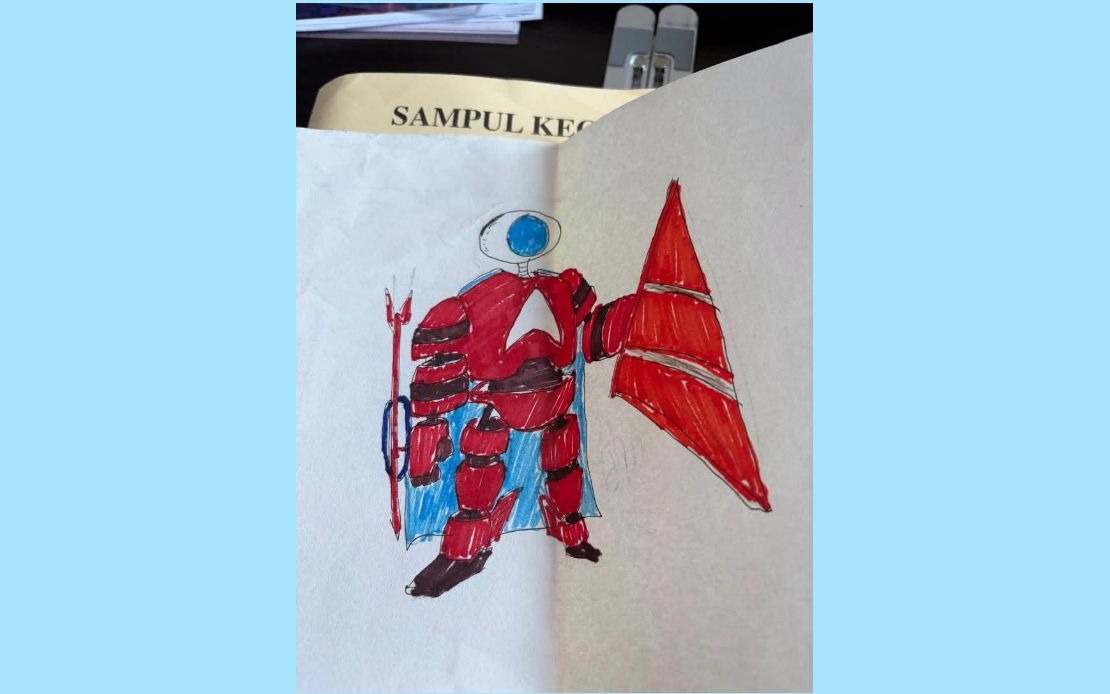
Prime Minister Datuk Seri Anwar Ibrahim has treasured a drawing gifted to him by a child with special needs during a recent community engagement session in Negeri Sembilan. The touching exchange, which took place at a Temu Anwar programme, prompted the Premier to publicly acknowledge the gesture on Facebook, reflecting on the emotional significance of the simple yet meaningful present.
The artwork, which features a robot character rendered in bold red and blue armour, depicts a figure holding what appears to be a staff-like object in its left hand. While seemingly modest in scope, the drawing carries profound personal meaning for Anwar, who took time to recognise the thoughtfulness behind the gift and the effort invested by the young artist. His public acknowledgement underscores the value placed on such personal connections within Malaysia's political leadership.
According to Anwar's social media post, the drawing was presented by the child whilst being carried by his father during the community dialogue event. This detail emphasises the inclusive nature of such engagements, where families of all circumstances are encouraged to participate and connect with national leadership. The intimate moment captured both the spontaneity of grassroots interaction and the genuine connection that can emerge between public figures and ordinary citizens.
Temu Anwar represents a structured platform designed to facilitate direct dialogue between Malaysia's top political leadership and the broader population. The initiative brings together the Prime Minister, young people, and members of the public from diverse socioeconomic and cultural backgrounds, creating spaces where constituents can express concerns, share experiences, and engage in meaningful conversation with the nation's chief executive. Such programmes are increasingly recognised as important mechanisms for bridging the gap between governmental institutions and the communities they serve.
The programme's inclusive approach appears to extend specifically to families with children facing developmental or physical challenges. By ensuring such households feel welcomed and valued within the political discourse, Malaysia's leadership signals its commitment to inclusive governance and representation. The decision by Anwar to publicly commemorate this particular exchange further amplifies this message, demonstrating that every citizen—regardless of circumstance—has a voice and deserves recognition within the national dialogue.
For families managing special needs, such moments of public acknowledgement carry particular significance. Children with developmental disabilities often face societal marginalisation or invisibility within formal political and civic spaces. When a Prime Minister publicly celebrates a gift from such a child, it sends a powerful symbolic message that these individuals and their families are valued members of the political community rather than peripheral figures.
The simplicity of the gift—a child's drawing—contrasts sharply with the sophistication typically associated with diplomatic exchanges. Yet this very plainness appears to be what moved Anwar. In a political environment often dominated by formal protocols and scripted interactions, a spontaneous present crafted by a young artist offers authentic human connection that cannot be manufactured or orchestrated. The Premier's appreciation for this authenticity reflects an understanding that genuine leadership involves openness to unexpected moments of real human encounter.
Public expressions of gratitude for such gifts serve multiple functions within democratic systems. They reinforce to citizens that their efforts—no matter how humble—are seen and appreciated by those in power. They demonstrate that political leadership encompasses emotional intelligence and capacity for genuine human connection beyond the performance of official duties. Furthermore, by amplifying such moments through social media, leaders can normalise the celebration of disability and special needs within public discourse.
The timing of Anwar's public acknowledgement, occurring days after the actual exchange, suggests the drawing has maintained presence in his immediate environment—perhaps displayed in his office or residence. This lingering quality speaks to how certain gifts transcend their material form to become repositories of meaningful human experience. For the child and father involved, Anwar's recognition likely represents validation that their presence and participation mattered within significant national events.
For Malaysia's political landscape, such small but deliberate gestures accumulate in shaping perceptions of leadership character and governance philosophy. In an era where political messaging is increasingly orchestrated through professional communications teams, moments of genuine human connection—and their authentic commemoration—stand out as particularly noteworthy. They suggest an administration conscious of the symbolic importance of inclusivity and the power of recognising ordinary citizens in extraordinary ways.

