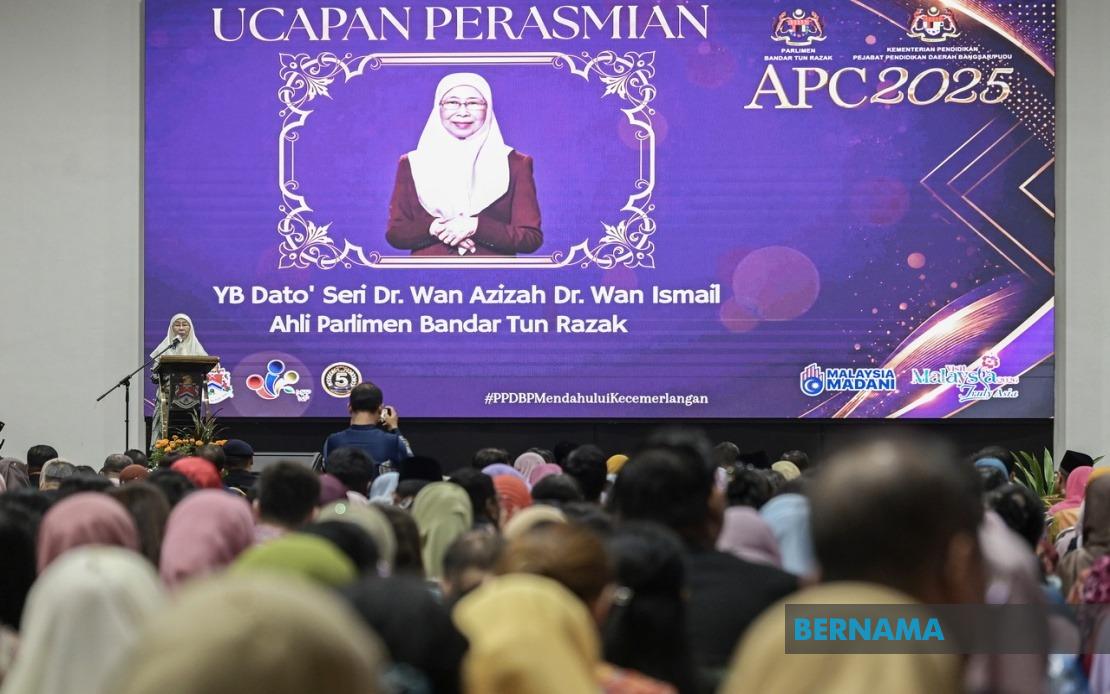
The measure of a nation's progress cannot be reduced to economic indicators, technological prowess, or infrastructure alone. At an awards ceremony in Kuala Lumpur on July 23, Prime Minister's wife Datuk Seri Dr Wan Azizah Wan Ismail articulated a vision of national development centred on human character, arguing that sustainable advancement flows from nurturing knowledgeable, ethical and compassionate individuals within society.
Speaking at the 2025 Excellent Service Award ceremony organised by the Bangsar/Pudu District Education Office at the Kuala Lumpur City Hall Training Institute, Dr Wan Azizah, who also serves as Member of Parliament for Bandar Tun Razak, underscored an uncomfortable truth often sidelined in policy discussions: the transformative power of schools and the professionals who work within them. Her remarks positioned education not as a mechanism for credential accumulation but as a fundamental institution through which societies transmit ethical frameworks and values across generations.
The context for her emphasis is particularly acute in Malaysia's urbanised centres. Many children in cities like Kuala Lumpur spend formative hours under the supervision of educators rather than parents, whose work commitments often demand their full attention during daytime hours. This structural reality means teachers and school administrators occupy a space of extraordinary influence in children's lives, often functioning as second parents in environments where primary caregivers are unavailable. Recognising this responsibility, Dr Wan Azizah stressed that educators shape not merely academic competency but the very character of future citizens.
Her framing of education's purpose reflects broader anxieties about what schools should deliver in a rapidly changing world. The curriculum debate in Malaysia has historically oscillated between competing priorities: academic excellence, moral education, vocational preparation, and national cohesion. By centering character development, compassion, and ethical grounding, Dr Wan Azizah's intervention suggests a deliberate rebalancing toward humanistic values at a moment when technological disruption threatens to marginalise such concerns.
The artificial intelligence era poses particular challenges to this vision. As AI systems increasingly handle routine cognitive tasks, the value proposition of traditional education—knowledge transfer and information processing—becomes increasingly diminished. Simultaneously, societies face growing uncertainty about distinguishing reliable information from misinformation, propaganda, and fabrication. Dr Wan Azizah identified this challenge directly, emphasising that education systems must prioritise critical thinking and values-based frameworks that allow students to navigate epistemic complexity with integrity.
For Malaysian policymakers and educators, this represents both validation and challenge. Validation because it positions character education and critical thinking—areas where Malaysia has invested considerable effort through initiatives like the Malaysian Education Blueprint and various curriculum reforms—as central rather than peripheral concerns. Yet it also challenges schools to ensure these values are genuinely embedded rather than rhetorically invoked. The distinction between values education as genuine moral formation versus values education as superficial moral instruction remains a perennial implementation problem.
The 2025 awards ceremony itself embodied this commitment institutionally. Approximately 1,000 attendees gathered to honour 746 teachers and school administrators drawn from 143 schools across the Bangsar/Pudu district, recognising their exceptional performance and dedication. This scale of recognition—nearly three-quarters of a thousand educators—signals that character-building and values-based education cannot be delegated to a small group of specialists but must become embedded throughout the entire teaching workforce and administrative structure. The diversity of schools represented underscores that this vision applies across all educational contexts, not merely elite institutions.
The presence of high-level officials including Prime Minister's Political Secretary Datuk Azman Abidin and Kuala Lumpur Federal Territory Education Department director Megat Affandi Ismail reinforced the political seriousness attached to educator recognition. In many contexts, teacher awards ceremonies function as routine bureaucratic occasions. Yet the presence of federal-level officials suggested this event carried symbolic weight in communicating government commitment to elevating the teaching profession's status and validating educators' contributions beyond salary and pension considerations.
Dr Wan Azizah's emphasis on character, ethics, and compassion also carries regional resonance. Across Southeast Asia, societies grapple with social fragmentation, communal tensions, and declining civic trust. Malaysia specifically navigates complex religious, ethnic, and ideological pluralism. When leaders articulate education's purpose in terms of developing compassionate citizens capable of critical thought and ethical reasoning, they implicitly argue for education as a mechanism of social cohesion and democratic citizenship rather than mere economic productivity.
The challenge facing Malaysian educators lies in translating this high-level commitment into classroom practice. Teachers already navigate demanding workloads, administrative burdens, and evolving curriculum requirements. Integrating robust character education and critical thinking development requires not only philosophical commitment but also practical resources: professional development, curriculum flexibility, time allocation, and institutional support structures that reward rather than penalise educators for investing in these dimensions.
Looking forward, Dr Wan Azizah's remarks suggest that national development narratives in Malaysia may be gradually shifting. The traditional emphasis on economic growth metrics and technological advancement has not disappeared but is increasingly accompanied by explicit recognition that sustainable progress depends on the quality of citizens, not merely the quantity of GDP or the sophistication of infrastructure. This recalibration, if genuinely implemented across policy and practice, could reshape educational priorities and teacher training frameworks throughout the country.
Ultimately, the strength Dr Wan Azizah identifies—the capacity to nurture knowledgeable, ethical, compassionate individuals—represents not a luxury add-on to development but its very foundation. In an era of technological disruption and social uncertainty, this vision positions educators as central architects of the nation's future, a recognition that, when translated into meaningful support and genuine institutional commitment, could fundamentally transform Malaysia's educational landscape.

