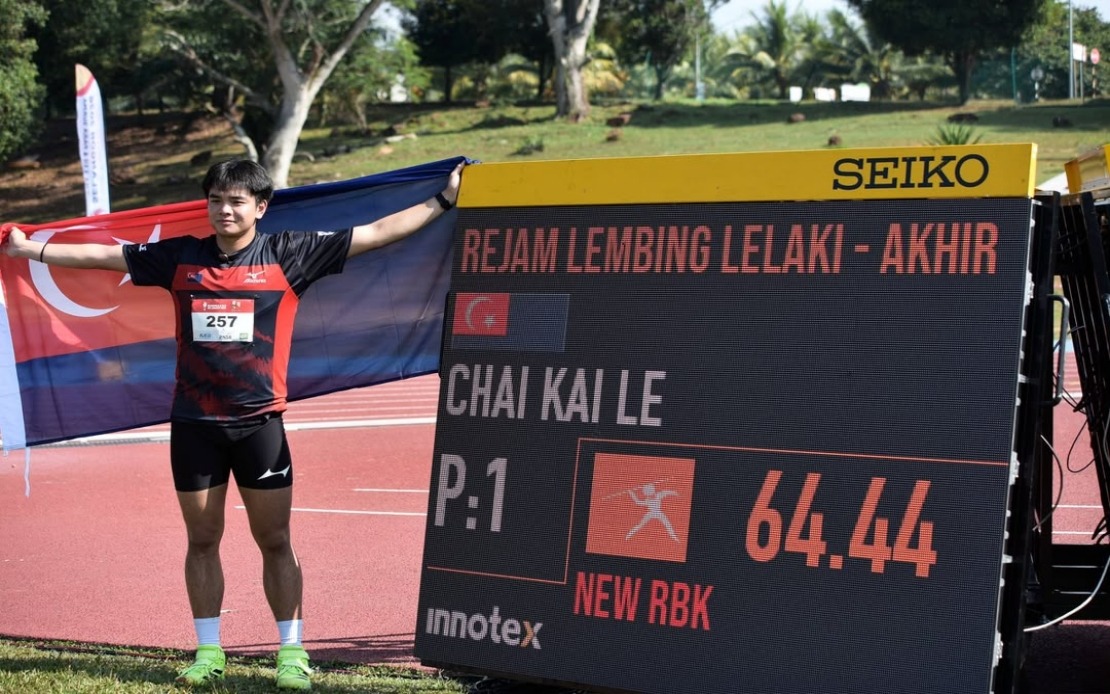
Johor's Chai Kai Le has etched his name into Malaysian sporting history by demolishing a javelin record that had stood unchallenged for more than two decades at the Selangor 2026 Malaysia Games. Competing at the Universiti Putra Malaysia Sports Centre in Serdang on August 17, the 18-year-old launched the javelin 64.44 metres on his second attempt, erasing the previous SUKMA record of 62.33 metres that had belonged to Sarawak's Kho Mei Kuan since the 2000 edition held in Penang. The achievement represents a significant breakthrough for Malaysian athletics, particularly in a field event where the nation has historically produced fewer world-class performers compared to sprinting disciplines.
The performance underscores Chai Kai Le's trajectory as one of Malaysia's most promising track and field prospects. His personal best of 65.65 metres in the under-20 category, set in national competition, indicates that the Johor athlete possesses technical proficiency and physical capability rivalling seasoned senior competitors. The gap between his national junior record and his SUKMA-winning throw suggests room for further improvement, a prospect that should energise Malaysian athletics administrators tasked with developing the next generation of Olympic and SEA Games contenders. At an age when many athletes are still refining their technique and building experience, Chai Kai Le has already demonstrated the consistency and mental fortitude required to perform under pressure at major regional competitions.
In post-competition remarks, Chai Kai Le attributed his success to systematic preparation spanning two years, underscoring the importance of long-term athlete development programmes. He candidly acknowledged a technical miscalculation during his final throwing sequence that resulted in lower back discomfort and fatigue, compelling him to abandon pursuit of further attempts. This pragmatic approach—prioritising injury prevention over chasing marginal performance gains—reflects growing maturity in how emerging Malaysian athletes manage their physical wellbeing during peak competition. His willingness to discuss technical shortcomings alongside achievements offers valuable insight into the mentality required for sustained athletic progression, a lesson particularly relevant for younger competitors observing from the sidelines.
Penang's Tan Chun Wei secured the silver medal with a throw of 60.43 metres, while Chai Kai Le's Johor teammate Mohd Noor Iman Norman claimed bronze with 59.04 metres. The presence of two Johor throwers on the podium suggests that systematic investment in athletics infrastructure and coaching capacity within the state has yielded tangible dividends. State-level performance variations in track and field disciplines often reflect differences in funding allocation, coaching expertise, and training facility access—factors that policymakers should consider when evaluating resource distribution across Malaysia's 16 states and federal territories.
Parallel to Chai Kai Le's javelin success, Penang's Mohammad Aiman Haikal Sahrudin claimed victory in the men's 10,000-metre race walk, completing the distance in 47 minutes 28.84 seconds. This performance positioned him ahead of Kelantan's Ahmad Farish Irfan Ahmad Fahmi, who finished second in 47 minutes 37.17 seconds, while Federal Territories' Khor Jing Hong secured third place in 47 minutes 49.27 seconds. The race walk, a discipline requiring exceptional endurance, technique, and mental resilience, has traditionally attracted less media attention than sprinting events yet remains strategically important for comprehensive national athletics development.
Mohammad Aiman's gold medal represents a marked improvement on his performance at the previous SUKMA edition held in Sarawak, where he claimed the silver medal in the same event. This progression exemplifies how competitive national platforms like the SUKMA Games provide crucial opportunities for athletes to refine technique, test themselves against peers, and build championship experience. For a young race walker still developing his craft, the trajectory from silver to gold across consecutive Games cycles indicates improving consistency and growing confidence in his capabilities. At 18 years old, Mohammad Aiman occupies the same developmental stage as Chai Kai Le, suggesting that Malaysian athletics is nurturing multiple talents across diverse disciplines simultaneously.
Looking beyond the immediate SUKMA competition, Mohammad Aiman articulated ambitious targets centred on national squad selection and qualification for the 2027 SEA Games. His strategic focus on the 20-kilometre race walk—the standard international distance that will feature at Southeast Asia's premier multi-sport event—demonstrates forward-thinking athlete management. The absence of a 10,000-metre race walk programme at the SEA Games necessitates that domestic competitors transition their conditioning and tactical approaches to longer distances, a transition that requires deliberate planning and specialised coaching support. His transparent communication of these objectives signals an athlete cognisant of the pathways required to compete internationally, a mentality essential for sustained progression within Malaysia's competitive sporting ecosystem.
The performances by both Chai Kai Le and Mohammad Aiman assume particular significance within the broader regional athletics landscape. Southeast Asia possesses substantial depth in track and field disciplines, with nations including Indonesia, Thailand, and Vietnam investing significantly in athlete development infrastructure. Malaysia's capacity to produce medal-winning performances at the SUKMA Games, while simultaneously developing athletes capable of contending on the SEA Games stage, requires sustained investment in coaching expertise, training facilities, and competitive opportunities. The Selangor 2026 Games serve as a crucial barometer of whether recent initiatives to strengthen Malaysian athletics have translated into tangible athlete development outcomes.
The javelin and race walk results also highlight the importance of event diversity within national athletics development frameworks. While sprinting disciplines often capture public imagination and media attention, comprehensive athletic excellence demands cultivation of expertise across technical, field, and endurance events. International success at major Games requires medal contributions from multiple disciplines, necessitating balanced resource allocation that prevents over-concentration in high-profile sprinting categories. The achievements of Chai Kai Le and Mohammad Aiman demonstrate that Malaysian athletes can excel when provided with appropriate coaching, training resources, and competitive opportunities across the full spectrum of track and field disciplines.
Looking ahead, both athletes exemplify the cohort of emerging Malaysian talent capable of delivering results on Southeast Asian and potentially broader Asian stages. Their success at the Selangor 2026 Games should catalyse investment in systematic talent identification and development pipelines that can identify similarly promising young athletes and provide structured pathways toward senior competition. The two-year preparation cycle that Chai Kai Le completed before breaking the Games record underscores the extended timeframes required for technical field event development, a reality that demands long-term strategic planning rather than ad-hoc competition participation. Malaysian athletics administrators should utilise these performances as catalysts for comprehensive programme evaluation and enhancement across all competitive levels.

