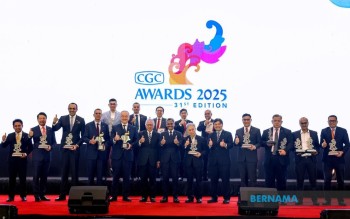
Malaysia's Credit Guarantee Corporation has recognised 32 outstanding achievements across its MSME and financial services sectors in the 31st iteration of its flagship awards programme, underscoring the pivotal role that enterprise resilience and inclusive growth play in the nation's economic development. The ceremony, held in Kuala Lumpur on August 11, brought together leading financial institutions, government bodies, and business leaders to celebrate firms and organisations that have demonstrated exceptional adaptability and commitment to supporting the country's entrepreneurial ecosystem.
CGC chairman Datuk Mohammed Hussein articulated a broader understanding of business resilience that extends well beyond traditional access to financing. Speaking during the ceremony, he emphasised that true resilience emerges from the character, discipline and strategic flexibility of enterprise owners themselves, with these human qualities often proving as critical as capital availability when businesses confront market shocks or operational disruptions. This perspective reflects growing recognition among Malaysian financial policymakers that sustainable MSME growth depends on multifaceted support systems rather than lending alone.
Hussein's remarks outlined a collaborative ecosystem model in which various stakeholders bear responsibility for enabling MSME success. He highlighted that government must establish a business-friendly regulatory environment, while research institutions should accelerate the translation of technological innovation into commercial viability. Large corporations can amplify their contribution by opening supply chains to smaller firms, creating procurement opportunities that drive growth throughout the economy. Financial institutions, in turn, must function as capital bridges that facilitate enterprise expansion and development, moving beyond conventional risk-averse lending practices.
The financial support CGC extended to Bumiputera enterprises demonstrates tangible commitment to inclusive growth objectives. During the past year, the corporation provided RM223 million in guarantees to 27 Bumiputera-owned companies, reflecting targeted efforts to ensure that Malaysia's enterprise development benefits reach entrepreneurs from indigenous communities. This targeted allocation sits within broader CGC operations and complements wider government initiatives aimed at narrowing wealth disparities and fostering equitable economic participation.
Environmental and social governance considerations have gained prominence in CGC's guarantee portfolio. The corporation channelled RM1.2 billion in sustainability-linked guarantees during the period under review, surpassing its initial RM1 billion target. This expansion signals that Malaysian financial institutions increasingly recognise climate transition investments and socially responsible business practices as integral to long-term competitiveness and risk mitigation, reflecting global trends toward sustainable enterprise models.
The awards distributed across multiple categories reflected the breadth of Malaysia's financial ecosystem. Alliance Bank Malaysia Bhd and CIMB Islamic Bank Bhd jointly secured the Best Financial Partner designation, acknowledging their substantial contributions to MSME financing and development. OCBC Al-Amin Bank Bhd earned recognition for its work with Bumiputera small enterprises, while Maybank Islamic Bhd received a special recognition award specifically honouring Bumiputera enterprise support. Public Bank Bhd and Alliance Bank Malaysia complemented these designations through Top Financial Institution Partner recognition, highlighting how conventional banking channels continue supporting MSME growth across Malaysia.
Islamic finance institutions claimed several award categories, demonstrating the expanding role of Shariah-compliant products in Malaysia's MSME financing landscape. CIMB Islamic Bank Bhd, OCBC Al-Amin Bank Bhd and Standard Chartered Saadiq Bhd collectively earned Top Financial Institution Partner awards in the Islamic banking category, while development financial institutions including Bank Simpanan Nasional and SME Development Bank Malaysia received separate recognition. Bank Simpanan Nasional additionally won the Top Financial Institution Partner award for the imSME platform, an increasingly important digital financing channel serving Malaysia's smaller enterprises.
The ceremony marked the formal launch of major new financing initiatives designed to fundamentally expand CGC's support capacity. The RM10 billion Bank Negara Malaysia-CGC Portfolio Guarantee and Portfolio Guarantee-i schemes represent a substantial infrastructure for risk-sharing between the central bank, CGC and participating financial institutions. These mechanisms aim to catalyse up to RM10 billion in guaranteed financing reaching an estimated 12,100 MSMEs across multiple economic sectors, a scale that could materially reshape MSME access to growth capital.
These portfolio guarantee schemes operate through a risk-sharing architecture that reduces uncertainty for financial institutions while improving approval odds for qualifying MSMEs. By distributing credit risk across the guarantee ecosystem, the schemes enable banks to extend financing to enterprises that might otherwise fall outside conventional lending parameters due to collateral constraints or limited credit histories. The initiative targets expansion, productivity improvements, sustainability transitions and overall competitive enhancement—objectives aligned with Malaysia's broader economic diversification ambitions.
CGC's strategic framework extending through 2030 emphasises deepening institutional impact on MSMEs while advancing financial inclusion alongside sustainable development imperatives. The corporation's emphasis on ecosystem collaboration reflects acknowledgment that MSME growth cannot succeed through guarantee mechanisms alone; rather, it requires integrated engagement across government bodies, financial partners, corporate supply chains and entrepreneurial communities themselves. For Malaysian businesses navigating increasingly complex operating environments, this coordinated approach may prove essential to maintaining momentum in an economy seeking to transition toward higher-value manufacturing and service sectors where MSME participation remains fundamental to success.

