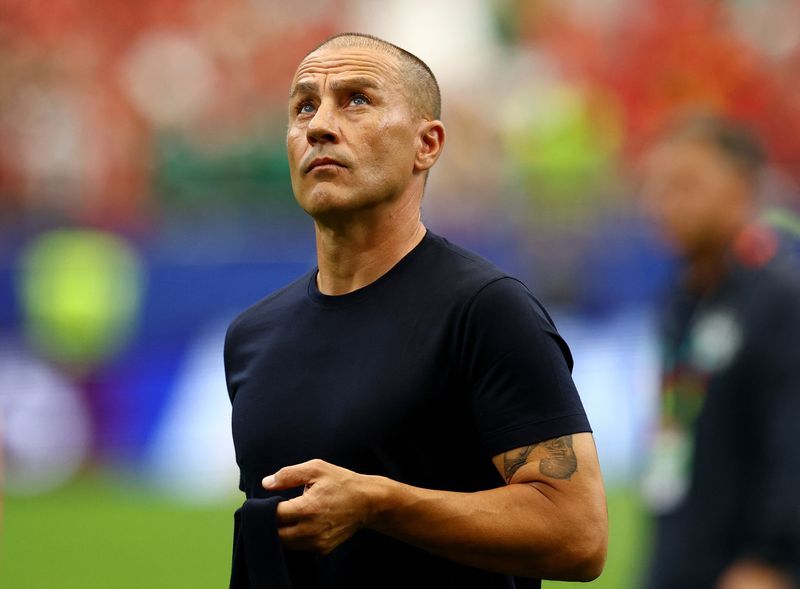
Uzbekistan's maiden World Cup campaign suffered a catastrophic setback in Houston when Portugal dismantled the Central Asian side 5-0 on Tuesday, leaving them teetering on the brink of early elimination from the tournament. Coach Fabio Cannavaro, the Italian maestro who lifted the World Cup trophy with his country in 2006, immediately stepped forward to absorb the responsibility for the lopsided scoreline, displaying the tactical maturity and leadership expected of a former World Cup winner. Yet despite the humiliation, Cannavaro struck a defiant tone, insisting his players remain capable of salvaging their campaign and that the harsh lesson could ultimately prove beneficial for a national team still finding its feet on football's grandest stage.
The mathematics of Uzbekistan's position grew increasingly bleak following the Portugal thrashing. Having already suffered a 3-1 defeat to Colombia in their opening match, the Central Asians now occupy the basement of Group K with no points and a goals-for tally that reads like a disaster scenario. A final group-stage clash against the Democratic Republic of Congo on Saturday represents their last lifeline to the round-of-16 stage, meaning victory becomes an absolute necessity rather than a desirable outcome. Even a win guarantees nothing, as they would still depend on other results to tip the balance in their favour. The mathematical path to progression remains theoretically possible but grows narrower by the hour, and Cannavaro's team must acknowledge the profound reality that failure to beat Congo would see them heading home after just three matches.
Speaking to assembled journalists after the defeat, Cannavaro demonstrated the accountability that defines experienced international football management. He rejected any suggestion that his players bore responsibility for the scoreline, instead pointing the finger directly at his own decision-making, tactical setup, and in-game adjustments. The former Parma, Real Madrid, and Juventus defender framed his assumption of blame as a matter of principle, noting that throughout his career—both as a player commanding defenders across Europe and now as a coach—he has consistently accepted responsibility for outcomes regardless of circumstances. This approach serves a deeper strategic purpose beyond mere politeness: by shielding his players from public criticism at such a vulnerable stage of their first World Cup, Cannavaro maintains confidence within the squad and preserves morale heading into their crucial final group game.
Cannavaro explicitly told journalists that any errors committed on the pitch stemmed from his tactical instructions rather than his players' execution. He explained that he had deliberately instructed his side to be adventurous, to embrace a courageous style of play rather than shrinking away in fear against superior opposition. In the context of a team making its World Cup debut against established continental powers, this philosophy carries particular weight. Cannavaro reasoned that accepting mistakes as part of the developmental process would help his players grow individually and collectively as they gain invaluable tournament experience. Such an approach reflects a longer-term vision that extends beyond any single match result, prioritising the cultivation of a national team culture that learns from adversity rather than becoming paralysed by it.
A critical turning point arrived mid-match when Uzbekistan's Azizjon Ganiev had what appeared to be a well-taken goal disallowed following a controversial foul decision in the lead-up to the strike. Cannavaro highlighted this moment as a psychological watershed, suggesting that the cancelled goal's impact reverberated through his team far more than the mere loss of a single point. Psychologically, such moments can break the resolve of players already facing an uphill battle against a superior opponent. The Uzbek side had been playing with the boldness and ambition that Cannavaro demanded, crafting attacking opportunities and demonstrating the kind of football that might have kept them competitive, when the disallowed goal effectively extinguished their flickering hopes and exposed them to Portugal's superior quality in the final half hour.
Comparable to their earlier performance against Colombia, Cannavaro observed that Uzbekistan had begun this Portugal encounter with genuine attacking intent and tactical discipline. Rather than retreating into defensive shells, his players were trying to implement a pressing system and create chances themselves. This approach contrasts sharply with how some international newcomers approach World Cup football, often choosing caution and containment over expression. Cannavaro's willingness to encourage such attacking football, even when facing Portugal's attacking prowess, demonstrates a coaching philosophy that values long-term team development over short-term damage control. Nevertheless, the execution ultimately fell short against world-class opposition, and the cumulative effect of conceding five goals in the second half proved both demoralising and ultimately decisive in shaping the match narrative.
Looking ahead to Saturday's encounter with the Democratic Republic of Congo, Cannavaro maintained that his players should not abandon their commitment to playing with courage and conviction. The instruction to maintain confidence and avoid becoming inhibited by fear represents his answer to preventing a total psychological collapse heading into their final group match. A team that loses not only matches but also its belief system becomes vulnerable to further heavy defeats, a scenario that could leave Uzbekistan eliminated and damaged for future World Cup campaigns. By insisting that his squad continue to attempt brave football and pursue victory against Congo with the same attacking philosophy that characterised their opening encounters, Cannavaro attempts to preserve the building blocks of a nascent football culture.
Uzbek football's participation in this World Cup represents a watershed moment for a nation with considerable potential but limited continental experience at football's pinnacle. Unlike established football nations that have developed generational knowledge of how to compete at World Cups, Uzbekistan enters largely as pioneers. This debut tournament, whatever the final outcome, will provide countless lessons that contribute to the development of the national team infrastructure. Cannavaro's framing of defeat as a learning opportunity rather than a catastrophe reflects the long-term perspective necessary when building a competitive international football programme in an emerging football nation. The experience gained by players and staff in this inaugural World Cup campaign, painful though it may be, could prove invaluable for future tournaments.
Cannavaro's insistence that mathematical elimination remains premature, despite the daunting circumstances, underscores the principle that international football rarely concludes until final calculations are complete. Group K outcomes depend not only on Uzbekistan's result but on Portugal and Colombia's meeting and the implications thereof. While the path to progression has narrowed substantially, claiming premature victory would be premature. Cannavaro's exhortation to his players to maintain belief until mathematics renders it impossible reflects both realistic optimism and the necessity of preventing total squad collapse. For Malaysian observers and Southeast Asian football followers more broadly, Uzbekistan's struggle illustrates the competitive gulf between established football nations and those attempting to build competitive programmes in an increasingly globalised and professionalized sport.