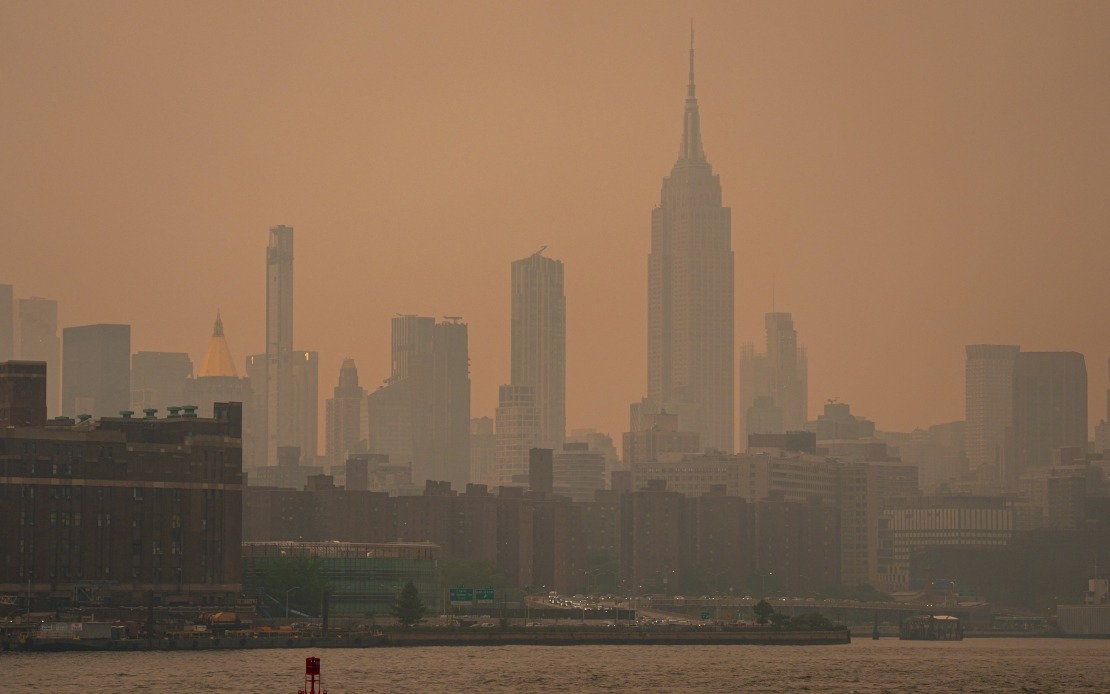
Mexican President Claudia Sheinbaum experienced significant travel complications en route to Sunday's Argentina-Spain World Cup final in East Rutherford, New Jersey, when deteriorating air quality from Canadian wildfires forced the cancellation of her commercial flight from Cancún. The scheduled two-hour delay on Saturday ultimately became a full cancellation, forcing the Mexican government to arrange alternative transport to ensure the president could still attend the prestigious sporting event as originally planned.
The smoke blanketing New York stems from ongoing wildfires across Canada that have created hazardous air quality conditions throughout the northeastern United States. These environmental disruptions underscore the cross-border impact of North American environmental challenges, affecting not only civilian populations but also high-level government travel. The incident highlights how natural disasters can create unexpected complications for diplomatic schedules and international commitments, particularly when weather conditions deteriorate rapidly and unexpectedly.
Confronted with the cancellation, Mexico's government pivoted to deploying an aircraft operated by the Defence Ministry to transport Sheinbaum overnight into Sunday. This alternative arrangement ensured the president could fulfil her commitment to attend the World Cup final, demonstrating the logistical capabilities available to senior government officials when commercial options become unavailable. The use of military aircraft represents a significant commitment of resources to maintain diplomatic presence at the international event.
Sheinbaum's attendance at the World Cup final carries particular diplomatic weight given that the tournament is hosted jointly by Mexico, the United States, and Canada. Her presence alongside U.S. President Donald Trump and Canadian Prime Minister Mark Carney represents a unified show of support from the three host nations for the competition's flagship match. The final brings together the leadership of all three nations in a rare collaborative display at a major international sporting event.
The invitation from Trump to attend the final underscores an interesting diplomatic gesture, particularly given the complex relationship between Mexico and the United States. Trade disputes and security concerns have dominated bilateral conversations between the two countries in recent years, creating considerable tension in the relationship. Despite these underlying frictions, both leaders recognised the symbolic importance of attending the World Cup final together, demonstrating that sporting events can sometimes transcend political disagreements and create space for diplomatic engagement.
For Malaysian and Southeast Asian readers, this situation illustrates how global sporting events like the World Cup function as important diplomatic platforms where leaders can signal cooperation and commitment to international partnerships. The tournament's expansion to include three nations makes it a unique case study in multilateral collaboration on major infrastructure and security projects. The successful coordination among Mexico, the United States, and Canada to deliver the World Cup represents a significant logistical and political achievement, despite occasional complications like those experienced with Sheinbaum's travel.
Sheinbaum's previous interaction with Trump occurred during the World Cup draw in Washington last December, marking their sole meeting related to the tournament prior to the final. This limited engagement between the two leaders reflects both the compressed timeframe of World Cup preparations and the somewhat fractious nature of current U.S.-Mexico relations. The final represents an opportunity for both leaders to reset messaging about the bilateral relationship within the context of celebrating a successful continental sporting event.
The Canadian wildfire situation affecting travel also underscores broader North American environmental challenges that transcend borders and national jurisdictions. Air quality issues originating in Canada have directly impacted operations in the United States, demonstrating the interconnected nature of environmental problems in the region. For Southeast Asian nations experiencing similar transboundary air pollution challenges from regional forest fires, the Mexican-U.S. experience offers a parallel example of how environmental crises can disrupt daily operations, including high-level government functions.
Despite the travel complications, Sheinbaum's successful arrival for the World Cup final maintains Mexico's role as an equal participant in the tournament's leadership structure. The incident, while inconvenient, ultimately proved manageable through the application of government resources and alternative logistical solutions. Her presence at the final ensures that all three host nations maintain symbolic representation at the competition's climax, reinforcing the trilateral nature of the tournament's hosting arrangement and the commitment of all three countries to its success.

