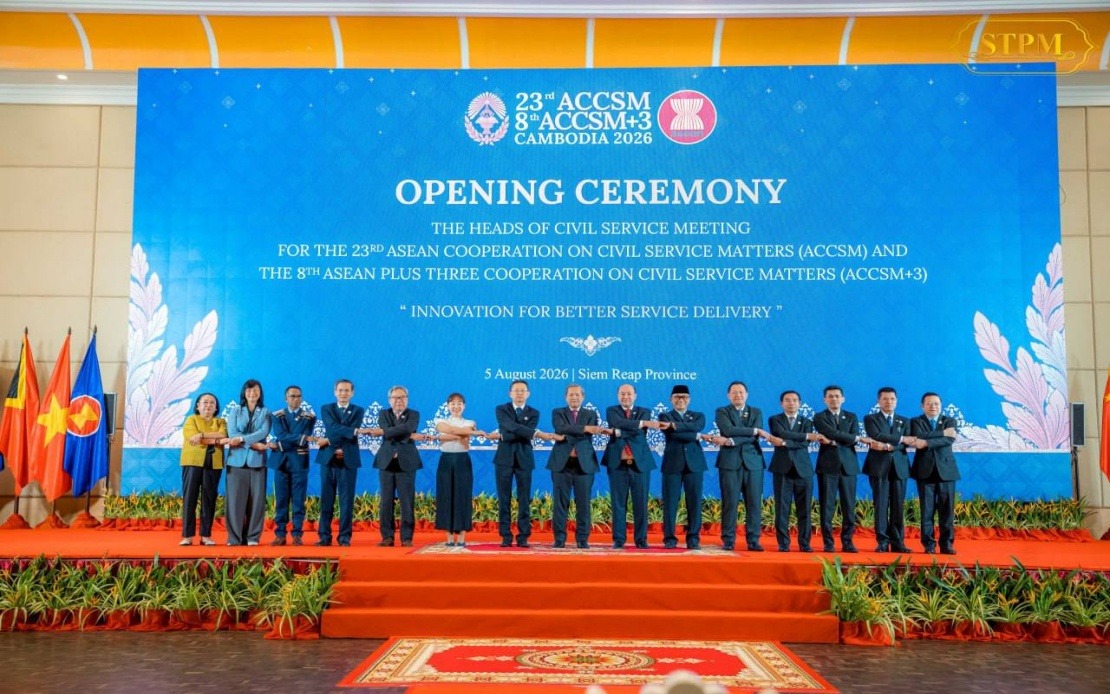
Cambodian Prime Minister Hun Manet has called upon ASEAN nations to strategically leverage artificial intelligence and digital innovation as tools for delivering improved public services while ensuring that technological advancement benefits all citizens and reduces the development disparities that characterize the region. Speaking at a high-level regional gathering in Siem Reap, Hun Manet emphasised that the region's approach to modernisation must be grounded in pragmatic understanding of citizens' genuine requirements rather than treating digital transformation as an end in itself.
The remarks, delivered at the joint 23rd ASEAN Cooperation on Civil Service Matters and 8th ASEAN Plus Three Cooperation on Civil Service Matters conference held from August 3 to 5, underscore a growing consensus among Southeast Asian governments that technological adoption must serve human-centred outcomes. The conference theme, "Innovation for Better Service Delivery," reflected a deliberate pivot away from technology-first thinking towards mechanisms that measure success by improvements in how citizens interact with and benefit from government services.
Hun Manet stressed that sustainable innovation requires foundational investments in institutional capacity and workforce development before nations rush to implement advanced technologies like artificial intelligence. This perspective carries significant weight in a region where member states operate at vastly different stages of digital maturity and economic development. Malaysia, Vietnam and Thailand have made substantial investments in digital infrastructure, while other nations remain in earlier phases of technological integration, creating a spectrum of readiness that demands differentiated approaches.
The Cambodian leader's insistence on tailoring AI adoption to each nation's capacity reflects practical experience with failed technology transfer projects across Southeast Asia, where expensive systems installed without adequate training or institutional support have languished underutilised. By advocating for sustainable pacing rather than uniform acceleration, Hun Manet essentially proposed that ASEAN avoid the trap of competitive pressure that often leads developing nations to adopt technologies prematurely, incurring costs without corresponding benefits.
Beyond administrative efficiency, Hun Manet positioned innovation as essential infrastructure for addressing region-wide challenges that transcend national borders. Climate-related disasters, including devastating floods and typhoons that regularly affect multiple nations simultaneously, require coordinated responses that public sectors are often ill-equipped to manage with legacy systems. Economic disparities between advanced manufacturing hubs and agrarian economies create pressures that only collaborative problem-solving can adequately address, while poverty persists in pockets throughout the region despite decades of growth.
The prime minister's emphasis on knowledge-sharing platforms represents recognition that ASEAN's strength lies in collective learning rather than individual nation competition. The ACCSM mechanism, which brings together civil service leaders from across the region, provides infrastructure for peer learning and policy harmonisation that can prevent costly duplication of effort and mistakes. By strengthening this platform, member states can share lessons learned from both successful implementations and cautionary tales of technology adoption that failed to achieve intended outcomes.
For Malaysia specifically, Hun Manet's framing offers useful perspective as the country navigates its own digital transformation agenda. While Malaysia has positioned itself as a regional technology hub, the Cambodian perspective on inclusive innovation serves as a reminder that domestic inequality demands attention alongside technological advancement. AI-powered government services, if poorly designed, risk creating new tiers of digital haves and have-nots, potentially deepening divides between urban populations with reliable internet access and rural communities with intermittent connectivity.
The conference outcomes carry implications for how ASEAN member states approach upcoming infrastructure investments and policy frameworks governing AI deployment in government. Harmonisation of standards and ethical guidelines across borders can prevent a race to the bottom where nations sacrifice citizen protections in pursuit of technological modernity. Regional cooperation on AI training programmes could create shared learning resources that reduce individual nation burden while building collective capacity.
Hun Manet's call for innovation to strengthen collective resilience acknowledges that Southeast Asia faces interconnected challenges requiring regional response. A pandemic in one nation rapidly affects all others; climate disasters in one country create refugee pressures and economic disruption across borders; technological disruption in manufacturing hubs reverberates through supply chains spanning the entire region. Public services designed in isolation prove inadequate for these realities, whereas coordinated approaches allowing real-time information sharing and resource mobilisation can generate faster, more effective responses.
The framing also reflects broader shifts in how development economists and governance specialists increasingly understand technology's role in improving lives. Rather than assuming that advanced technology automatically generates positive outcomes, contemporary thinking emphasises that implementation context, user training, institutional integration, and alignment with actual citizen needs determine whether innovations succeed or become expensive ornaments to existing systems. ASEAN's diversity makes this lesson particularly acute, as one-size-fits-all solutions have repeatedly failed across the region.
Moving forward, the challenge for ASEAN member states involves translating these aspirational calls into concrete mechanisms that actually shape technology procurement, staff training programmes and policy development. Individual nations often face pressure from technology vendors, international development agencies and regional competitors to adopt innovations rapidly, creating institutional momentum that can overwhelm deliberative processes. Strong regional frameworks providing legitimacy for measured approaches could help governments resist such pressures while maintaining credibility with constituents expecting modern services.
The conference's emphasis on civil service capacity development also signals recognition that technology remains merely a tool requiring skilled human operators and thoughtful governance structures. Across ASEAN, many government agencies struggle with recruitment and retention of digitally-literate staff, particularly in rural outposts where salaries cannot compete with private sector opportunities. Regional cooperation on developing training curricula and career pathways could address these human resource constraints that often prove more limiting than technology availability itself.
Ultimately, Hun Manet's vision for people-centred, innovation-driven public services reflects matured thinking about development trajectories. ASEAN nations have largely moved past debates about whether to embrace technology, instead focusing on how to do so in ways that strengthen rather than undermine social cohesion, reduce rather than perpetuate inequality, and build rather than erode public trust in institutions. Success in this endeavour will significantly influence whether the region's next decade of technological change translates into broadly shared prosperity or concentrates benefits among already-advantaged populations.

