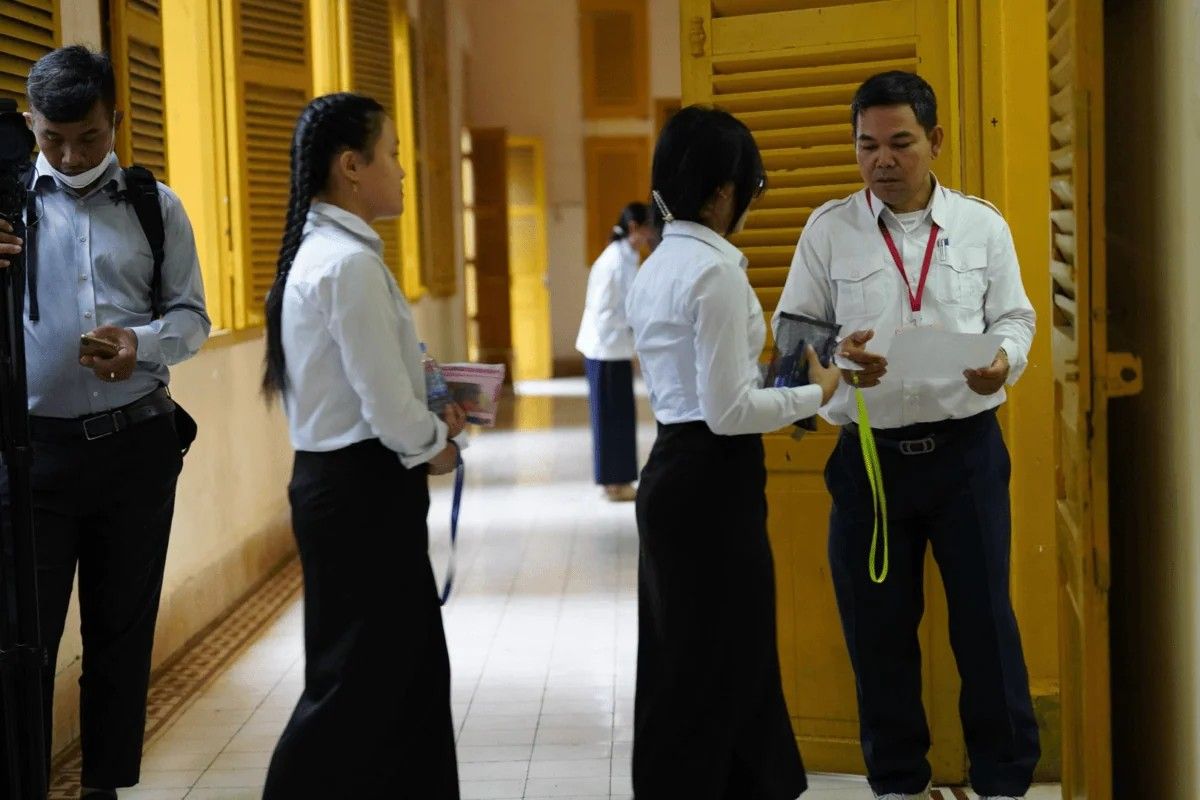
Cambodia's Grade 12 examination season has opened with over 150,000 candidates across the kingdom sitting their final secondary school assessments, though the shadow of ongoing territorial disputes continues to disrupt education in vulnerable border regions. The exams, which began on August 10, represent a return to more stable testing conditions compared to the previous year's chaotic administration, which coincided with the onset of armed hostilities between Cambodian and Thai forces. Education Minister Hang Chuon Naron presided over the opening ceremony in Phnom Penh, using the occasion to highlight both the progress made in restoring normal academic life and the persistent displacement affecting thousands of border students.
The examination administration will stretch across numerous centres throughout Cambodia, accommodating students across two distinct academic streams. Science track candidates number over 37,000, while the social science cohort exceeds 130,000, reflecting the significantly larger enrollment in humanities-based programmes typical across Southeast Asian secondary education systems. These figures underscore the scale of Cambodia's educational apparatus and the substantial logistical undertaking required to coordinate simultaneous assessments across a geographically dispersed student population. The organisational effort represents a major commitment by the Ministry of Education, Youth and Sport to maintain examination integrity and accessibility despite ongoing regional tensions.
The contrast between this year's examination environment and last year's turbulent conditions illustrates the profound impact of the Cambodia-Thailand border crisis on education. The 2025 exams took place precisely one month after the initial armed clashes erupted along the shared frontier, creating an atmosphere of uncertainty and anxiety among both students and educators. Minister Hang Chuon Naron specifically referenced the extraordinary resilience demonstrated by students in conflict zones, recounting an anecdote of a student from Oddar Meanchey province who studied from tractors whilst his family fled the violence, yet subsequently achieved top grades and gained admission to a prestigious higher education institution. Such accounts underline how educational aspirations persist even under extreme duress, though they equally highlight the profound inequity between students studying in secure environments and those navigating conflict zones.
The territorial occupation of schools continues to represent one of the most direct impediments to educational access in affected provinces. Twenty-five schools across Cambodia's border regions remain closed and inaccessible to students because Thai military forces currently occupy these facilities, a consequence of last year's military incursions. This ongoing occupation deprives thousands of students of their regular educational environment and creates logistical challenges for both school administrations attempting to maintain continuity and families seeking to ensure their children receive formal instruction. The forced displacement from established learning spaces disrupts not merely curriculum delivery but also the social and institutional infrastructure that schools provide to rural communities.
Oddar Meanchey province has emerged as one of the most severely affected regions, with students displaced from their schools bearing the burden of educational disruption most acutely. The Minister noted that students from Banteay Mean Rith Lower Secondary School currently attend classes in temporary camps rather than their original facility, a makeshift arrangement that remains inferior to proper educational infrastructure. This temporary provision, while representing an attempt to maintain some continuity of instruction, fundamentally alters the learning experience and places additional stress on already displaced families. The Cambodian government has formally demanded that Thai forces permit students to return to their original classrooms, framing educational access as a sovereignty and human rights issue rather than a purely administrative matter.
Beyond territorial complications, the Ministry has implemented comprehensive anti-corruption measures designed to prevent the examination irregularities that marred the previous year's administration. The leakage of mathematics examination papers during the 2025 exams represented a serious breach that undermined assessment credibility and raised questions about the integrity of academic evaluation. In response, the Anti-Corruption Unit has deployed more than 4,000 observers tasked with monitoring examination administration across all centres, matching the deployment levels from the previous year. This substantial observer presence aims to deter misconduct through visible oversight and comprehensive documentation of examination procedures, though the effectiveness of such measures depends equally on institutional commitment to enforcing consequences for detected violations.
The restoration of a more relaxed examination atmosphere this year reflects not merely the absence of immediate military conflict but also the psychological significance of stable examination conditions for student performance. When examinations occur amidst active military tension and civilian displacement, students experience heightened anxiety that inevitably affects concentration and cognitive function. The Minister's optimism about calmer conditions this year suggests that while the underlying territorial disputes remain unresolved, the immediate security situation has stabilised sufficiently to permit more normal educational operations. However, this relative improvement masks the continued suffering of border communities whose schools and educational infrastructure remain under foreign military control.
For Malaysian readers and broader Southeast Asian observers, Cambodia's examination crisis illustrates how regional disputes directly harm educational access and opportunity, particularly for vulnerable populations in border regions. The closure of twenty-five schools through military occupation represents a form of indirect educational deprivation that extends conflict impacts beyond direct violence into systemic disruption of development services. Cambodia's situation serves as a reminder of how border tensions that might appear as distant political matters in capital cities translate into profound disruptions to the lives of rural students and families. The examination irregularities that necessitated enhanced anti-corruption measures also highlight governance challenges that afflict regional educational systems more broadly.
The examination season ahead will test not only Cambodia's students but also its institutional capacity to deliver credible academic assessment whilst navigating unresolved territorial disputes. Success requires simultaneous achievement of three objectives: maintaining examination security and integrity, ensuring equitable access across all provinces, and upholding the legitimacy of final assessments that determine university admission and future educational pathways. The 150,000 students sitting these exams carry not merely personal educational aspirations but also national significance as they represent Cambodia's emerging generation of educated professionals. Their successful navigation of both academic content and the logistical challenges imposed by ongoing territorial occupation will demonstrate the resilience of Cambodia's educational system.

