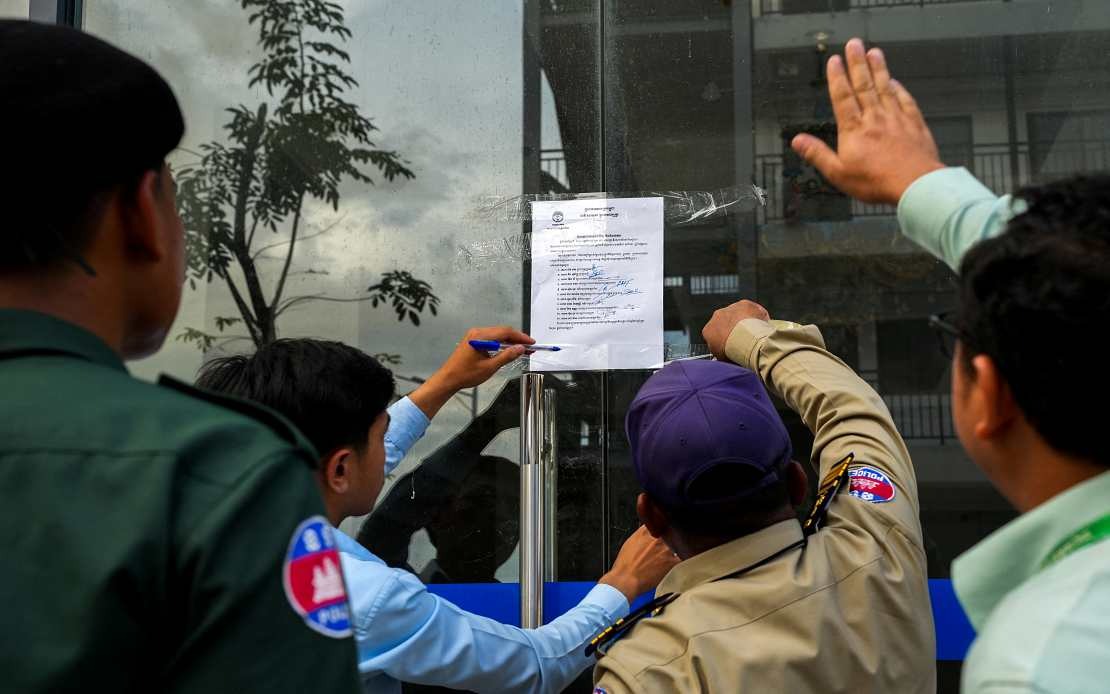
Cambodia has dramatically escalated its battle against organised cybercrime, expelling more than 16,000 foreign nationals suspected of operating online fraud schemes during the opening six months of 2026. The deportations form part of a broader immigration enforcement sweep that saw the kingdom remove over 45,000 foreigners altogether, signalling the government's determination to dismantle what has become an entrenched criminal ecosystem operating from Cambodian territory. Police Lieutenant General Sok Veasna, who heads the General Department of Immigration, announced the figures at a mid-year review meeting on Tuesday, emphasising that the intensification of operations against cyber-fraud networks has been sustained since January.
The scale of Cambodia's crackdown reflects the severity of the cybercrime problem that has drawn international scrutiny and damaged the nation's diplomatic standing. For years, cybercriminal networks orchestrating romance scams, investment fraud, and call-centre operations have used Cambodia as a base, targeting vulnerable victims across Asia and beyond. The sheer volume of suspected scammers apprehended—16,000 in just six months—demonstrates the enormous scale of these operations and the logistical challenge they pose to regional law enforcement. Veasna's announcement underscores the government's shift toward more aggressive enforcement, moving beyond sporadic raids to a sustained systematic campaign.
A key deterrent measure adopted by Cambodian authorities is the permanent ban on re-entry imposed on all deported individuals. This approach aims to prevent repeat offenders from simply returning to Cambodia and resuming criminal activity, a common problem in regions where deportation carries limited consequences. The permanence of such bans sends a signal that the kingdom will not tolerate serial involvement in cybercrime. However, experts caution that such measures, while visible and politically valuable, may prove insufficient without deeper structural reforms targeting the networks that harbour and protect these criminals.
Thong Mengdavid, deputy director at the China-ASEAN Studies Centre of the Cambodia University of Technology and Science, has publicly acknowledged the diplomatic value of the deportation campaign whilst warning of its limitations. He characterises the mass removals as a necessary but incomplete response to a multifaceted criminal problem. From his perspective, visible enforcement actions serve an important purpose in rehabilitating Cambodia's international reputation, which has suffered considerably due to persistent reports of cybercriminal sanctuaries operating within its borders. The deportations demonstrate to the international community that the government is taking the issue seriously and acting decisively.
Yet Mengdavid identifies a critical flaw in relying solely on deportations: the underlying infrastructure enabling these operations remains intact. The truly powerful actors in cybercriminal networks are rarely the individual scammers engaged in day-to-day fraud operations. Instead, kingpins operating at higher levels orchestrate activities, manage finances, and negotiate with accomplices in other jurisdictions. More troublingly, local protection networks—involving police officers, local officials, and other gatekeepers with access to state power—enable these criminal enterprises to operate with relative impunity. Without dismantling these protective layers, deportations of rank-and-file operatives may simply create vacancies that are quickly filled by replacements.
The connection between cybercrime networks and human trafficking further complicates Cambodia's enforcement challenge. Many individuals involved in cyber-scam operations are themselves victims of trafficking, coerced into joining criminal enterprises through debt bondage, threats, or deception about employment opportunities. They arrive in Cambodia believing they will work legitimate jobs, only to find themselves imprisoned in compounds and forced to participate in fraud schemes under threat of violence. Addressing cybercrime therefore cannot be separated from tackling human trafficking, a far more complex problem requiring international cooperation, victim assistance programmes, and capacity-building among local law enforcement.
Cambodia's legislative framework has recently strengthened with the April promulgation of the Law on Combating Online Scams, which establishes enhanced penalties for organisers and ringleaders of cybercriminal networks. The law represents a significant escalation in legal consequences, moving beyond generic fraud statutes to create specific offences targeting the orchestrators of large-scale online schemes. This legislative step signals an attempt to target higher-level criminals rather than merely street-level operatives. However, criminal codes are only effective when consistently enforced and when prosecutors have adequate resources and political will to pursue senior figures rather than settling for easier convictions of lower-ranking suspects.
The regional implications of Cambodia's crackdown extend well beyond its borders. Southeast Asia as a whole faces mounting pressure from cybercriminal networks that exploit porous borders, varied law enforcement capacities, and corruption to operate across multiple jurisdictions. Cambodia's struggle with cybercrime is emblematic of broader regional challenges. The Philippines, Thailand, and Myanmar have similarly grappled with large-scale scam operations. Malaysia, as a developed economy and financial hub, remains a target for these networks and has experienced significant losses to its citizens from cyber-fraud originating elsewhere in the region. Successful action in Cambodia thus carries implications for neighbouring nations' security.
International cooperation has become essential to disrupting these networks effectively. Cybercriminals operate transnationally, often with members distributed across several countries, victim targeting spanning multiple jurisdictions, and financial flows routed through complex offshore mechanisms. Individual nations acting alone, even with stringent laws and energetic enforcement, cannot fully contain such networks. Cambodia's deportations are most effective when coordinated with destination countries willing to prosecute their own nationals upon return and to support information-sharing that helps identify network structures and financial pathways.
The challenge of addressing corruption within Cambodia's own institutions remains perhaps the most intractable element of the problem. If police officers, immigration officials, and local administrators are complicit in protecting cybercriminal operations—either through active facilitation or deliberate negligence—enforcement actions targeting foreign suspects will have limited impact on network viability. Meaningful progress requires institutional reforms, internal accountability mechanisms, and potentially international oversight or capacity-building assistance. These measures are politically sensitive and operationally demanding, which may explain why visible deportations have taken priority over less publicly dramatic reforms.
Cambodia's government has framed the crackdown as essential to maintaining public safety and restoring the kingdom's international standing. The reputational damage from harbouring cybercriminal networks has been substantial, affecting investment decisions, tourism flows, and diplomatic relations. Visible enforcement action addresses these concerns directly. Yet the sustainability of improvements depends on whether the underlying drivers of cybercrime—corruption, weak institutional capacity, poverty creating vulnerability to recruitment, and transnational criminal networks—are genuinely tackled or merely managed through periodic enforcement surges.
Moving forward, stakeholders in Cambodia and throughout Southeast Asia must balance the symbolic importance of high-profile deportations with investment in the institutional, legal, and international mechanisms required to dismantle cybercriminal networks at their roots. The first half of 2026 has demonstrated Cambodia's capacity to execute enforcement operations at scale. The next phase of this campaign will reveal whether such capacity translates into sustainable disruption of organised cybercrime or merely creates a rotating door through which suspects are periodically expelled before returning or being replaced by others.

