Cambodia's Minister of Information Neth Pheaktra has escalated pressure on Thailand by invoking independent witnesses to the territorial dispute, claiming that Asean observers, foreign diplomats and UN representatives have now documented evidence that contradicts Bangkok's categorical denials of encroachment. The intervention by external monitors represents a tactical shift in how Cambodia frames the long-running boundary conflict, moving beyond bilateral accusations to present what it characterises as objective verification of facts on the ground. Pheaktra made his remarks on Monday following Air Chief Marshal Prapas Sornchaidee, who heads Thailand's Joint Information Center, explicitly rejecting Cambodian allegations that Thai forces are expanding military infrastructure, constructing roads and establishing fortifications inside Cambodian territory.
Thailand's position hinges on the assertion that it maintains no policy of territorial invasion or occupation, and that its military and security operations exist solely to protect Thai troops, civilians and what Bangkok considers its legitimate sovereign territory. Prapas further contended that the physical presence of military personnel and installations cannot in themselves establish international boundaries, and that territorial matters should instead be resolved through formal legal channels, historical maps, technical evidence and the Joint Boundary Commission. Notably, this invocation of legal and technical mechanisms for boundary determination aligns with Cambodia's own longstanding insistence that sovereignty must be established through agreed instruments rather than military control or the creation of physical facts on the ground. Despite this shared rhetorical agreement on principles, the two nations remain fundamentally divided over whether the current military activities constitute legitimate sovereign protection or unlawful territorial expansion.
Pheaktra seized on this principle to reframe the dispute as no longer a matter of competing narratives between two adversaries. He argued that the introduction of external monitors and observers has fundamentally altered the nature of the disagreement, stripping away Cambodia's historical disadvantage in having to rely solely on its own claims and documentation. The physical evidence he highlighted—shipping containers, razor wire barriers and other infrastructure installed in areas Cambodia claims as its own—can now be inspected, photographed and verified by parties without a stake in either nation's territorial claims. This shift toward third-party observation represents Cambodia's attempt to depoliticise the dispute by anchoring it in verifiable facts rather than official statements, making it increasingly difficult for Thailand to dismiss concerns as propaganda or unsubstantiated allegations.
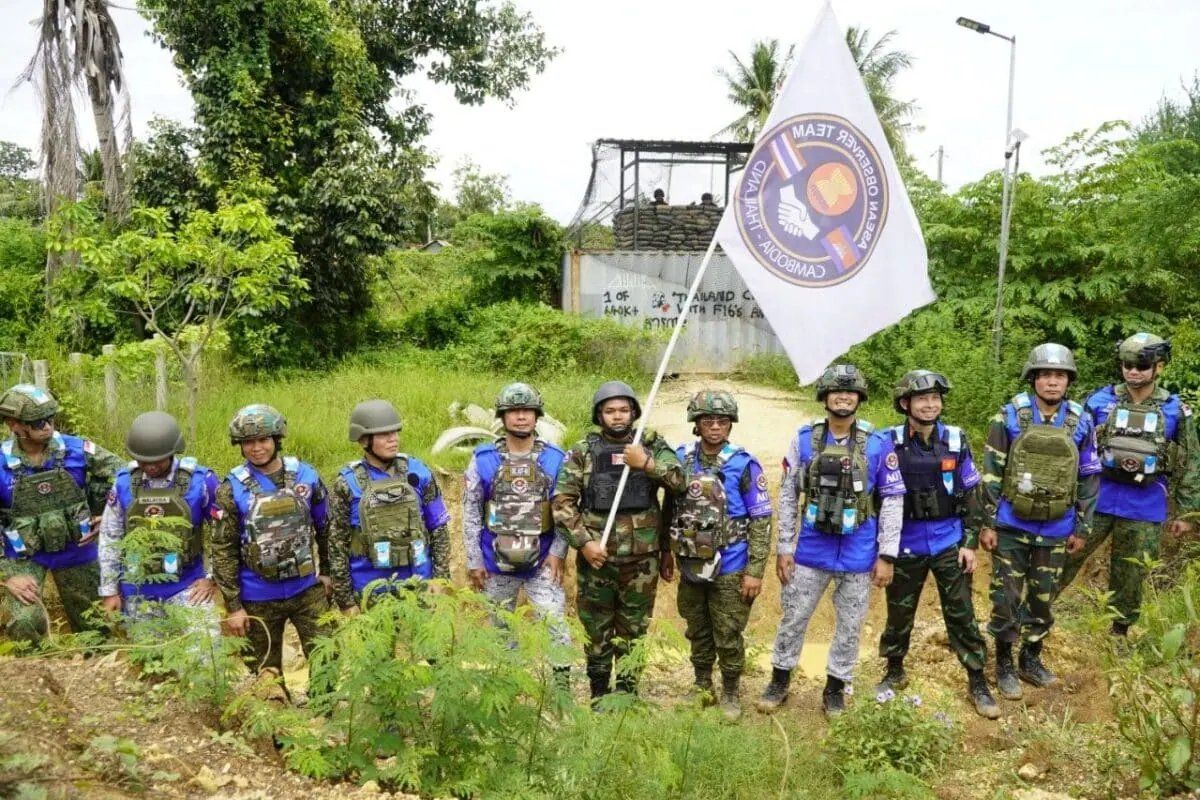
The Asean Observer Team in Cambodia, operating under Philippine leadership, has recently conducted inspections of three separate locations in Banteay Meanchey province where Cambodia asserts its citizens have been displaced. At Boeung Trakuon in Kouk Romiet commune, the observers documented 44 shipping containers positioned across 14 separate sites, with Cambodia reporting that over 7,800 residents from nearly 1,900 families, including almost 1,850 children, remain unable to return to their homes. The inspections at Chouk Chey and Prey Chan villages added another 72 containers across 10 locations to the documented count. Collectively, the three surveyed areas contain 116 containers distributed across 24 locations, and Cambodia maintains that more than 13,000 individuals, including over 3,400 children, have been unable to access their homes in these regions. These figures, if accurate, represent a significant humanitarian dimension to what both sides frame primarily as a sovereignty question.
Pheaktra leveraged the Asean observations to underline a crucial distinction: these are no longer assertions made unilaterally by Cambodian authorities but documented findings by multilateral observers with mandates to verify conditions independently. He emphasised that diplomatic representatives from various nations have personally visited the affected areas and witnessed the containers and barriers in place, transforming what might otherwise be dismissed as propaganda into a matter of record observable by international stakeholders. This expansion of the evidentiary base gives Cambodia leverage in international forums, as the dispute becomes increasingly difficult to characterise as a one-sided complaint without credible foundation. The observation effort therefore serves Cambodia's interest in internationalising the dispute and preventing Thailand from managing it through bilateral channels where Thai diplomatic and economic leverage might be greater.
Cambodia has also drawn on observations from Tom Andrews, the UN Special Rapporteur on the situation of human rights in Cambodia, who visited displaced communities and the border region during his July mission. Andrews subsequently reported that while approximately 650,000 Cambodians were displaced during the broader conflict, more than 20,000 individuals remain unable to return to their homes, with the residents he met attributing this inability to occupation by Thai security forces. His focus on the human rights dimension—particularly the inability of affected civilians to return safely to their communities—adds a humanitarian dimension to Cambodia's claims that extends beyond questions of legal sovereignty. By framing the issue through the lens of displaced persons unable to access their homes and property, Cambodia attempts to activate international human rights mechanisms and norms that transcend traditional boundary disputes.
Yet Pheaktra's reliance on third-party observation carries inherent limitations that both Thailand and informed observers recognise. The Asean Observer Team's mandate is confined to verifying ceasefire conditions, not determining territorial sovereignty or adjudicating boundary disputes. Similarly, Andrews' expertise and mandate concern human rights rather than international law governing state boundaries. Neither observation regime possesses the authority or mandate to make binding determinations regarding which nation holds legitimate sovereignty over contested areas. This distinction means that while third-party verification may document physical conditions—the presence of containers, barriers and troops—such observations cannot in themselves resolve the underlying legal question of where the legitimate international boundary lies. Thailand can therefore acknowledge the observed facts while maintaining that these observations are consistent with legitimate sovereign protection activities.
Pheaktra nonetheless sought to establish a clear distinction between legitimate border protection and what he characterised as the creation of new territorial facts through military installation. He employed a series of direct declarative statements—shipping containers are not border markers, barbed wire is not a treaty, trenches are not boundary maps, planted flags are not title deeds—to argue that physical occupation cannot substitute for legal sovereignty. This rhetorical approach attempts to delegitimise Thailand's implicit argument that military control establishes effective sovereignty. Cambodia grounds its own claim on what it characterises as established legal foundations: the Franco-Siamese treaties and conventions, historical maps and boundary documents, the 2000 Cambodia-Thailand border memorandum of understanding, the 2003 Terms of Reference governing boundary work, and the ongoing Joint Boundary Commission process.
Thailand's response, delivered through Prapas, maintains that neither country can unilaterally establish sovereignty through public declarations, and that Thailand will continue protecting what it considers its legitimate territory regardless of Cambodian protests or international observation. Prapas emphasised that Thailand would not halt security measures simply because Cambodia demanded their cessation. This impasse reflects a deeper disagreement over the factual baseline: Thailand asserts it is conducting legitimate protective operations within its own territory, while Cambodia contends that these operations represent the progressive occupation of Cambodian land under the guise of security requirements. The dispute thus presents a classic problem in international relations where military control on the ground and legal claims to territory diverge sharply.
Cambodia has additionally linked the territorial issue to humanitarian obligations under the December 27 ceasefire agreement, specifically Point 4, which commits both parties to enabling affected civilians to return to their homes on their respective sides without obstruction and in conditions of safety and dignity. For Pheaktra, the thousands of Cambodian residents still unable to return behind containers and barriers constitute physical evidence that the post-conflict situation remains fundamentally unresolved. He argued that the ceasefire agreement does not grant either party licence to create new facts on the ground or to use security justifications to permanently alter territorial control. This framing transforms the boundary dispute into a question of ceasefire compliance and humanitarian obligation, potentially opening different diplomatic or accountability channels than those available through traditional boundary commission processes.
The dispute's trajectory suggests that Cambodia is pursuing a multifaceted strategy: invoking international observation to internationalise the issue, appealing to human rights and humanitarian norms to activate alternative accountability mechanisms, grounding claims in historical legal instruments to establish a legal foundation, and linking territorial questions to ceasefire implementation to leverage regional security frameworks. Thailand, meanwhile, maintains that security requirements within its own territory justify the measures in question and that international observation does not alter Thailand's prerogatives as a sovereign state. For Malaysia and other Southeast Asian neighbours, the intensifying dispute underscores risks inherent in unresolved boundary issues, the potential for humanitarian displacement, and the importance of regional mechanisms like Asean and the Joint Boundary Commission in managing conflicts before they escalate further.

