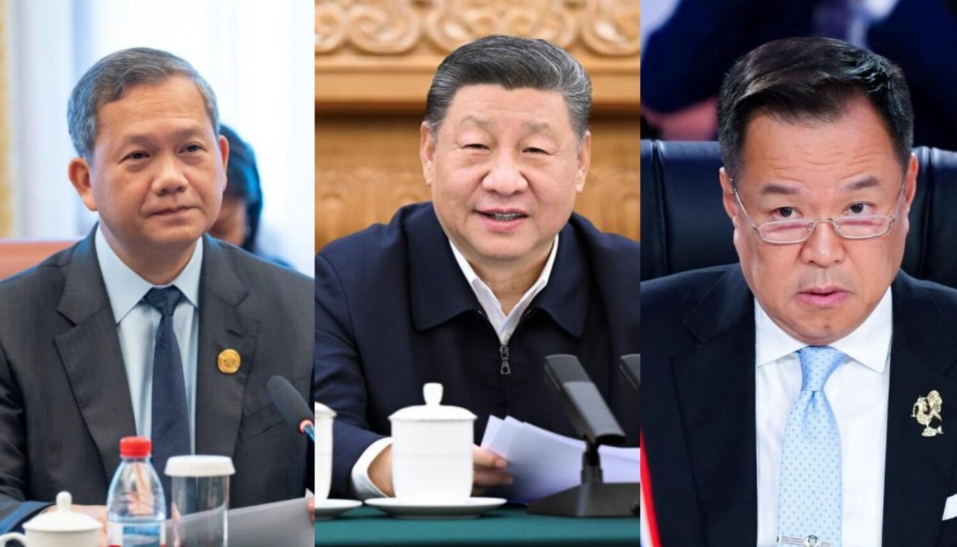
The leaders of Cambodia and Thailand are travelling to Shanghai this month to participate in the World AI Conference 2026, creating fresh opportunity for dialogue on their long-standing maritime and territorial disputes. Prime Minister Hun Manet of Cambodia and his Thai counterpart Anutin Chanvirakul have both received invitations from Chinese President Xi Jinping to attend the conference opening on July 17. Both premiers are expected to hold individual meetings with Xi and Chinese Premier Li Qiang during what promises to be a significant diplomatic occasion in China's calendar.
Hun Manet's delegation will arrive in Shanghai on July 15 and depart on July 17, accompanied by Foreign Minister Prak Sokhonn, Defence Minister Tea Seiha, and Sun Chanthol, first vice-chairman of the Council for the Development of Cambodia. Anutin's entourage is expected to include Thai Foreign Minister Sihasak Phuangketkeow. The composition of both delegations—notably the inclusion of defence and foreign ministry officials on the Cambodian side—suggests that substantive strategic discussions are anticipated beyond ceremonial attendance at the technology conference.
Cambodia's foreign ministry has framed the visit as an opportunity to deepen bilateral ties with China, emphasizing the advancement of the Comprehensive Strategic Partnership of Cooperation and the Diamond Cooperation Framework. The statement spoke of building an all-weather Cambodia-China Community with a Shared Future in what Beijing calls the new era of international relations. Thailand's foreign ministry echoed similar language about strengthening the Thailand-China Comprehensive Strategic Cooperative Partnership, underscoring how both nations view engagement with Beijing as central to their respective strategic positioning in the region.
The Shanghai meeting takes place roughly eighteen months after the two premiers last sat down for formal negotiations. Their most recent substantive engagement occurred in December, when discussions stalled without significant progress toward resolving the territorial disputes that have festered for decades. Since then, the two countries have engaged in limited diplomatic contact, with their only notable interaction being a handshake for cameras during the Asean Future Forum held in Hanoi in early June. That encounter, while symbolically important for regional unity, produced no concrete movement on the border issues affecting both nations.
Observers of Southeast Asian affairs are now watching closely to determine whether China will use its considerable economic and diplomatic leverage to push both neighbours toward a negotiated settlement. As a dominant trading partner for both Cambodia and Thailand, Beijing possesses substantial influence over the foreign policy calculations of each nation. The convergence of both leaders in Shanghai, coupled with their scheduled meetings with top Chinese officials, creates an ideal environment for Beijing to mediate or encourage progress on outstanding disputes.
However, analysts cautioning against excessive optimism point to structural obstacles that transcend diplomatic niceties and bilateral posturing. Kin Phea, director of the International Relations Institute at Cambodia's Royal Academy, has identified the Thai military establishment as a critical barrier to resolution. According to Phea, civilian Thai governments have repeatedly agreed to border management protocols and dispute resolution mechanisms with Cambodia, only to see military leadership ignore or actively undermine those commitments through continued encroachments and territorial assertions.
These military actions have left approximately 20,000 Cambodian civilians unable to return to their homes, creating a humanitarian dimension to the dispute beyond mere territorial demarcation debates. The occupation of Cambodian territory represents a daily assertion of control that makes civilian populations hostages to political stalemate. Phea argues that Thailand's military institution has demonstrated persistent willingness to override civilian decision-making authority when territorial or security interests are at stake, effectively constraining what any Thai government can credibly promise to the Cambodian side.
Phea has called upon China to adopt a more interventionist diplomatic posture, moving beyond facilitating talks toward actively arbitrating between the parties and enforcing compliance with previous agreements. He specifically referenced the Fuxian Consensus, a Chinese-brokered agreement reached in December 2025 that ostensibly committed both nations to peaceful resolution through diplomatic channels and adherence to international law. That consensus, however, has not yet translated into substantive changes on the ground or meaningful progress through formal negotiating mechanisms like the Joint Boundary Commission.
The analyst has outlined a specific roadmap for resolution: Thailand must withdraw military forces from areas under its occupation, return delegations to the Joint Boundary Commission without further delay, and demonstrate genuine commitment to the diplomatic framework established months earlier. Until the Thai military accepts these constraints on its operational freedom, Phea contends, civilian governments in Bangkok will lack the institutional capacity to deliver on any agreements they might reach with Cambodia. This structural asymmetry—where military institutions can veto civilian commitments—represents perhaps the most intractable challenge to resolution.
The Shanghai conference thus represents both opportunity and potential disappointment. While the presence of both prime ministers in Beijing creates unprecedented access to top Chinese decision-makers and theoretical conditions for breakthrough discussions, the underlying Thai military resistance to constraint suggests that Chinese diplomatic pressure alone may prove insufficient. Beijing's willingness to move from conference hosting to active arbitration and pressure on Bangkok will determine whether this gathering produces genuine movement or merely another photo opportunity masking continued stalemate.

