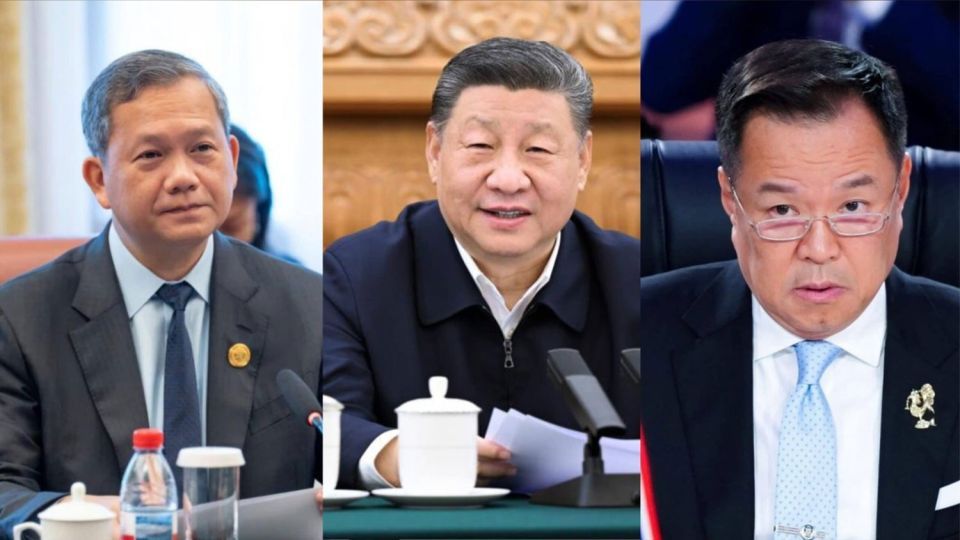
Prime Minister Hun Manet of Cambodia and his Thai counterpart Anutin Chanvirakul are set to converge on Shanghai later this month for the World AI Conference 2026, convening on July 17 at the invitation of Chinese President Xi Jinping. The dual appearance at this high-profile technology gathering provides a rare opportunity for engagement between the two Southeast Asian leaders, though the critical question looming over their visit concerns whether Beijing will leverage its considerable economic and diplomatic influence to nudge them toward resolving a festering border conflict that has derailed their bilateral relationship since December.
Hun Manet's delegation will comprise key ministerial figures including Foreign Minister Prak Sokhonn, Defence Minister Tea Seiha, and Sun Chanthol, the first vice-chairman of Cambodia's Council for the Development of Cambodia. Thailand's representation will include Foreign Minister Sihasak Phuangketkeow alongside Anutin. Both prime ministers are scheduled for separate meetings with Xi and Chinese Premier Li Qiang, signalling the weight Beijing places on these interactions. Cambodia's foreign ministry characterized the visit as emblematic of the countries' commitment to strengthening their strategic partnership and advancing their Comprehensive Strategic Partnership of Cooperation framework. Thailand's diplomatic statement echoed similar sentiments, framing the Shanghai engagement as an opportunity to reinforce bilateral ties for mutual advantage.
The two leaders previously crossed paths at the third ASEAN Future Forum held in Hanoi during early June, where they performed the ritualistic handshake for photographers but engaged in no substantive discussions regarding their territorial tensions. This pattern of symbolic gestures masking substantive avoidance has characterized recent interactions between Phnom Penh and Bangkok. Observers now speculate whether the Shanghai setting—where China can host bilateral conversations within its own framework—might finally create conditions for meaningful dialogue. Regional analysts contend that China, as a dominant trading partner for both nations and a power with vested interests in regional stability, possesses sufficient leverage to encourage practical negotiations.
Yet structural obstacles persist in ways that may frustrate even Beijing's diplomatic overtures. According to Kin Phea, director of the International Relations Institute at the Royal Academy of Cambodia, the fundamental impediment lies not with civilian leadership but with Thailand's military establishment. Phea argues that Bangkok's armed forces have systematically failed to honour commitments agreed upon with Cambodian officials, routinely disregarding the boundary between the two nations and encroaching on Cambodian territory without constraint. This civil-military disconnect reflects Thailand's ongoing political instability and the disproportionate influence wielded by military actors over foreign policy implementation.
Phea advocates for a more muscular Chinese role in the dispute resolution process, suggesting that Beijing should position itself as an active arbitrator rather than a passive observer. He calls for China to compel both nations to return to the negotiating table and pursue resolution through diplomatic channels rooted in international law. Such efforts would build upon the Fuxian Consensus, a framework brokered by China in December 2025 that ostensibly committed both sides to peaceful resolution. However, the consensus has remained largely a dead letter, undermined by Thailand's failure to implement its provisions.
The core dispute involves territorial occupation—several Cambodian border areas remain under Thai military control, displacing approximately 20,000 Cambodian civilians from their homes and denying them the ability to return. This humanitarian dimension adds urgency to the diplomatic stalemate. The Joint Boundary Commission, the bilateral mechanism designed to address such issues, has remained dormant as Thailand has shown no inclination to resume formal negotiations or withdraw forces from contested zones. Phea explicitly demands that Thailand respect the Fuxian Consensus by withdrawing its troops and engaging the commission without further procrastination.
For Malaysia and the broader Southeast Asian region, the Cambodia-Thailand impasse carries broader implications. Unresolved border disputes create instability that can ripple across the region, complicating ASEAN's internal dynamics and potentially inviting external powers to exploit divisions. Malaysia itself has experienced protracted border negotiations and maritime delineation issues, making it keenly aware of how territorial disputes can fester when political will diminishes. The question of whether China can successfully mediate the Cambodia-Thailand conflict will test Beijing's capacity to manage intra-regional tensions and could set precedents for how other territorial disagreements might be addressed.
The Shanghai conference represents a tactical opportunity for China to pursue mediation in a discreet setting, away from public ASEAN forums where political sensitivities run highest. Whether Xi and Li will actively pressure Anutin to implement the Fuxian Consensus remains uncertain. Thailand's apparent military obstruction of its own government's commitments suggests that even direct Chinese intervention may face resistance if Bangkok's security establishment calculates that maintaining territorial presence serves its strategic interests better than normalization. The extent to which economic incentives or diplomatic pressure can overcome military institutional interests will likely determine the outcome of any behind-the-scenes conversations.
For Cambodia, the Shanghai visit offers a chance to reinforce its partnership with China and potentially secure Beijing's continued backing on the border dispute. Hun Manet has invested significantly in deepening Cambodia-China relations, viewing Beijing as a critical counterweight to larger regional powers and as essential support in dealing with Thailand. The presence of Defence Minister Tea Seiha on the delegation underscores that military-to-military aspects of the relationship remain important. Yet Cambodia's leverage remains limited; without China's active, public advocacy for enforcing the Fuxian Consensus, Phnom Penh has few mechanisms to compel Thai withdrawal or recommencement of negotiations.
The timing of the Shanghai conference coincides with broader regional shifts in the balance of power and the evolution of China's role as a regional mediator. Having successfully brokered agreements in Myanmar and other contexts, Beijing has incentive to demonstrate that it can resolve even complex bilateral disputes among its neighbours. However, the Cambodia-Thailand case proves more difficult than others because it involves direct military occupation and the intersection of sovereignty claims with domestic political instability in Thailand. The success or failure of any Chinese initiative will reveal much about Beijing's actual capacity to shape regional outcomes and about the limits of economic influence when fundamental security interests collide.
Observers across Southeast Asia will watch closely for signals emerging from Shanghai. A breakthrough in Cambodia-Thailand relations would validate China's regional mediation efforts and potentially strengthen its hand in future disputes. Conversely, another round of diplomatic pleasantries without substance would suggest that the roots of the conflict run deeper than external mediation can address. For Malaysia and other ASEAN members, the outcome holds relevance both as an indicator of regional stability and as a benchmark for how multilateral mechanisms and external actors might engage with their own unresolved boundary questions.

