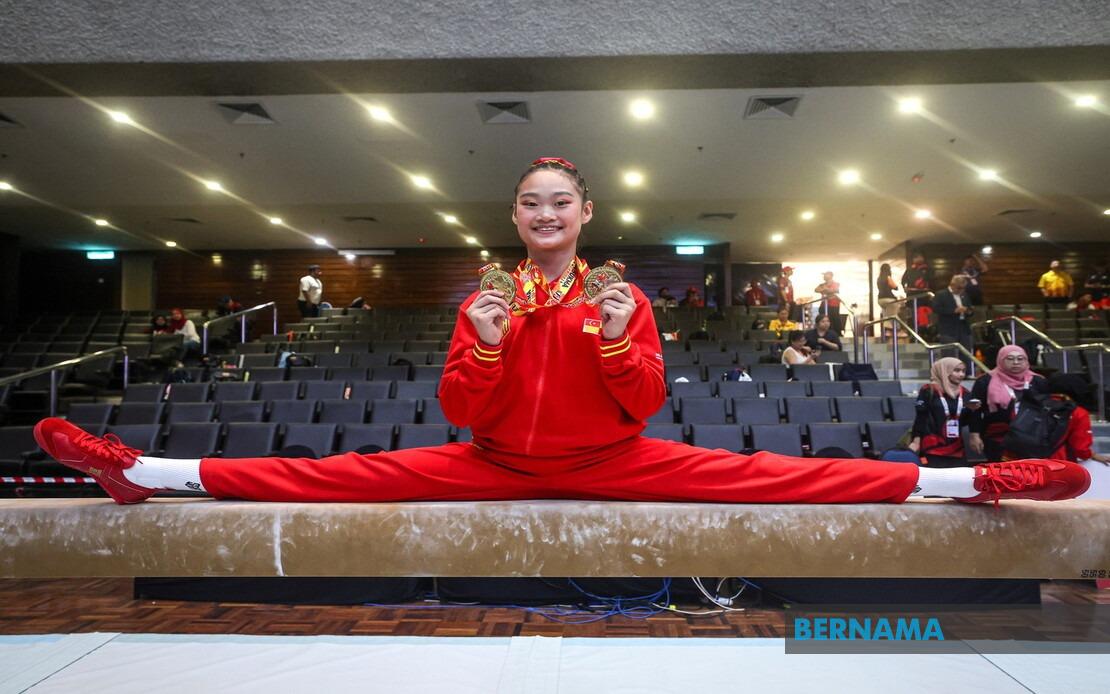
Selangor's rising star Cadence Teh Zi Qi delivered a commanding performance at the Malaysia Games 2026 artistic gymnastics competition in Bangi, securing dual gold medals that underscored her status as the nation's leading female gymnast. Competing at Dewan Canselor Tun Abdul Razak (DECTAR) on the Universiti Kebangsaan Malaysia campus, the 17-year-old successfully retained her individual all-around crown while anchoring Selangor to victory in the team event, demonstrating consistency at the highest level of domestic competition.
Teh's all-around triumph came with an aggregate score of 48.550 points across the four apparatus disciplines. Her vault execution yielded 12.050 points, with her uneven bars routine earning 11.400. The balance beam apparatus proved particularly strong, delivering 13.350 points, while her floor exercise concluded the sequence with 11.750 points. This comprehensive performance affirmed her technical proficiency across the spectrum of women's artistic gymnastics disciplines, a hallmark of elite all-around competitors preparing for international stages.
The podium positions demonstrated regional representation across Malaysia's gymnastics landscape. Sarawak's Aurin Zulkarnain captured the silver medal with 44.500 points, finishing 4.050 points behind Teh. The bronze medal was shared between two athletes: Annabelle Ho Syin Yee representing Federal Territories and Penang's Amanda Ching Lee Wern, both finishing with identical scores of 42.250 points. This distribution reflected the competitive depth emerging in Malaysian women's gymnastics, with talent distributed across several states vying for national prominence.
Beyond the individual title, Teh was instrumental in Selangor's team gold medal success, joining teammates Nicole Wong Ziyi, Airisha Zuraidi, Wong Zi Qi, Leong Yee Shean, and Haifa Izzazi Mohd Faizul to accumulate 169.300 points. The substantial team margin—demonstrating a 3.000-point advantage over the runners-up—reflected Selangor's depth of talent and systematic development infrastructure in artistic gymnastics. Federal Territories secured the team silver with 166.300 points, while Johor rounded out the podium with 157.000 points, indicating a three-state concentration of gymnastic excellence within Malaysia's competitive ecosystem.
During her post-competition interview, Teh provided candid insight into her performance narrative, acknowledging that her early apparatus routine on uneven bars had not proceeded as planned. She disclosed that nervousness had affected her proprioceptive awareness during the bars portion, resulting in a single fall that could have significantly compromised her overall score. However, her subsequent performances on balance beam and floor exercise demonstrated recovered composure and technical execution, permitting her to maintain the lead and ultimately secure retention of her title.
The gymnast's strategic approach to apparatus progression became evident when discussing her vault routine. Rather than attempting a higher-difficulty vault skill, Teh opted for a Tsukahara pike, a decision reflecting sound competition judgment and risk assessment typical of experienced competitors. This tactical restraint in vault—balanced against elevated technical challenge elsewhere—illustrates sophisticated understanding of all-around competition dynamics and point maximization across multiple disciplines.
Teh's balance beam routine received particular emphasis in her reflections, as she revealed elevation of difficulty to specifications aligned with preparations for the 2026 Asian Games. This deliberate calibration of technique and challenge across the traditional SUKMA calendar represents strategic long-term planning for major continental competition. Her recognition of this beam routine as representing a substantial advancement in her personal skill repertoire underscores the dual function of domestic competition—serving simultaneously as testing ground for new technical elements while maintaining competitive focus.
Looking forward, the national gymnast identified psychological refinement as an ongoing developmental priority. Improved nervousness management and sustained concentration during apparatus transitions represent cognitive and emotional dimensions that separate elite domestic competitors from those capable of sustained international performance. These self-identified areas for improvement demonstrate maturity beyond her seventeen years and suggest coaching staff capable of developing well-rounded athletes attentive to competition psychology alongside technical execution.
Teh's remaining SUKMA 2026 competition calendar includes apparatus finals across uneven bars, balance beam, and floor exercise, scheduled across the following two days. These finals provide further opportunity for point accumulation and podium positioning, though her dominant all-around victory strongly positions her as primary medallist contender in each apparatus. The apparatus finals typically showcase specialist excellence where athletes emphasize individual apparatus mastery, potentially permitting Teh opportunities to demonstrate enhanced routines incorporating difficulty adjustments made since all-around competition.
The competitive landscape evident in Teh's SUKMA performances carries implications for Malaysian artistic gymnastics' trajectory toward international competitiveness. Her multi-apparatus proficiency and retention of major titles suggest systematic development capable of producing athletes meeting increasingly stringent international standards. The emergence of competitive depth across multiple states—reflected in silver and bronze medalists from Sarawak, Federal Territories, and Penang—indicates geographic diversification of talent that could strengthen the national program's sustainability and reduce over-reliance on singular geographic centers of excellence.
Cadence Teh's SUKMA 2026 achievements position her prominently within Malaysia's Olympic pipeline, with the 2026 Asian Games looming as a critical evaluation point for her readiness for senior international competition. Her balance beam difficulty adjustments and consistent multi-apparatus performance suggest coaching staff confidence in her developmental trajectory and competitive maturation. These domestic dominance performances serve as platform for continued technical refinement and international exposure necessary for progression toward Olympic and world championship qualification standards anticipated for subsequent competition cycles.

