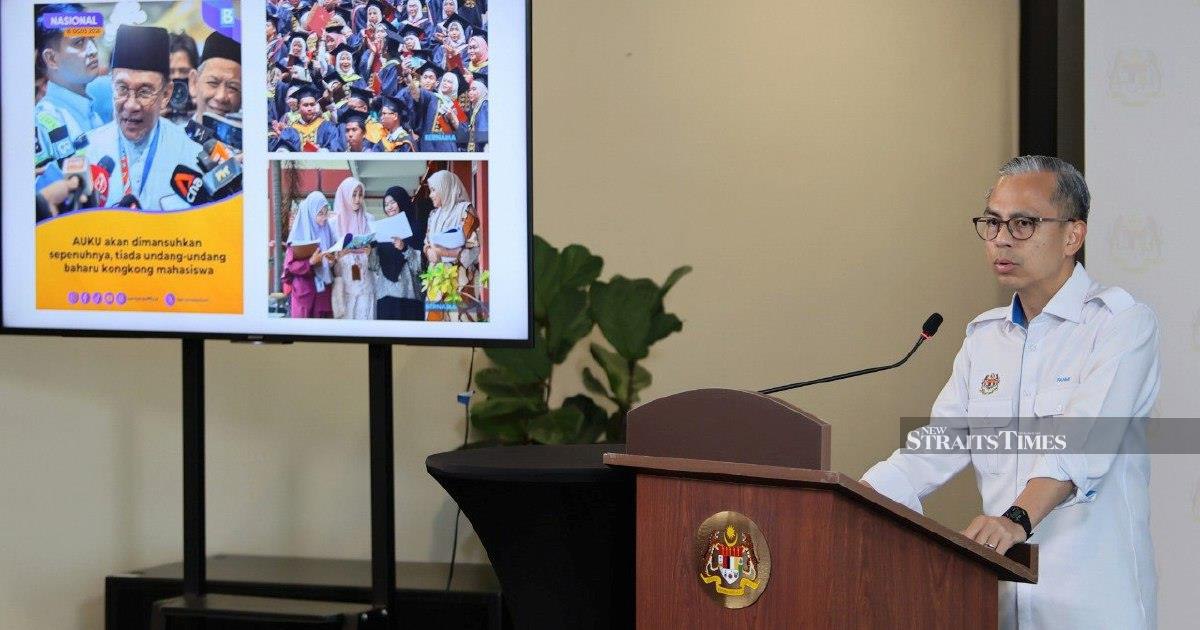
Malaysia's government appears intent on downplaying diplomatic tensions surrounding Prime Minister Datuk Seri Anwar Ibrahim's recent comments on Taiwan, with government spokesman Datuk Seri Fahmi Fadzil indicating that the cabinet had not deemed the matter significant enough to warrant collective discussion. The remarks, which prompted a notably sharp rebuke from Taipei, did not feature on the agenda when cabinet members convened, according to Fahmi's statement released in Putrajaya.
This clarification arrives at a delicate moment in Malaysia's relationship with Taiwan, an island that occupies an ambiguous position in the geopolitical landscape of Asia-Pacific. As an economically vibrant democracy and major technology hub, Taiwan maintains a complex web of unofficial ties with numerous countries, including Malaysia, whilst its political status remains one of the most sensitive issues across the wider region. The Taiwan question has historically required careful diplomatic handling from nations seeking to maintain balanced relationships with both Taipei and Beijing.
The absence of cabinet-level discussion suggests either confidence that Anwar's comments do not represent a significant policy shift, or a deliberate decision to avoid elevating the matter into an official inter-ministerial dialogue that could further complicate an already sensitive situation. By framing the incident as not requiring formal cabinet deliberation, the Malaysian government appears to be signalling that no major policy course correction is necessary. This approach reflects a calculated restraint, keeping the issue compartmentalised rather than allowing it to become a broader government-wide concern.
For Malaysian readers, the broader context involves understanding how trade-dependent Southeast Asia navigates the Taiwan conundrum. Malaysia, like many regional nations, balances significant economic interests with both Taiwan and mainland China. Taiwan ranks among Malaysia's important electronics and semiconductor trading partners, whilst China remains a major investor and trading partner with substantial influence over regional affairs. This economic interdependence means that careless diplomatic remarks can carry commercial consequences that extend well beyond symbolic political gestures.
Taipei's decision to respond sharply to Anwar's comments underscores how carefully monitored official statements about Taiwan have become in the region. Any perceived shift in a country's position on Taiwan's status or international standing attracts immediate scrutiny from both Taipei and Beijing. Such responses are not mere protocol; they reflect deeper anxieties about how Taiwan's de facto political autonomy is acknowledged or questioned by regional partners. When a prime minister's remarks prompt a rebuke, it typically indicates that Taipei interpreted the comments as potentially undermining Taiwan's standing in ways that demanded public correction.
Fahmi's statement that the cabinet did not discuss the matter carries its own nuance for observers of Malaysian governance. It could imply that the government viewed Anwar's comments as personal observations rather than official policy pronouncements, or that senior officials determined the situation did not require collective decision-making at the cabinet level. This distinction matters because it affects how Malaysia's foreign policy direction is perceived internationally. If ministers believe no coordinated response is necessary, it sends a message about the government's confidence in its diplomatic positioning on the issue.
The decision to address the matter through a spokesman's statement rather than a formal cabinet communiqué or ministerial briefing suggests Malaysia seeks to manage the narrative with minimal official fanfare. This approach is consistent with how sensitive bilateral issues are often handled in Southeast Asian diplomacy, where public silence is frequently preferable to detailed explanations that might invite further scrutiny or misinterpretation. By keeping the conversation at the spokesperson level, the government maintains plausible deniability whilst still acknowledging that external parties have raised concerns.
The incident highlights an enduring challenge for Malaysian policymakers: articulating positions on deeply contested regional issues without triggering unwanted international responses. Taiwan's status sits at the intersection of multiple competing interests—Beijing's historical claims, Taiwan's democratic self-governance, the international community's pragmatic acknowledgment of Taiwan's economic and strategic importance, and nations' desire to maintain stable relationships across this fault line. Prime ministers and senior officials must therefore calibrate their language with exceptional care, mindful that each phrase may be parsed for hidden meanings or policy shifts.
For business leaders and investors monitoring Malaysia's diplomatic orientation, the cabinet's apparent inaction provides modest reassurance that no sudden policy realignment is occurring. Yet it also underscores that Taiwan-related issues remain sufficiently sensitive that they cannot be openly debated in formal government settings without risk of external escalation. This paradox—where important regional relationships cannot be frankly discussed in official forums—reflects the broader geopolitical constraints within which Southeast Asian governments operate.
Looking forward, this episode suggests that Malaysian officials will likely continue exercising extraordinary caution on Taiwan matters, with high-level discussions conducted privately if at all, and public statements carefully vetted to avoid diplomatic incidents. The region's economic dynamism and strategic importance mean that tensions between Taiwan, China, and their various partners will remain a permanent feature of the Asian geopolitical landscape. How countries like Malaysia manage these tensions through quiet diplomacy, rather than public posturing, may ultimately prove more consequential for regional stability than the statements that occasionally provoke official responses.

