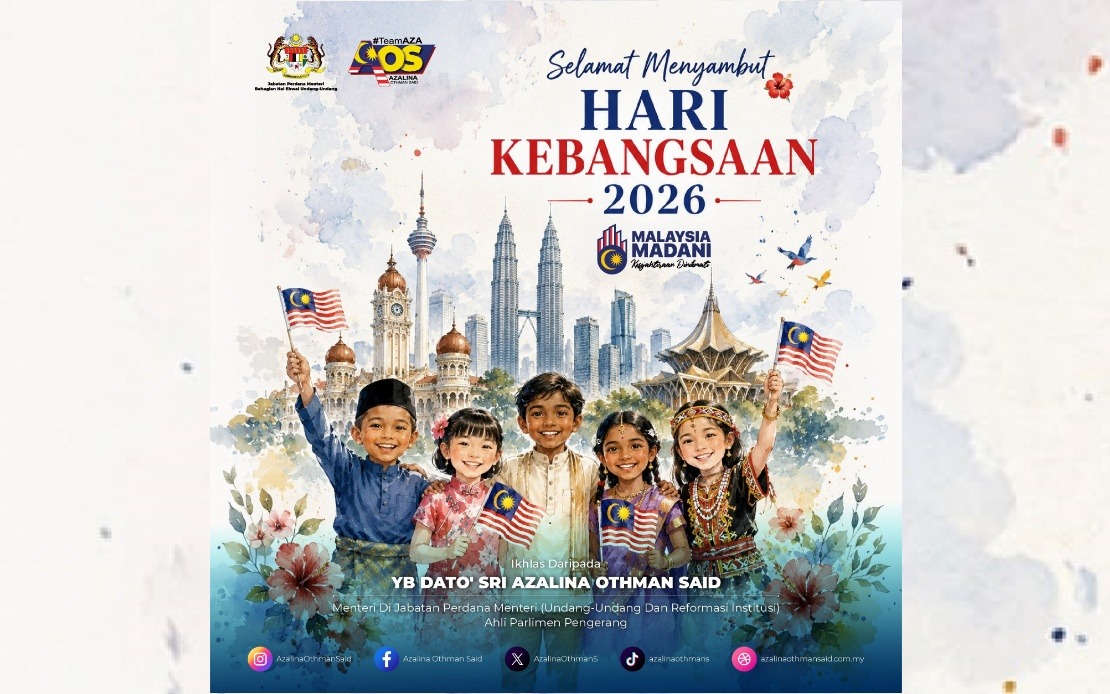
Malaysia's senior government officials used the occasion of the nation's 69th National Day to rally citizens around themes of unity, shared responsibility and collective prosperity. Speaking through social media platforms on August 31, members of the Cabinet articulated a vision of national cohesion that transcends Malaysia's diverse ethnic, religious and cultural landscape. Their remarks reflect the government's framing of contemporary challenges through the lens of foundational national values established during the independence struggle decades ago.
Datak Seri Azalina Othman Said, the Minister in the Prime Minister's Department responsible for law and institutional reform, positioned national independence as an ongoing project requiring constant cultivation. She argued that Malaysia's historical strength has consistently derived from its capacity to unite across difference, suggesting that this remains the template for navigating present circumstances. Her vision connected contemporary harmony to the nation-building project itself, implying that unity is not merely a social preference but a structural necessity for maintaining the independence hard-won by earlier generations. This framing positions disunity as a threat to the fundamental achievement of 1957.
Home Minister Datuk Seri Saifuddin Nasution Ismail framed National Day as a moment for national reflection, explicitly linking past sacrifice to present obligation. His argument that citizens must now carry forward the legacy established through independence struggle creates a responsibility narrative—today's Malaysians inherit not only the benefits of independence but also the duty to preserve it. By emphasising shared homeland and collective love for Malaysia despite differences in identity markers, Saifuddin presented unity as the practical mechanism through which Malaysians can fulfill this inherited responsibility.
Works Minister Datuk Seri Alexander Nanta Linggi expanded the geographic and demographic scope of this unity message, deliberately invoking the federation's vast territorial expanse and diverse settlement patterns. His emphasis on connection between cities and villages, and explicit mention of Peninsular Malaysia, Sabah and Sarawak, addresses potential regional divisions while celebrating Malaysia's pluralistic composition. Alexander's framing suggests that harmony is achievable precisely because Malaysians share institutional and territorial frameworks despite vastly different lived experiences and geographic contexts.
Minister in the Prime Minister's Department (Religious Affairs) Senator Dr Zulkifli Hasan introduced a theological dimension to the National Day discourse, arguing that independence represents a sacred trust rather than merely a political or historical achievement. His interpretation draws on Islamic concepts of justice and stewardship, suggesting that true independence requires not just institutional preservation but spiritual and moral commitment. By invoking founding Prime Minister Tunku Abdul Rahman Putra Al-Haj and independence fighter Dr Burhanuddin Al-Helmy, Zulkifli positioned contemporary governance within a continuum of principled leadership spanning decades.
Zulkifli's invocation of National Laureate Datuk Seri Dr A. Samad Said's poetry further elevated the independence narrative into cultural and intellectual registers. The inclusion of literary perspectives on national unity suggests that Malaysia's cohesion requires not just political commitment but cultural and intellectual reinforcement. This multi-layered approach—combining religious, historical, and artistic references—indicates an effort to address independence and unity as civilisational rather than merely administrative projects.
The government's MADANI (Madah, Adil, Nobles, Amanah, Ihsan) framework emerged as a contemporary expression of independence principles. Zulkifli outlined specific policy implementations including expanded BUDI MADANI subsidies, education infrastructure allocation, artificial intelligence access for youth, and healthcare efficiency improvements. This connection between independence commemoration and cost-of-living interventions reveals how the government links historical national values to immediate material concerns. For Malaysian voters navigating inflationary pressures, this positioning suggests that present policies represent authentic expressions of founding national commitments.
Minister in the Prime Minister's Department (Federal Territories) Hannah Yeoh and Higher Education Minister Datuk Seri Dr Zambry Abd Kadir both commented on public enthusiasm for National Day celebrations. Zambry specifically noted early evening arrivals at Dataran Putrajaya and characterised the gathering as evidence of spontaneous patriotic commitment. This observation of public participation serves rhetorical purposes beyond simple description—it validates government claims about national sentiment while suggesting that ordinary Malaysians independently embrace the unity and harmony narratives that officials promote.
National Unity Minister Datuk Aaron Ago Dagang interpreted the displayed unity as proof of government success in building harmonious society, directly linking public behaviour to policy outcomes. Similarly, Digital Minister Gobind Singh Deo positioned Malaysia's multicultural celebration as a global exemplar, suggesting that harmony provides competitive advantage in contemporary international contexts. This reframing of unity as a strategic asset rather than merely a moral imperative may resonate particularly with younger Malaysians and internationally-oriented constituencies.
Gobind's assertion that Malaysia's diversity represents something "the entire world looks at as a success" and his emphasis on demonstrated capacity to "govern it well" connect National Day commemoration to contemporary debates about governance legitimacy and international standing. His framing suggests that unity directly enables effective administration, creating a reinforcing cycle where harmony produces better governance, which in turn strengthens social cohesion. For Malaysia's regional position amid geopolitical uncertainties in Southeast Asia, this narrative positioning may carry particular weight.
The 2026 National Day theme "Malaysia MADANI: Kesejahteraan Dinikmati" (Malaysia MADANI: Shared Prosperity Enjoyed) explicitly connects historical independence to contemporary prosperity distribution. The emphasis on enjoyment of wellbeing across the population addresses a potential gap between formal political independence and material equity. This theming suggests government awareness that citizens evaluate independence not merely as historical achievement but through their experienced quality of life and access to opportunity.
Collectively, the ministerial remarks reveal sophisticated framing of national identity around several integrated themes: independence as ongoing project requiring perpetual commitment; unity as prerequisite for both historical achievement and contemporary governance; diversity as Malaysia's distinctive strength rather than complicating factor; and material prosperity as necessary expression of independence principles. These messages, coordinated across multiple ministers yet adapted to different portfolios and constituencies, suggest deliberate efforts to construct comprehensive national narrative that connects past sacrifice, present policy, and future aspiration into coherent framework accessible to Malaysia's remarkably diverse population.

