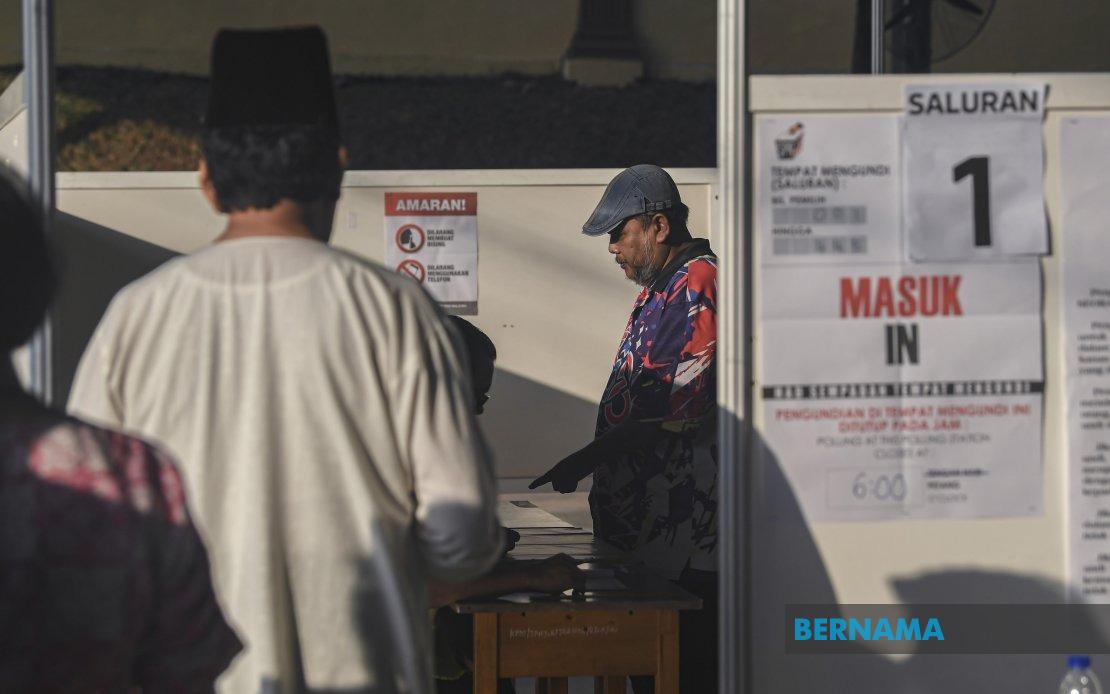
High-ranking federal officials exercised their democratic rights alongside ordinary Malaysians on Wednesday morning as Johor embarked on its electoral process to determine the state's political leadership for the coming term. Members of the federal cabinet were among those who queued at polling stations across the southern state, demonstrating the government's participation in what constitutes one of the country's periodic tests of political support at the regional level.
Datak Seri Azalina Othman Said, who holds the portfolio of Minister in the Prime Minister's Department with responsibility for Law and Institutional Reform, was among the first government representatives to cast her vote. She headed to Sekolah Kebangsaan Bandar Penawar in Pengerang at 8.15 am, shortly after the polling centres began operations. Her early participation underscored the government's eagerness to demonstrate commitment to the electoral process and civic engagement.
The Defence Minister, Datuk Seri Mohamed Khaled Nordin, also fulfilled his voting obligation, appearing at Sekolah Kebangsaan Rinting 1 in Masai at 8.30 am. His presence at a polling station represented both his personal franchise and, symbolically, the defence establishment's role within Malaysia's broader democratic framework. The choice of a neighbourhood school as a polling venue reflects Malaysia's practice of using accessible community facilities for electoral purposes.
Plantation and Commodities Minister Datuk Seri Dr Noraini Ahmad conducted her voting at Sekolah Menengah Kebangsaan Dato' Onn in Batu Pahat at 8.50 am, adding her voice to the electoral process in a constituency far from the capital. Her participation highlighted how cabinet members scattered across the country's various administrative duties nonetheless maintained their roles as engaged citizens within the democratic system.
Among subordinate ministerial ranks, Deputy Works Minister Datuk Seri Dr Ahmad Maslan cast his ballot at Sekolah Kebangsaan Seri Bahagia in Benut at 8.40 am, while Deputy Communications Minister Teo Nie Ching voted at Sekolah Jenis Kebangsaan Cina (SJKC) Kulai Besar at 9.30 am, just ten minutes after arriving at her designated polling centre. These officials' timely participation reinforced the messaging that voting is an essential responsibility across all levels of government.
The 16th Johor State Election represented a significant democratic exercise for Southeast Asia's region, involving the mobilization of substantial electoral infrastructure and resources. Across the state, polling authorities had established 1,076 separate voting centres, within which 4,889 individual polling streams were deployed to process voters efficiently. This logistical undertaking, involving trained poll workers and electoral commissioners, commenced simultaneously at 8 am, ensuring consistent opening times and fair access throughout Johor's diverse communities.
The electorate participating in this exercise numbered approximately 2.7 million registered voters, a substantial proportion representing Johor's adult population and reflecting decades of voter registration drives. These voters faced the fundamental choice of determining which political coalition or party would govern their state during the subsequent electoral cycle. The scale of participation required careful planning and coordination among electoral administrators to accommodate such numbers within a single day of voting.
Campaigning for positions and support had concluded at precisely midnight the previous evening, ending the mandatory 14-day campaign period. This restriction on electioneering represented Malaysia's regulatory framework for ensuring equal opportunities among competing candidates and parties while limiting campaign-related disruptions to daily life. The transition from campaign mode to voting day marked a formal shift toward the electoral process's decisive phase.
Voting was scheduled to continue until 6 pm, providing a ten-hour window for voters to exercise their franchise across the state. This extended polling period accommodated working populations, students, and others with daytime commitments, recognizing that elections in modern societies must accommodate diverse schedules and circumstances. The extended hours also reflected international best practices in democratic administration, ensuring accessibility for various demographic groups.
For Malaysian observers and the broader Southeast Asian region, Johor's electoral exercise carried implications beyond the state itself. As Malaysia's southernmost state and a significant economic contributor to the federation, Johor's political direction influences economic policies, infrastructure development, and federal-state relations. The state's government formation affects not only the 4.1 million Johor residents but also regional commerce, transportation networks, and cross-border arrangements with Singapore.
The participation of federal ministers in the voting process, rather than remaining aloof during regional elections, emphasized the interconnectedness of Malaysia's political system. Federal-state dynamics remain crucial to understanding how the nation's governance operates, with state governments wielding significant authority over land, local government, Islamic affairs, and certain revenue sources. The outcome of Johor's election would therefore shape not merely state-level decision-making but could potentially influence federal coalition mathematics and policy directions.
Such electoral events in Malaysian states serve as barometers of public sentiment regarding incumbent administrations and emerging political movements. Johor, historically a significant state politically and economically, provided voters an opportunity to assess their preferences through the ballot box. The competitive nature of modern Malaysian state elections, with multiple coalitions fielding candidates, ensured that voters faced meaningful choices rather than predetermined outcomes.
As voting proceeded throughout Wednesday, observers within Malaysia and internationally monitored the election's conduct, scrutinizing factors including voter turnout, potential irregularities, and the eventual results. The peaceful participation of government officials and ordinary citizens alike demonstrated Malaysia's commitment to orderly democratic processes, despite occasional controversies surrounding electoral administration and political competition at various levels of government.

