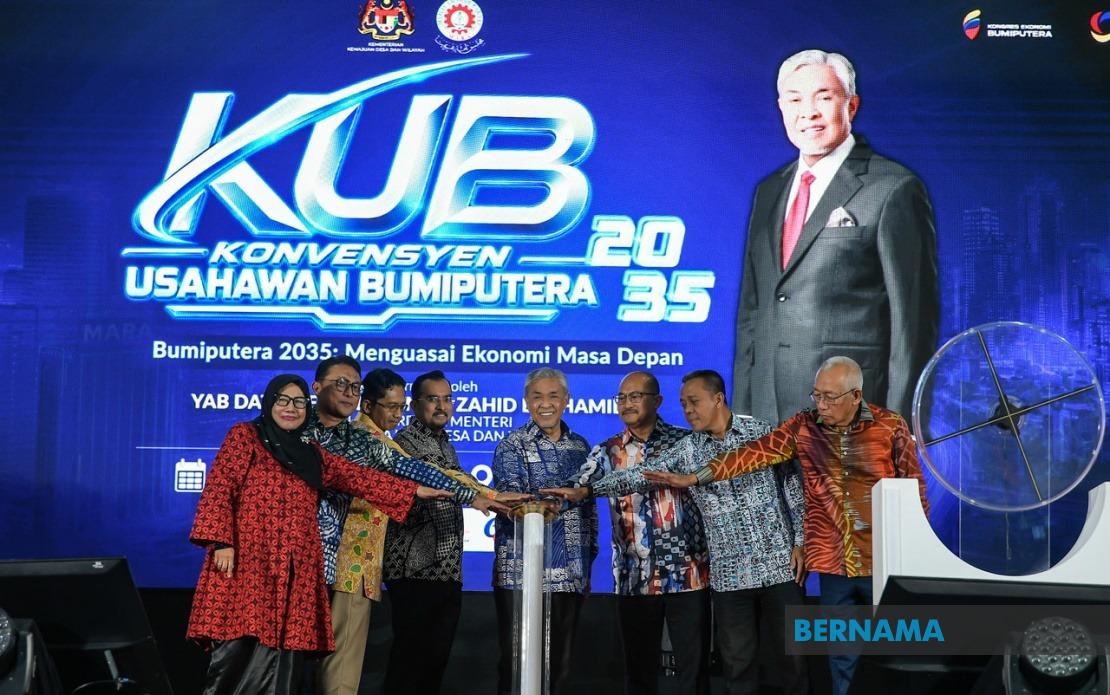
Deputy Prime Minister Datuk Seri Dr Ahmad Zahid Hamidi has called for a fundamental shift in how Bumiputera entrepreneurs approach business, urging them to graduate beyond their traditional role as participants in Malaysia's economic value chain. Speaking at the closing ceremony of the Bumiputera Entrepreneurs Convention 2035 Declaration in Alor Setar, Ahmad Zahid stressed that the community must now focus on building ownership structures, expanding their commercial reach, and gaining decisive control within their respective sectors. This represents a critical evolution in the government's approach to Bumiputera economic development, moving away from tokenistic participation toward substantive wealth creation and industry leadership.
The Deputy Prime Minister, who also holds the Rural and Regional Development portfolio, acknowledged that decades of effort have successfully established Bumiputera participation across Malaysia's economy. However, he argued that this foundational phase must now transition into a more ambitious stage centred on genuine ownership accumulation and business growth. Ahmad Zahid emphasized that entrepreneurs themselves must demonstrate the courage and strategic vision required to expand their operations, compete effectively against established players, and generate measurable economic value rather than relying solely on government scaffolding.
Ahmad Zahid outlined three strategic pillars that must underpin the transformation of Bumiputera entrepreneurship through 2035. The first involves integrating the fragmented support ecosystem that currently operates across multiple government agencies and programs. He identified a persistent structural problem: financing mechanisms, training programmes, and market access opportunities remain siloed across different channels, forcing entrepreneurs to navigate a complex and often inefficient bureaucratic landscape. By consolidating these instruments, the government aims to create a seamless support architecture where entrepreneurs can access comprehensive assistance within a unified framework rather than piecing together solutions from disparate sources.
The second pillar represents a philosophical reorientation from simply producing entrepreneurs toward nurturing and developing existing ones. This distinction carries significant implications for policy design. Rather than focusing government resources on business registration and initial startup support, the emphasis should shift toward helping already-active entrepreneurs surmount growth barriers and achieve scale. This approach recognizes that many Bumiputera businesses stall at modest operational levels, failing to mature into substantial enterprises that could meaningfully contribute to broader economic objectives. By redirecting support toward expansion and professionalization, the government hopes to transform surviving businesses into thriving regional or national players.
The third strategic component ensures that Malaysia's overall economic expansion translates directly into strengthened local enterprises. Ahmad Zahid's framing suggests concern that macroeconomic growth can occur without proportionate benefit to the Bumiputera business community, a pattern that has indeed characterized portions of Malaysia's recent development trajectory. By linking national growth targets explicitly to local company strengthening, the government signals its intention to measure success not merely through aggregate GDP figures but through demonstrated increases in Bumiputera business performance, revenue, and market share.
The fragmentation Ahmad Zahid identified reflects long-standing structural challenges in Malaysia's business support architecture. State development corporations, federal agencies, banking institutions, and university incubation centres all operate largely independently, creating confusion and inefficiency for entrepreneurs seeking capital, mentorship, or market connections. An integrated ecosystem would theoretically enable an entrepreneur to access financing, technical training, supply chain linkages, and market intelligence through coordinated channels, dramatically reducing transaction costs and time expenditure. For Southeast Asian context, such integration mirrors efforts undertaken in Singapore through its Enterprise Singapore initiative, though Malaysia's more complex federal structure makes implementation substantially more demanding.
The transition from participation to ownership carries profound distributional implications for Malaysian society. Participation-focused models typically involve Bumiputera involvement in projects or ventures structured and controlled by others, generating employment and contractual income but limited wealth accumulation. Genuine ownership, by contrast, creates pathways toward asset accumulation, equity stakes, and long-term generational wealth transfer. For entrepreneurs in rural areas and secondary cities, this distinction proves particularly consequential, as ownership models enable them to retain capital within their communities rather than dispersing profits to external stakeholders or consolidated corporate centres.
The scaling imperative Ahmad Zahid emphasized reflects understanding that individual Bumiputera businesses operating at modest scale cannot effectively compete in sophisticated sectors or generate employment at scale themselves. A boutique manufacturer or specialized services provider may achieve profitability but cannot contribute meaningfully to large infrastructure projects, significant export markets, or major employment creation without reaching critical size. Government policy increasingly recognizes that nurturing a few large Bumiputera champions capable of regional or international competition may yield greater systemic benefits than supporting thousands of microenterprises.
The announcement emerges amid broader regional competitive pressures as Southeast Asian economies jostle for manufacturing investment and technology sector prominence. Thailand, Vietnam, and Indonesia have similarly emphasized building domestic business capabilities beyond basic participation, recognizing that long-term prosperity requires indigenous champions rather than permanent dependence on foreign investors or multinational corporations for employment and tax revenue. Malaysia's explicit focus on Bumiputera ownership and control partly reflects this competitive imperative, though it additionally addresses internal social cohesion concerns regarding equitable wealth distribution across ethnic communities.
Implementing the three strategic pillars will require substantial bureaucratic reorganization and potentially difficult political negotiations among agencies protecting existing territorial jurisdictions. Some centralization of previously decentralized resources will likely prove controversial among state governments and established institutional stakeholders. Nevertheless, Ahmad Zahid's framing suggests the government views such organizational friction as acceptable given the stakes involved in Bumiputera economic advancement and the apparent inadequacy of existing fragmented approaches.
For Malaysian entrepreneurs, the speech signals shifting government priorities that could materially affect available support programmes and funding mechanisms over coming years. Those positioned to demonstrate scalability and genuine ownership potential may benefit substantially from consolidated ecosystem initiatives, while those content with modest participation-level operations may find diminished policy attention. This represents an implicit pressure toward growth ambition and competitive aspiration rather than comfortable operational stability, a cultural reorientation that entrepreneurship scholars often identify as critical for transitioning developing economies toward sustainable competitiveness.

