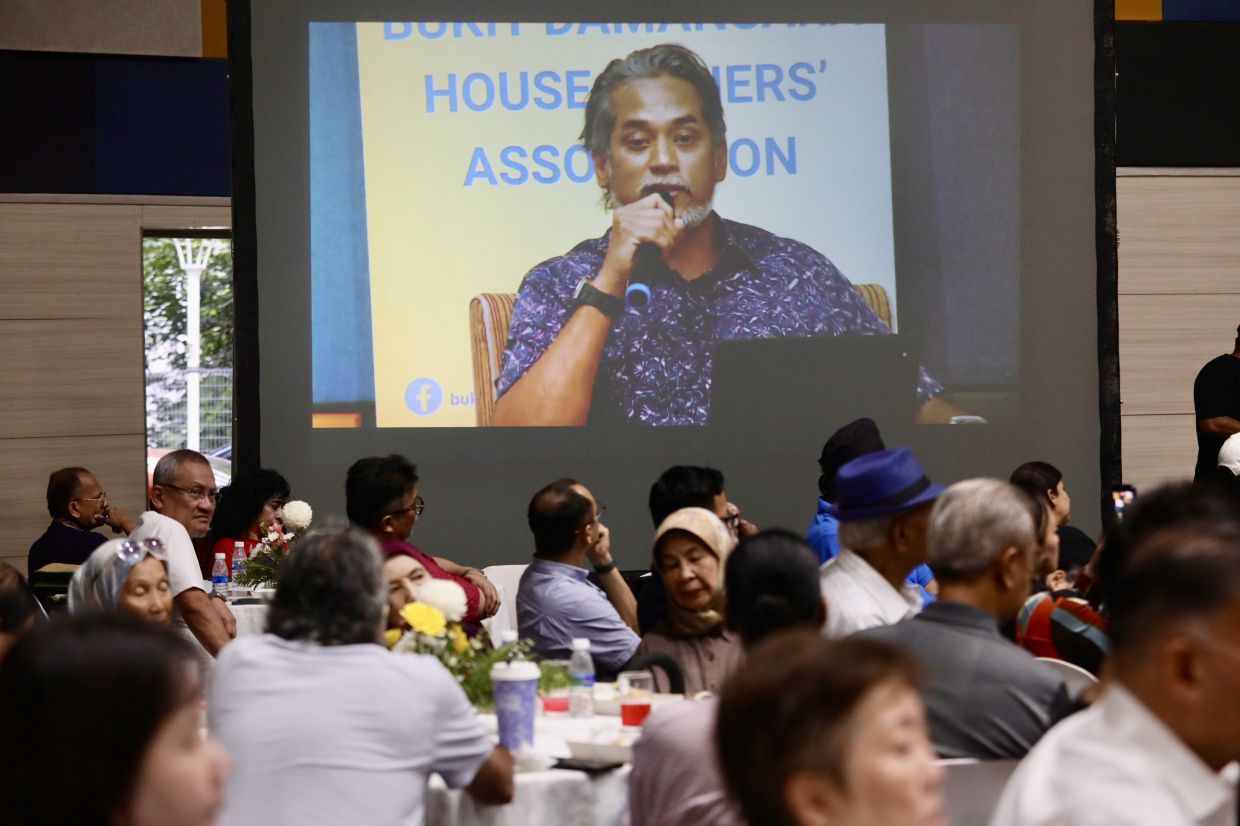
Hundreds of residents in the affluent Bukit Damansara neighbourhood have formally petitioned Kuala Lumpur City Hall to revoke a construction permit authorising the vertical expansion of a semi-detached residential property, marking a significant pushback against what many view as an incompatible development in their established residential enclave. The call came during a town hall organised by the Bukit Damansara Home Owners' Association at Pusat Komuniti Bukit Damansara, drawing approximately 400 residents who seized the opportunity to air grievances over the project and related neighbourhood challenges.
The gathering, held under the theme "Your Voice Matters", represented the first major community dialogue since Khairy Jamaluddin assumed the presidency of the association in early August. The three-hour session featured direct engagement between residents and decision-makers, including Rosli Nordin, town planner executive director at City Hall's Planning Department, and Supt Ahmad Firdaus Mustafia Kamal, deputy police chief of the Brickfields district, both present to address community concerns and explore practical remedies.
Central to resident frustrations is the perception that the approval process lacked meaningful community consultation. Resident A. Zakki, in his 40s, articulated the architectural concern underpinning the opposition, explaining that the original two-storey semi-detached design harmonised with the uniform character of the streetscape. The proposed conversion to a three-storey structure fundamentally disrupts this consistency, he argued, transforming a property that has existed in equilibrium with its neighbours into a visibly incongruent element. Zakki noted that a petition bearing signatures from 19 neighbouring households demonstrates substantial local resistance to the undertaking.
The permit's timeline reveals a pattern of regulatory oscillation that has likely deepened community mistrust. City Hall granted initial approval in December 2025, allowing the property owner to proceed with the additional floor construction. However, following resident complaints, a stop-work order was issued in January 2026, suggesting municipal acknowledgment of legitimate concerns. Yet approximately two months prior to the town hall, in June 2026, the approval was mysteriously reinstated, enabling the contractor to resume work. The project currently stands at roughly 10 percent completion, with structural pillars already erected, creating a visible symbol of the dispute in the neighbourhood.
Beyond the headline renovation controversy, residents highlighted secondary but serious consequences stemming from the construction activity. Structural damage has emerged in adjacent properties, with cracks appearing in neighbouring houses—a development that raises questions about construction standards and site management oversight. These physical manifestations of the project have transformed what might otherwise be an abstract planning dispute into a tangible threat to property integrity and resident safety, fuelling the demand for permit withdrawal.
City Hall's response, delivered through Rosli, remained measured but non-committal. Officials acknowledged that they would formally register the concerns raised by residents regarding the renovation's impacts, suggesting a willingness to document grievances without immediately pledging remedial action. This cautious stance may reflect bureaucratic protocol or genuine consideration of the community's position, though residents clearly sought more decisive intervention. Khairy, moderating the proceedings, emphasised his role as a bridge between community sentiment and government machinery, pledging personal follow-up to accelerate problem resolution.
The town hall also surfaced a secondary crisis affecting the neighbourhood: traffic congestion during school drop-off and pick-up periods, occurring from 7:00 am to 7:30 am and again from 2:00 pm to 4:00 pm in the vicinity of SK Bukit Damansara and Stella Maris International School Damansara. The congestion reflects broader challenges in affluent Malaysian neighbourhoods where vehicle-dependent lifestyles intersect with concentrated school schedules. Supt Ahmad Firdaus indicated that police authorities are addressing the matter through standard protocols, though specifics remained vague.
Ameirul Azraie Mustadza, chairman of SK Bukit Damansara's Parent-Teacher Association, disclosed ongoing efforts to manage the congestion through parental education and compliance measures. The association has repeatedly counselled parents against double-parking outside school premises, a common practice that exacerbates gridlock. Notably, the PTA considered engaging Rela volunteers for traffic management but lacked financial resources to sustain such an initiative. The group has formally approached traffic police for support, and while responses have been received, residents expressed frustration that police presence remains sporadic rather than consistent.
Infrastructure deficiencies beyond traffic also emerged during the dialogue. Residents urged Air Selangor to undertake comprehensive inspections of the water pipeline network serving the neighbourhood, following several pipe burst incidents that have disrupted water supply to homes. An Air Selangor representative acknowledged the agency's awareness of these incidents and indicated that plans exist to systematically replace ageing pipeline infrastructure throughout Bukit Damansara—though no timeline was provided. For residents already grappling with construction-induced disruptions, the prospect of water service interruptions during pipeline replacement adds another layer of neighbourhood stress.
The convergence of these issues—the semi-detached house renovation, traffic congestion, and water infrastructure decay—reveals the complex challenges facing Malaysia's established middle and upper-class residential enclaves. Bukit Damansara exemplifies neighbourhoods that have matured with relatively stable architectural character and service provision, making them attractive to residents seeking predictability and community cohesion. Development pressures and ageing infrastructure now threaten that stability, prompting resident mobilisation and demanding more responsive governance.
Khairy's framing of the town hall as an instrument for bridging communities and policymakers reflects contemporary political discourse around participatory governance, particularly relevant given his position as a prominent national political figure navigating local constituency issues. For Bukit Damansara residents, the gathering represented both an opportunity to formally document their opposition and a test of whether vocal community sentiment translates into meaningful policy reversal. The extent to which DBKL ultimately responds to the petition—either by withdrawing the construction permit or defending the approval—will signal to residents whether town halls function as genuine consultative forums or largely ceremonial exercises in political engagement.

