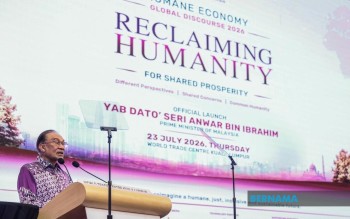
The government's budgeting process for 2027 will kick off in August, with Prime Minister Datuk Seri Anwar Ibrahim confirming that the financial blueprint will reach parliament in early October. Speaking at the Humane Economy Global Discourse 2026 in Kuala Lumpur on July 26, Anwar, who doubles as Finance Minister, outlined the philosophical underpinning that will shape the upcoming allocation of public resources. Rather than pursuing growth as an abstract numerical target, he signalled that Budget 2027 will be anchored to a broader vision of improving citizens' material circumstances and quality of life.
Anwar's characterisation of the budget philosophy reflects a deliberate repositioning of how Malaysia frames its economic narrative. By declaring that the economy serves people rather than people serving the economy, he articulated a framework increasingly adopted by governments seeking to address inequality and social fragmentation. This distinction matters for Southeast Asia, where rapid growth has often coexisted with regional wealth gaps and eroding social cohesion. The Malaysian government's explicit commitment to measuring success beyond gross domestic product figures suggests a recognition that mere economic expansion can mask deepening disparities if prosperity does not reach ordinary households.
The Prime Minister elaborated that genuine prosperity must manifest in tangible improvements across multiple dimensions of daily life. Higher wages that reflect productivity gains, employment that provides meaning and stability rather than mere subsistence, housing that families can afford without generational debt burdens, healthcare systems accessible to all regardless of income, and educational pathways that unlock potential across socioeconomic lines—these constitute the building blocks of what Anwar characterised as dignified living. For Malaysian policymakers, this framing addresses longstanding concerns about affordability crises in housing, healthcare access disparities between urban and rural areas, and wage stagnation in segments of the formal workforce.
Social mobility emerged as a critical measure in Anwar's articulation of economic purpose. He emphasised that growth should widen opportunity rather than concentrate it, a principle with particular resonance in Malaysia where intergenerational economic movement has slowed in recent decades. The budget framework he described would evaluate policy decisions through this lens—asking whether proposed measures genuinely enable individuals from disadvantaged backgrounds to advance, or whether they perpetuate existing hierarchies. This represents a departure from purely supply-side approaches that assume benefits automatically trickle downward, instead demanding direct attention to mechanisms enabling upward mobility.
The government's intended approach to Budget 2027 also signals integration of long-term structural challenges into fiscal planning. Anwar explicitly linked the budget to Malaysia's semiconductor strategy, energy transition agenda, and digital transformation initiatives. These are not peripheral concerns but central to how the budget allocates resources and shapes incentive structures. The semiconductor sector's strategic importance to Malaysia's future competitiveness, the necessity of transitioning energy systems away from fossil fuel dependence, and the digital skills gap that threatens employment prospects—these considerations will apparently infuse budget priorities rather than receiving compartmentalised treatment.
Sustainability doctrine, as Anwar framed it, directly addresses fiscal intergenerational equity. He explicitly rejected the practice of burdening future generations with environmental degradation, accumulated financial obligations, or deteriorated social infrastructure to finance current consumption. For Malaysia, this principle carries particular weight given existing challenges including coastal vulnerability to climate impacts, accumulated government debt levels, and aging infrastructure requiring substantial investment. A budget consciously designed around sustainability principles would factor long-term costs of environmental externalities and infrastructure deterioration into current spending decisions rather than deferring these costs forward.
Anwar's emphasis on human capability expansion through innovation reflects anxiety about technological displacement without adequate social provision. Rather than assuming innovation automatically benefits society, his framing demands that technological advancement actively enhance human capacities—whether through upskilling programmes, entrepreneurship support, or creation of higher-value employment. The alternative risk he implicitly identified is innovation that concentrates wealth and opportunity among capital owners while displacing workers, a pattern observed in several Southeast Asian economies undergoing rapid digitalisation.
The governance framework Anwar articulated requires treating development beneficiaries as partners rather than passive recipients or economic inputs. This philosophical stance influences budget architecture in consequential ways. Community engagement in identifying local priorities, devolution of fiscal resources enabling local decision-making rather than centralised distribution, and programme design incorporating beneficiary perspectives rather than imposing external solutions—these become integral to budget implementation rather than optional improvements. For Malaysia's federal system, this principle suggests potential restructuring of how funds flow between federal and state governments and how constituencies influence spending priorities.
The timing of Budget 2027 formulation beginning in August allows roughly two months for departmental submissions, inter-agency consultation, and parliamentary preparation before the October tabling. This timeline is relatively constrained for such a comprehensive exercise, though Malaysian budgetary processes have operated within similar windows previously. The compressed schedule may influence whether fundamental restructuring of spending priorities can occur or whether adjustments remain marginal within existing frameworks. Early signals from ministry consultations during the August formulation period will indicate whether Budget 2027 represents incremental refinement or more substantial reorientation toward the humanistic economy vision Anwar articulated.
For Malaysian businesses and investors, Anwar's framework suggests budget policies prioritising domestic wage growth and consumer purchasing power over cost-competitiveness through wage suppression. Long-term infrastructure investments aligned with energy transition and digital capabilities suggest stable policy direction in these sectors. For workers and households, the articulated vision implies budget measures addressing cost-of-living pressures, housing affordability, and skills development rather than austerity or regressive taxation. Regional observers across ASEAN will watch Budget 2027 as a test of whether Malaysia can operationalise humanistic economy principles through actual fiscal allocation, potentially influencing development discourse across Southeast Asia.

