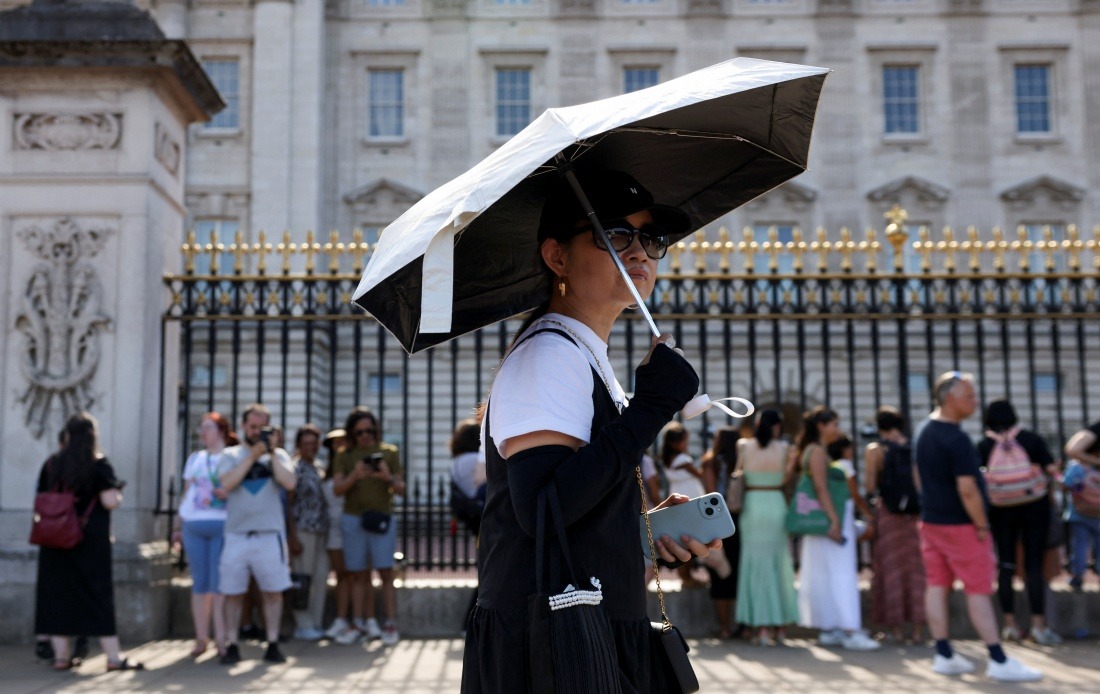
Britain's ceremonial traditions have taken an unprecedented backseat to public safety this week, with the UK Household Division announcing the cancellation of all guard change ceremonies at Buckingham Palace, Windsor Castle, and across London. The suspension, announced on Tuesday, marks a rare interruption to one of the country's most recognisable pageantry events, reflecting the severity of the weather emergency now gripping the United Kingdom.
The decision follows a red weather warning issued by the Met Office on Monday, signalling exceptionally dangerous conditions expected to unfold over the coming days. Forecasters are predicting temperatures will climb to 39 degrees Celsius on Wednesday and Thursday, with some regions potentially recording even higher readings. These figures carry particular significance for Britain, a temperate climate nation where such extremes remain relatively uncommon and where much infrastructure, including buildings and public spaces, is not designed to withstand sustained intense heat.
In a statement explaining the dramatic operational shift, the Household Division emphasised that the wellbeing of military personnel, the working horses integral to the pageantry, and the large crowds of public spectators formed the foundation of their decision-making. No ceremonial guard changes will occur in Windsor or London across Tuesday, Wednesday, and Thursday. The Royal Horse Guards' ceremony scheduled for Wednesday will proceed in a heavily modified form, beginning earlier in the morning and dispensing with the full ceremonial regalia and choreography that normally characterises such events.
Military organisers have implemented additional protective measures for the personnel who remain on duty. Soldiers will be deployed to shaded locations wherever possible and rotated at more frequent intervals to minimise their exposure to the intense heat while in full uniform and under the weight of ceremonial dress. This adaptation underscores the practical challenges posed by extreme temperatures for those performing public-facing military duties, particularly when dressed in traditional heavy uniforms designed for aesthetic impact rather than thermal comfort.
The heatwave's impact extends far beyond the ceremonial grounds of London and Windsor. Educational authorities across southern England have responded to the red weather alert by closing schools en masse, transforming entire regions into shuttered learning environments. Somerset County Council announced that approximately 100 schools across the county would remain closed during the peak heat period. Buckinghamshire reported a similar scale of closures, while Gloucestershire suspended classes at more than 80 institutions. London's major schools, nearly ten of which have cancelled in-person lessons, join this unprecedented wave of educational disruption.
This coordinated shutdown reflects a calculated assessment by local authorities that the combination of extreme heat, typically inadequate cooling systems in older school buildings, and the challenges of safely managing large numbers of children during dangerous weather conditions justified suspending normal operations. The clustering of these affected counties within the red weather warning zone—a designation encompassing London, Somerset, Buckinghamshire, and Gloucestershire—indicates the geographic scope of the threat and the consistency of responses among neighbouring authorities.
For Malaysian observers, the UK's response to this meteorological crisis offers instructive contrast to how tropical nations routinely manage persistent high temperatures. While Malaysian schools and public institutions operate year-round in equatorial heat, British infrastructure and public services have been designed around cooler seasonal norms. The sight of Buckingham Palace, perhaps the world's most famous symbol of British pageantry and continuity, suspending its ceremonial functions due to heat represents a striking illustration of how climate systems fundamentally shape societies' operational capacity.
The cancellation also raises broader questions about climate resilience and adaptation in developed nations. Britain's existing building stock, public transport systems, and outdoor work protocols were established when sustained temperatures above 35 degrees Celsius were statistical anomalies rather than increasingly common occurrences. As climate patterns shift globally, such emergency closures may become more frequent rather than exceptional events, requiring substantial investment in adaptation infrastructure and revised operational protocols.
For Southeast Asia, the UK scenario provides a reminder of the vulnerability that can exist in societies ill-prepared for temperature extremes, even relatively modest ones by tropical standards. Malaysia's experience managing consistent heat and humidity, while certainly posing its own challenges, has produced institutional knowledge and infrastructure design practices that assume high temperatures as baseline conditions. The contrast illustrates how climate vulnerability is not solely a function of absolute temperature levels but of the relationship between climatic conditions and the systems built to accommodate them.
The Met Office's red weather warning represents the most serious alert status the organisation can issue, applied only when dangerous conditions pose widespread threat to life and property. This exceptional designation triggered coordination across multiple government agencies, local councils, and public institutions, underscoring how Britain's institutional structures are designed to respond to rare, extreme events rather than routine conditions. The scale of school closures and ceremonial cancellations reflects this emergency posture, with hundreds of thousands of people's daily routines disrupted by weather conditions that would be unremarkable in equatorial climates.
As temperatures climb in the coming days, the Household Division's decision to scale back one of Britain's most visible traditions serves as a potent symbol of prioritising human and animal welfare over ceremonial obligation. The modified Royal Horse Guards ceremony, proceeding without its traditional pageantry but with enhanced protective measures, represents a pragmatic balancing act between maintaining institutional continuity and acknowledging genuine operational constraints. Whether these measures prove sufficient, and how rapidly Britain's regions recover once cooler conditions return, will determine whether this week's emergency closures are remembered as an exceptional anomaly or as a harbinger of necessary institutional adaptation to shifting climate realities.