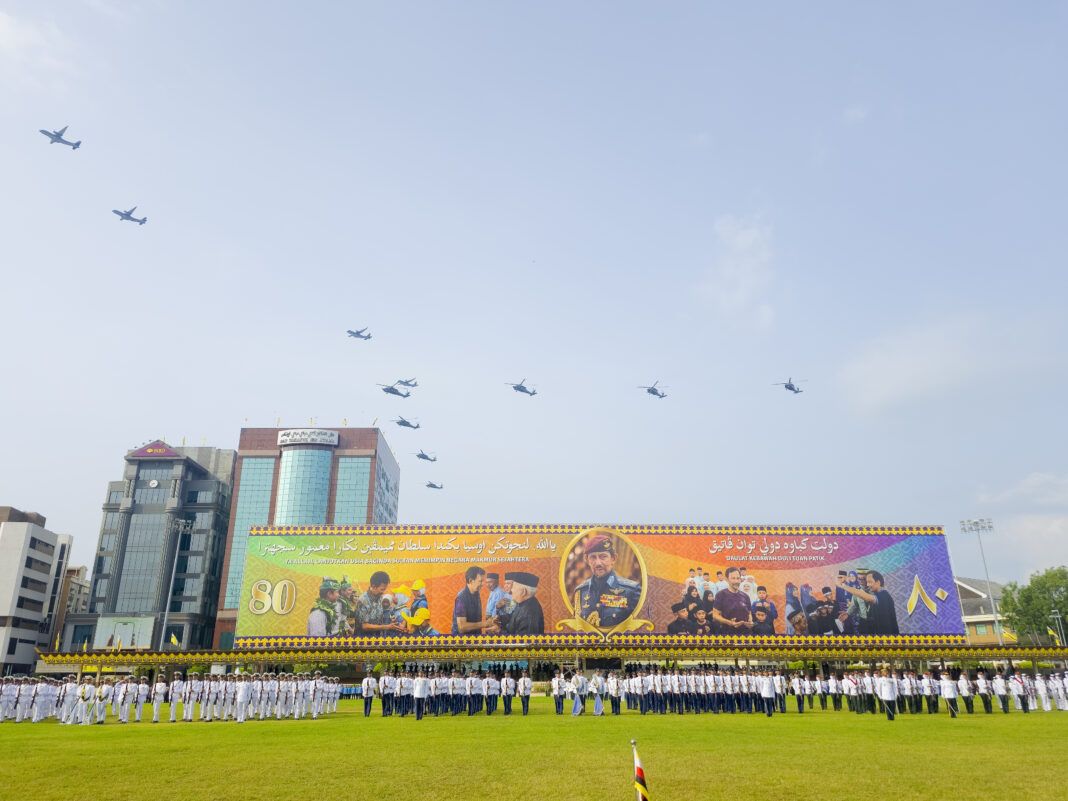
Brunei Darussalam is entering the final operational stage of preparations for an elaborate ceremonial parade that will commemorate the 80th birthday of His Majesty Sultan Hassanal Bolkiah, Sultan and Yang Di-Pertuan of Brunei Darussalam. A comprehensive full dress rehearsal for the guard of honour parade took place on Saturday at Taman Haji Sir Muda Omar 'Ali Saifuddien, the sprawling national monument grounds that will serve as the venue for the main event scheduled to unfold on Wednesday morning.
The rehearsal represents a critical juncture in the months-long preparation process, allowing organisers to test ceremonial protocols, coordinate military units, fine-tune timing, and identify any logistical adjustments needed before the actual celebration. Such high-profile state ceremonies demand meticulous planning, particularly when they involve the supreme head of state and require the participation of multiple government agencies and ceremonial bodies. The attention to detail evident in conducting a full-scale rehearsal underscores the significance Brunei attaches to this milestone occasion.
Oversighting the rehearsal and broader celebration planning is Yang Amat Mulia Pengiran Indera Setia Diraja Sahibul Karib Pengiran Anak Idris Pengiran Maharaja Lela Pengiran Muda Abdul Kahar, who holds the position of Chief of Adat Istiadat Negara—the chief of national protocols and traditions. Beyond his ceremonial role, he serves as co-adviser to the National Committee for His Majesty's 80th Birthday Celebration for 2026, positioning him as a key custodian of the event's cultural and procedural authenticity.
The national committee directing these efforts reflects Brunei's whole-of-government approach to the celebration. At the helm as co-chairs are five senior ministers representing the key pillars of state governance. Datuk Seri Setia Awang Ahmaddin Abdul Rahman, in his capacity as Coordinating Minister for Social Policies and Manpower and Minister of Home Affairs, brings domestic affairs expertise to the planning. Major General (Rtd) Datuk Paduka Seri Awang Halbi Mohd Yussof, serving as Coordinating Minister for National Security, Minister at the Prime Minister's Office, and Minister of Defence II, ensures the military and security dimensions are appropriately managed.
Rounding out the co-chair contingent are Datuk Seri Setia Awang Nazmi Awang Mohamad, whose purview as Minister at the Prime Minister's Office encompasses public service governance; Datuk Seri Setia Dr Mohd Isham Jaafar, the Minister of Health, who likely oversees public health and safety protocols; and Pengiran Datuk Seri Setia Shamhary Pengiran Datuk Paduka Mustapha, the Minister of Culture, Youth and Sports, who brings custodianship of national cultural expression to the table. This ministerial composition suggests the celebration will integrate cultural programming, security considerations, public service mobilisation, health safeguards, and broader social dimensions.
For Malaysia and the broader Southeast Asian region, Brunei's detailed preparations for such state occasions offer instructive insights into how the nation maintains ceremonial traditions while navigating contemporary governance complexities. The participation of such senior officials signals that birthday celebrations for reigning monarchs carry profound significance in Brunei's political framework, serving not merely as festive occasions but as moments of national affirmation and institutional demonstration.
The timing of the 2026 celebration marks a symbolic milestone for Sultan Hassanal Bolkiah, who has reigned since 1967 and is among the world's longest-serving monarchs. An 80th birthday ceremony provides an appropriate occasion for a nation to reflect on stability, continuity, and the enduring role of the sultanate in Bruneian society. For regional observers, such events also underscore the continuing centrality of hereditary monarchy in Southeast Asian governance structures, even as democratic and republican models coexist elsewhere in the region.
The selection of Taman Haji Sir Muda Omar 'Ali Saifuddien as the venue carries symbolic weight as well. The expansive grounds honour the memory of a highly revered former sultan and provide an appropriate setting imbued with historical significance. The morning timing for Wednesday's main parade demonstrates Brunei's preference for daylight ceremonial displays, a choice that maximises visibility for state media documentation and public participation, should spectators be permitted.
The full dress rehearsal model adopted reflects international best practices in ceremonial event management, where advance practice runs allow participating units—likely military personnel, police contingents, and other uniformed services—to synchronise movements, test sound systems, coordinate traffic management, and resolve unforeseen operational difficulties in a controlled environment. This methodical approach reduces the risk of protocol missteps or logistical breakdowns during the actual celebration.
For Malaysian officials and the broader regional audience, the visible commitment of Brunei's highest-level government machinery to these preparations illustrates how even small nations prioritise state ceremonial functions as essential expressions of national identity and institutional legitimacy. The involvement of the Defence Ministry, coupled with security coordination, indicates that such events receive formal security planning befitting gatherings of senior state figures and potential dignitaries.
Looking forward, the Wednesday ceremony will likely feature formal greetings, military processions, cultural performances reflecting Bruneian traditions, and possibly diplomatic remarks or attendance from neighbouring leaders. The success of these final rehearsals sets the stage for a celebration that will reinforce both domestic unity and Brunei's continuity as a stable regional player. For Southeast Asia more broadly, the event demonstrates the enduring appeal of traditional ceremonial formats in expressing national sentiment and honouring revered leaders.

