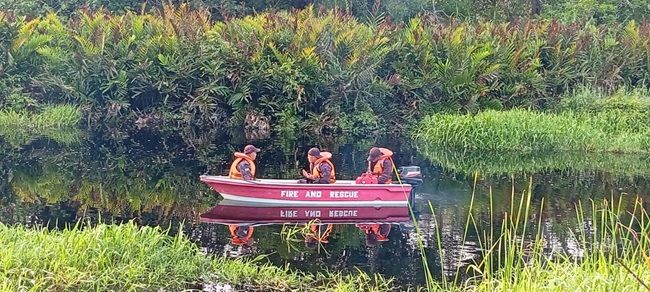
Brunei's emergency services have mounted an intensive three-day search for a fishing enthusiast who went missing after what appears to be a crocodile attack in the waters of Kampong Baru Sungai Bera. The coordinated operation, which shows no signs of abating despite the passage of time, reflects the serious threat that large reptiles pose to riverside communities across Southeast Asia—a region where such incidents, though uncommon, carry devastating consequences when they do occur.
The Fire and Rescue Department (FRD) received the initial distress alert on Wednesday, June 24, prompting immediate deployment of personnel and specialized equipment to the scene. Acting Station Officer Mohd Zulkifli Md Tahir led a team of nine firefighters aboard two fire engines to the location, where they established contact with the victim's family and gathered crucial preliminary information. According to witness accounts obtained at the scene, the man had been engaged in fishing activities along the river when the alleged crocodile attack happened, a pursuit that has long carried occupational risks in tropical waterways throughout the region.
The scale of the ongoing rescue effort underscores the gravity with which Brunei's authorities are treating the disappearance. The operation encompasses multiple specialized units working in coordinated fashion to maximize search coverage across the river system. Patrol boats operated by the FRD have been conducting systematic sweeps along the waterway, while teams have also combed the adjacent riverbanks on foot, examining accessible areas for any sign of the missing person. This multi-vector approach reflects international best practices in search and rescue operations, particularly in aquatic environments where currents and submerged obstacles complicate visibility and accessibility.
Technological assets have proven central to the search strategy. The FRD's unmanned aerial surveillance drones have been deployed repeatedly to scan wider areas of the river and surrounding terrain, offering reconnaissance capabilities that ground teams cannot achieve independently. Aerial surveillance provides crucial advantages in such operations, enabling searchers to identify objects or disturbances in the water that might escape notice from river level. This integration of modern technology with traditional search methods represents a pragmatic adaptation to the specific challenges posed by Sungai Bera's geography and the urgent nature of a potential crocodile attack scenario.
Beyond the FRD's direct involvement, the operation has drawn substantial support from other governmental agencies, reflecting the multi-disciplinary nature of crisis response in Brunei. The Royal Brunei Police Force (RBPF) has fielded officers from the Seria Police Station alongside specialized personnel from POLMAR, the force's dedicated marine unit. The Wildlife Division has also been engaged, bringing crucial expertise regarding crocodile behavior and habitat knowledge that could prove instrumental in predicting where the animal—and potentially any remains of the victim—might be located. Such coordinated agency response, though demanding of resources, provides the best statistical chance of a favorable outcome.
Operational command has been invested in Senior Superintendent Amirul Hadi Junaidi, who heads the Operations Branch and bears responsibility for maintaining search momentum and strategic direction. Effective command structure proves essential in extended rescue operations, where fatigue, evolving environmental conditions, and the psychological toll of fruitless searching can erode team performance. Strong leadership ensures that personnel rotation, resource allocation, and tactical adjustments respond appropriately to new information and changing circumstances.
The incident illuminates persistent human-wildlife conflict concerns in Brunei and throughout Southeast Asia. Crocodile populations in the region have made something of a recovery in recent decades following earlier conservation efforts, which has occasionally brought increased animal-human contact in traditional river zones. While fatal attacks remain statistically rare, their occurrence in densely populated or well-traveled waterways generates both immediate trauma and broader community anxiety. For Malaysian readers familiar with similar incidents in Peninsular Malaysia and Sabah, the Brunei situation carries particular resonance, as it highlights shared regional challenges in managing wildlife coexistence with riverside livelihoods.
The extended timeline of the search raises difficult questions about outcomes. As hours extend into days without discovery of the victim, possibilities narrow considerably. Crocodile predation typically results in rapid submersion and consumption, which may account for the absence of visible evidence. The river's current, depth variation, and underwater obstacles can disperse or conceal remains, making detection increasingly difficult as time passes. Family members and rescue personnel face the emotional weight of mounting uncertainty, a psychological dimension that accompanies all prolonged missing-person operations.
For Brunei's residents and those in neighboring regions who depend on rivers for subsistence fishing, livelihood, or recreation, such incidents serve as sobering reminders of environmental hazards that demand respect and caution. The incident may prompt renewed emphasis on water safety awareness, crocodile awareness education, and perhaps additional wildlife monitoring infrastructure in known crocodile habitats. Regional cooperation on wildlife management and emergency response protocols could prove valuable as Southeast Asian nations collectively manage human-wildlife interfaces in shared waterways and ecosystems.

