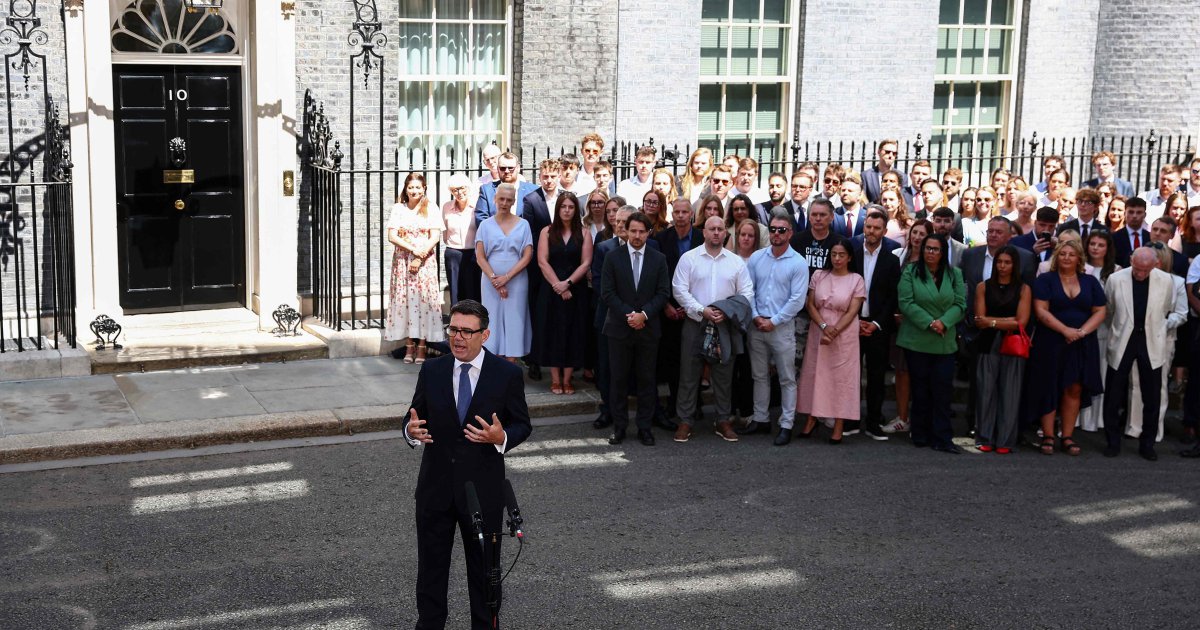
Andy Burnham's assumption of the premiership on Monday marks a sobering milestone for British democracy: the seventh occupant of 10 Downing Street in just over a decade. As the country confronted this latest transition, the prevailing mood among voters was one of profound weariness rather than optimism. Claire Walker's exasperated refrain—"not another one"—captured a sentiment resonating across the British electorate: a deep fatigue with the relentless cycle of prime ministerial changes that has come to define contemporary British politics.
The velocity of leadership turnover in the United Kingdom stands as a remarkable departure from historical norms. Between early 2016 and 2025, the country has cycled through seven different individuals at the helm of government, a pattern that would have been unthinkable in the post-war consensus era when prime ministers typically served for years or even decades. This acceleration reflects deeper fractures within the Conservative and Labour parties, each struggling with internal cohesion and ideological clarity. The frequency of these changes has transformed what should be moments of democratic renewal into expressions of institutional dysfunction.
For Malaysian observers, this phenomenon offers instructive parallels and contrasts worth considering. Malaysia has experienced its own periods of political volatility, particularly during the transition from the Barisan Nasional era to the Pakatan Harapan government and subsequent coalitional shifts. However, the scale and speed of British churn represents an extreme case study in how parliamentary systems can fragment when major parties lose internal discipline and voter confidence simultaneously. Understanding the mechanisms that have produced such instability in a mature Westminster democracy provides context for evaluating political stability more broadly across Commonwealth nations.
The underlying causes of this revolving-door premiership are multifaceted and interconnected. The Brexit referendum of 2016 fundamentally fractured the Conservative Party, forcing successive leaders to navigate an irreconcilable divide between those committed to a clean break with the European Union and those favouring closer alignment with Brussels. Each attempt to forge consensus on this defining issue produced instead further factionalism and leadership crises. Additionally, the Labour Party's own internal struggles over direction and identity contributed to a broader sense of political paralysis, as neither major party could establish a stable governing coalition with sufficient public support.
The economic dimension cannot be overlooked when examining voter frustration. The decade since 2016 has encompassed the COVID-19 pandemic, surging inflation, stagnant wage growth, and mounting pressure on public services. Rather than providing steady, competent stewardship through these challenges, the succession of prime ministers instead seemed to compound citizen discontent through perceived incompetence and inability to articulate coherent policy visions. Each leadership transition promised renewal but delivered instead further disruption and policy whiplash.
For Southeast Asian governments observing from afar, the British experience underscores the political costs of allowing institutional norms to erode. The Westminster system relies heavily on unwritten conventions and mutual restraint among political actors. When parties prioritise factional advantage over institutional stability, and when voters lose faith in the competence of their leaders, the consequences ripple through society in ways that extend far beyond normal political competition. The degradation of public trust in institutions, once diminished, proves remarkably difficult to restore.
Burnham's accession to the premiership arrives amid public expectations that have been substantially dampened by repeated disappointments. Unlike previous transitions that occasionally sparked hope for transformative change, his elevation to the top office elicited primarily resignation rather than anticipation. This reflects a fundamental erosion of the premium traditionally attached to the prime ministerial office. The position that once carried weighty gravitas has been diminished by its rapidly rotating occupancy, almost rendering it interchangeable rather than distinctive.
The psychological impact on voters deserves particular attention. Political scientists have long documented that excessive instability in leadership correlates with declining democratic engagement and rising cynicism about the possibility of meaningful political change. When citizens witness seven different prime ministers in a decade, the implicit message is that leadership itself has become peripheral to deeper institutional or structural forces beyond any individual's control. This can paradoxically increase vulnerability to populist movements promising dramatic disruption as an alternative to the perceived futility of conventional politics.
For regional observers in Southeast Asia, the British case presents cautionary lessons about the importance of strong party institutions and internal discipline. Malaysia's political system has demonstrated resilience precisely when political parties have maintained sufficient internal cohesion and when leadership transitions, while sometimes contentious, have occurred within structured frameworks rather than as constant ruptures. The contrast underscores how different institutional arrangements and political cultures produce vastly different outcomes even within broadly comparable Commonwealth structures.
The international dimensions of Britain's political turbulence warrant consideration as well. Extended periods of domestic political instability typically constrain a nation's capacity to project influence internationally or maintain consistent diplomatic positioning. The succession of prime ministers, each potentially bringing different foreign policy orientations, creates uncertainty for allied nations and complicates long-term strategic planning. This reality reinforces why maintaining political stability, though sometimes frustrating to reform advocates, carries genuine national security implications.
Looking forward, the central question for Britain remains whether Burnham's government can arrest the cycle of instability or whether the underlying pathologies will produce yet another transition within months. The voter fatigue expressed so clearly represents both a crisis and, potentially, an opportunity: a moment when the public has signalled unambiguously that business-as-usual politics cannot continue. Whether political elites heed this message will substantially shape whether the decade ahead represents genuine renewal or merely the continuation of dysfunction under different management. For now, the exasperation captured in comments like Walker's reflects a Britain weary of perpetual upheaval.

