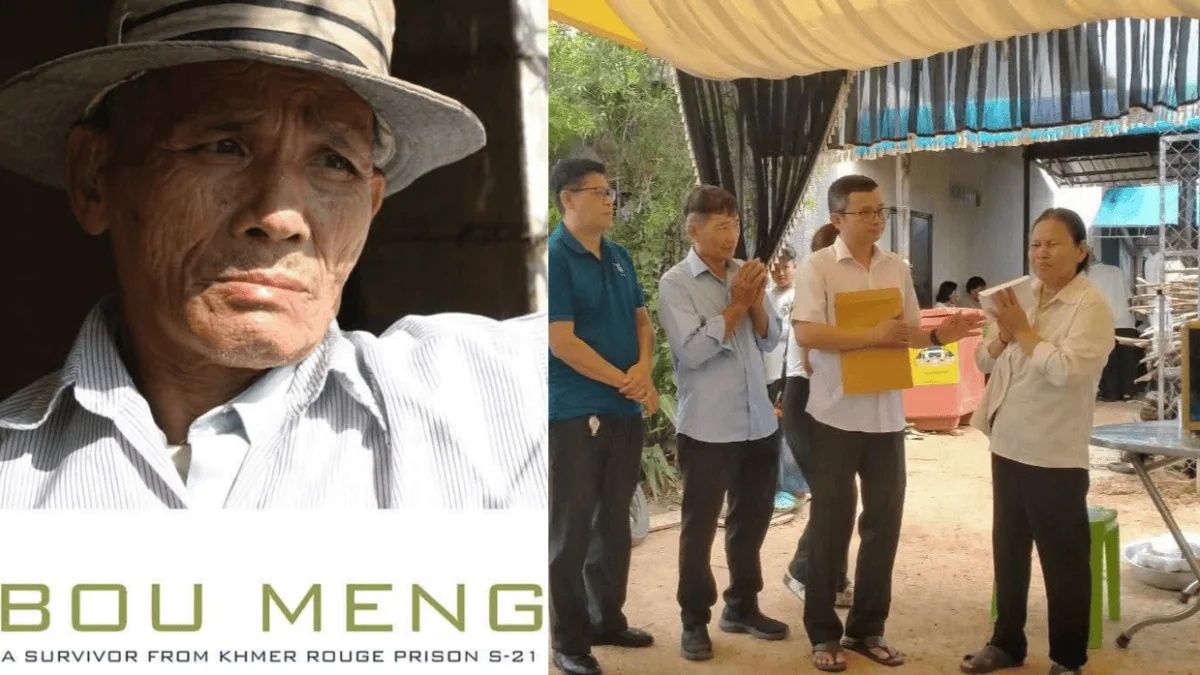
The death of Bou Meng on August 14, 2026, marks the passing of one of Cambodia's most significant living links to the horrors of the Khmer Rouge regime. At 85 years old, Meng was among only seven documented survivors of Tuol Sleng prison, known as S-21, the notorious detention and interrogation centre that became a symbol of the regime's systematic brutality. The Tuol Sleng Museum, now a memorial to the estimated 17,000 people who perished there, announced his death with a statement acknowledging the profound loss of a crucial historical witness whose lived experience bridged the gap between the genocide's victims and subsequent generations seeking accountability.
Meng's imprisonment in 1977 came during the darkest period of the Khmer Rouge's four-year rule, when paranoia and ideological extremism reached fever pitch. He and his wife were both detained at S-21, where the regime's leadership conducted systematic interrogations, torture, and executions in pursuit of imagined enemies. Their children were separated and sent to labour camps for young people, a separation that would prove permanent. The fates of his wife and children remain unknown, their names among the hundreds of thousands lost to the genocide that claimed approximately two million Cambodian lives between 1975 and 1979.
What distinguished Meng's survival in this inferno was a skill that would have seemed mundane in ordinary circumstances but proved lifesaving under the Khmer Rouge's machinery of death. His abilities as a painter caught the attention of his captors, who recognised the utility of his talent for their propaganda purposes. Prison commandant Kaing Guek Eav, known as Comrade Duch, chose to spare Meng from execution to employ him in creating artwork. This arbitrary selection, based on utility rather than mercy, exemplified the regime's dehumanising logic where individual lives held value only insofar as they served state objectives.
The significance of Meng's survival extended far beyond the personal trauma he endured. Nearly three decades later, his testimony became instrumental in the pursuit of justice through the Extraordinary Chambers in the Courts of Cambodia, an international tribunal established to prosecute senior Khmer Rouge leaders for crimes against humanity and genocide. When Kaing Guek Eav stood trial at the ECCC, Meng provided eyewitness accounts of the torture, interrogation procedures, and systematic killings that characterised S-21's operations. His testimony, drawn from direct experience rather than historical record or secondhand accounts, carried evidentiary weight that helped secure convictions and hold accountable those responsible for orchestrating the prison's machinery of death.
For Malaysian and broader Southeast Asian readers, Bou Meng's life and testimony carry particular resonance in understanding how accountability for mass atrocities develops across decades. Cambodia's experience demonstrates both the challenges and possibilities of transitional justice in post-conflict societies. The ECCC proceedings, in which Meng participated, represent a model of international cooperation that has influenced discussions about accountability in other Southeast Asian contexts where historical injustices remain unresolved. The tribunal's work, supported by survivor testimony like Meng's, established important legal precedents for prosecuting crimes against humanity in regional contexts.
In his final years, Meng dedicated himself to ensuring that his survival was not merely personal fortune but a responsibility to educate. He regularly welcomed visitors to the Tuol Sleng Museum, now one of Cambodia's most visited historical sites, where he shared his account of S-21's operations and the broader context of the genocide. Museums across Southeast Asia recognise the irreplaceable value of survivor testimonies in Holocaust and genocide education. Meng's presence at Tuol Sleng transformed it from a mere repository of documents and artefacts into a space where living memory could confront visitors with the human dimensions of institutional violence.
The museum's statement about Meng's passing explicitly framed his death as a loss of historical witness, acknowledging that each survivor who dies takes irreplaceable knowledge with them. This reality has prompted institutions across Cambodia and the region to intensify efforts in documenting survivor testimonies before this generation passes entirely. Projects such as oral history initiatives and video archives have become increasingly urgent as the window for firsthand accounts narrows. Meng's willingness to repeatedly recount his experiences in the final chapters of his life represented an act of historical conscience, understanding that education about genocide remains an ongoing responsibility.
The Khmer Rouge tribunal itself has wound down its operations, with the most significant convictions having been secured. Yet the work of memorialisation and education continues through institutions like Tuol Sleng and through survivors like Meng who chose to bear witness. His death comes at a moment when Cambodia is navigating complicated questions about how to preserve genocide memory while simultaneously rebuilding national identity. The challenge of remembering without being consumed by trauma, of educating without retraumatising, remains central to Cambodian society's ongoing reckoning with its past.
For the broader region, Meng's death underscores the finite nature of survivor testimony as a resource for justice, education, and reconciliation. Southeast Asia contains multiple sites of historical atrocity and mass violence whose survivors are themselves ageing. Whether through Cambodia's experience with the ECCC, ongoing discussions about accountability in Myanmar, or unresolved questions about past violence in other nations, the region faces the reality that the window for survivor-based justice and testimony is narrowing. Institutions must adapt their approaches to transitional justice and historical education as this irreplaceable resource becomes increasingly scarce.
Bou Meng's legacy ultimately rests not only in his survival of S-21 or his crucial testimony against Duch, but in his deliberate choice in later life to transform his trauma into an instrument of education. He lived long enough to see accountability achieved through the courts, but spent his final decades engaged in the quieter, equally essential work of ensuring that future generations understood what had occurred and why such events must never recur. His passing marks the end of an era in which direct witnesses to the Khmer Rouge's crimes remain available to share their experiences in person.

