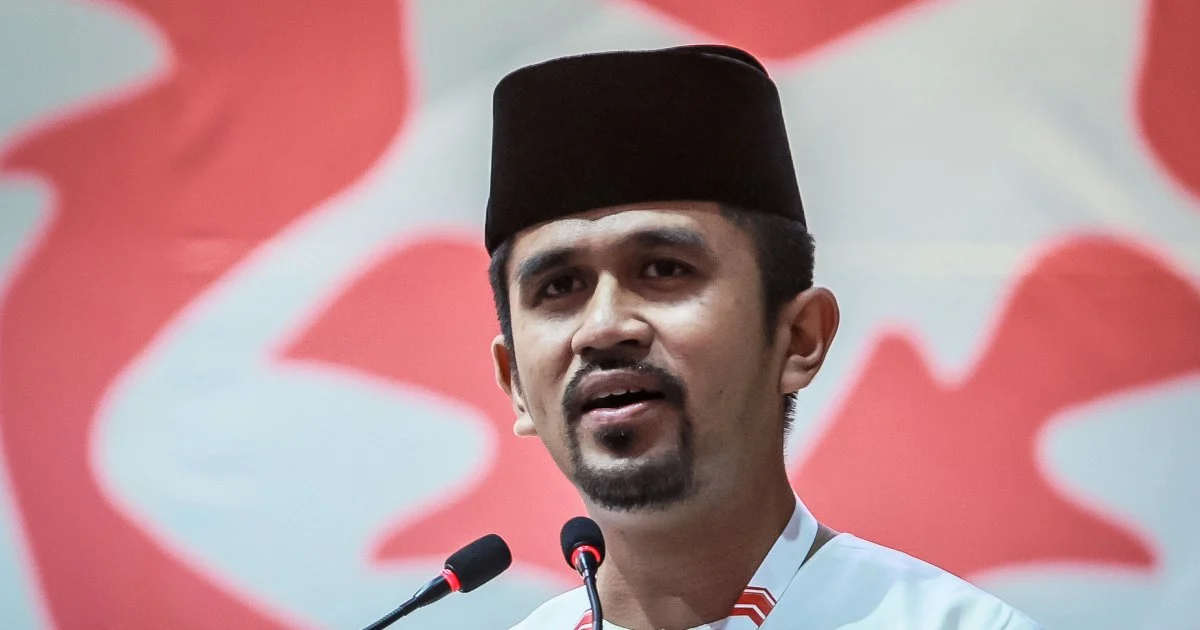
Umno Youth secretary-general Hafiz Ariffin has thrown down a political gauntlet by publicly questioning the curious absence of several high-profile Pakatan Harapan leaders from the opposition coalition's candidate line-up ahead of Johor's July 11 state election. The move represents a shift in the pre-election discourse, moving beyond policy debates to scrutinise the internal mechanics of PH's campaign strategy in the economically significant southern state.
The challenge underscores how electoral contests in Malaysia have increasingly become exercises in reading between the lines, where candidate selection decisions carry messages about confidence, internal dynamics, and political viability. For observers of Malaysian politics, the composition of a party's slate often reveals more about internal confidence levels and factional positioning than any official pronouncement. In Johor's context, where BN has traditionally maintained formidable political machinery, the presence or absence of heavyweight figures on the opposition ticket carries particular significance.
Hafiz Ariffin's intervention from the BN Youth platform suggests a coordinated effort to undermine PH's credibility in the state by raising questions about whether the coalition's top echelon is sufficiently confident to contest. This tactical approach aims to sow doubt among voters about PH's internal cohesion and leadership commitment to the Johor contest. The questioning mechanism allows BN to frame the narrative before the official campaign fully mobilises, gaining agenda-setting advantage in a crucial battleground.
Johor represents a particularly sensitive political theatre for both coalitions. The state has historically served as a BN stronghold, generating reliable electoral returns for the ruling coalition. Any shift in voter sentiment in Johor would have cascading implications for Malaysia's broader political balance. The absence of top PH leadership figures from candidate rosters could indeed be interpreted as a sign of strategic caution or alternatively as evidence of confidence in ground-level party workers. The ambiguity itself becomes fodder for opposition criticism.
The timing of Ariffin's statement carries tactical weight. By raising these questions in the pre-campaign period, BN Youth aims to set the conversational tone and potentially distract from substantive policy discussions. In Malaysian electoral politics, controlling the narrative flow before official campaigns commence often determines which issues dominate public discourse. By establishing early focus on PH's internal composition rather than campaign platforms, BN creates psychological pressure on the opposition coalition.
For PH, the challenge presents a communication problem requiring explanation. Whether senior figures have opted to focus on national-level politics, chosen to concentrate campaign efforts in other states, or face constraints from other commitments, the coalition needs to articulate a coherent rationale to counter suggestions of weakness or internal discord. The absence becomes politically significant not because of inherent logic but because opponents have successfully weaponised it for messaging purposes.
This form of political attack reflects the increasingly sophisticated nature of Malaysian electoral competition. Rather than direct policy contestation, parties increasingly focus on exploiting procedural decisions, candidate selections, and internal organisational choices as grounds for questioning opponent credibility. These indirect attacks often prove more effective than traditional messaging because they invite speculation and create space for negative interpretation without requiring parties to make affirmative policy arguments.
For Malaysian and Southeast Asian political observers, the Johor contest illustrates how opposition coalitions navigate the inherent disadvantages of competing against entrenched ruling coalitions. PH's decision-making regarding candidate selection—whether driven by resource constraints, strategic calculation, or other factors—becomes subject to reinterpretation by opponents as evidence of weakness. This dynamic makes candidate selection among the most consequential decisions opposition movements face, as every choice carries both tactical and symbolic weight.
The broader implications extend beyond Johor's borders. How PH responds to these challenges, whether the coalition can effectively mobilise its base despite the absence of certain high-profile figures, and what electoral outcomes materialise will provide important signals about opposition viability nationally. Johor remains a crucial proving ground for testing whether BN's traditional dominance remains unshakeable or whether shifting voter demographics and political attitudes have created openings for PH advances.
Hafiz Ariffin's intervention also demonstrates how Malaysian politics continues evolving into a multi-dimensional competition encompassing not just election day itself but the pre-campaign narrative environment. Parties invest significant effort in shaping perceptions before formal official campaigns commence, recognising that early impression-formation influences subsequent campaign dynamics. BN Youth's questioning tactic seeks to establish negative frames around PH before the opposition coalition can fully control its own messaging environment.
The absent PH figures themselves remain unnamed in the public discussion thus far, adding another layer of ambiguity. This vagueness allows Ariffin and BN strategists to construct maximally damaging interpretations without specific factual constraints. Rather than defending against specific accusations about particular individuals, PH faces the more diffuse challenge of combating generalised impressions about leadership confidence and coalition cohesion. This representational advantage for BN underscores how narrative control becomes increasingly valuable in modern electoral competition.