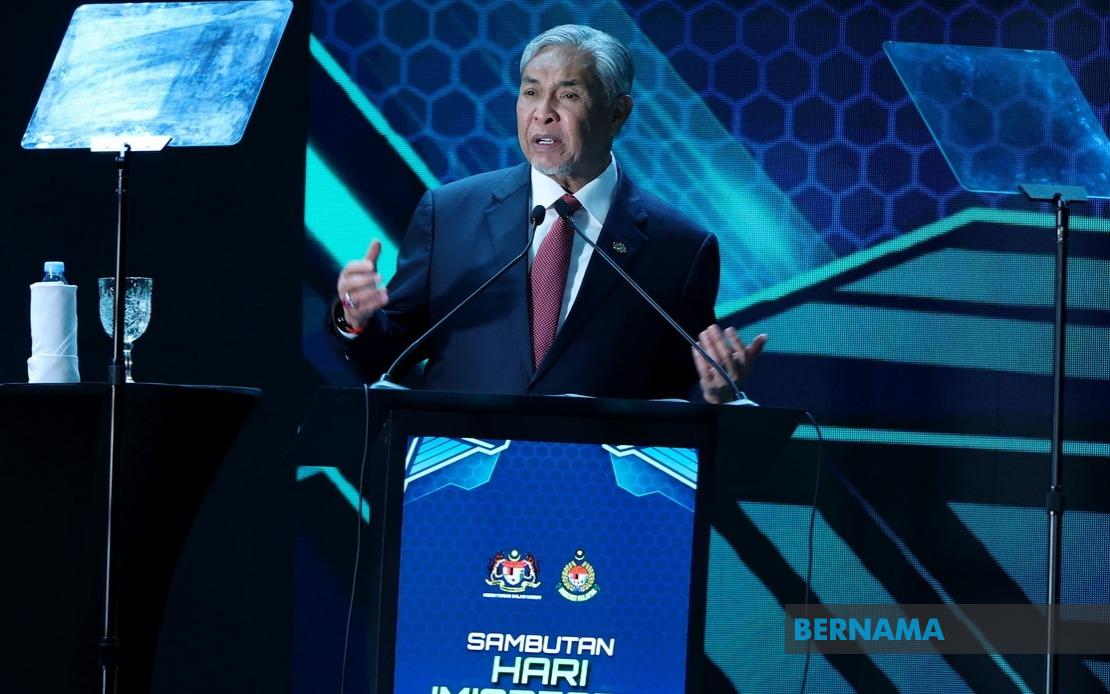
Barisan Nasional has reaffirmed its dedication to remaining within the Unity Government framework, with the coalition's leadership citing a formal resolution passed at UMNO's most recent General Assembly as the basis for this position. Datuk Seri Dr Ahmad Zahid Hamidi, who serves concurrently as BN chairman, UMNO president, and Deputy Prime Minister, made the declaration at a press conference in Cyberjaya on July 21 while attending the 2026 Immigration Day celebration. His statement carries particular weight given his triple portfolio and his position as the second-highest ranking official in government, signalling that the decision represents a unified position across both BN's leadership and UMNO's broader membership base.
The emphasis placed by Ahmad Zahid on the General Assembly's role underscores the hierarchical importance of party conventions in Malaysian politics. By repeatedly framing the commitment as stemming from the "highest level" of party decision-making, Ahmad Zahid sought to convey that this is not merely a leadership preference but a binding resolution that reflects grassroots party sentiment. This framing carries strategic value in Malaysian politics, where party assemblies serve as barometers of internal support and legitimacy. The invocation of the General Assembly's authority was notably deliberate, suggesting that BN felt compelled to justify its continued participation in the Unity Government through appeal to collective party will rather than leadership discretion alone.
The timing of this reaffirmation is significant within the broader political context of Malaysia's coalition politics. Unity Government arrangements, which brought together traditionally opposing forces following the 2022 general election, have faced periodic strain as constituent parties navigate competing interests and electoral ambitions. By securing and publicising a formal General Assembly resolution, BN has created a mechanism to manage internal dissent and external pressure that might otherwise threaten the coalition's stability. This approach reflects a recognition that durability of such cross-party arrangements depends not only on elite consensus but on demonstrable support from party structures and membership.
Ahmad Zahid's remarks regarding Prime Minister Datuk Seri Anwar Ibrahim's cabinet prerogatives reveal another layer of the political dynamics at play within the Unity Government. His explicit acknowledgement that appointment and dismissal of ministers constitutes the Prime Minister's absolute right, while seemingly straightforward, addresses an underlying tension inherent in coalition governance. By clearly delineating authority boundaries, Ahmad Zahid effectively insulated the Prime Minister from potential criticism while simultaneously establishing clear expectations about the limits of coalition partners' influence over cabinet composition. This clarity serves both parties' interests: it protects Anwar's executive authority while providing BN with a framework for understanding the limits of its leverage.
The context for Ahmad Zahid's statement includes recent warnings issued by Prime Minister Anwar Ibrahim regarding ministerial conduct during state election campaigns. Anwar had cautioned government members against using their positions to attack coalition partners during electoral contests, warning that such behaviour would trigger demands for resignation. This directive addresses a recurrent challenge in Malaysian coalition politics: the tension between maintaining electoral competition within states while preserving unity at the federal level. Ahmad Zahid's affirmation of the Prime Minister's absolute authority in such matters effectively endorses this disciplinary mechanism, demonstrating BN's acceptance of federal-level governance principles that transcend coalition boundaries.
The implications of BN's continued participation in the Unity Government extend beyond Malaysia's immediate political landscape to influence regional stability and investor confidence. Southeast Asia's largest economy benefits from policy continuity and predictable governance structures, both of which depend on coalition stability. BN's formal recommitment, backed by General Assembly resolution, provides assurance to markets and foreign governments that Malaysia's government possesses sufficient internal coherence to implement consistent policies across medium-term horizons. For Malaysia's ASEAN partners and major trading partners, such clarity regarding domestic political arrangements matters considerably in investment and trade relationship calculations.
For Malaysian voters and political observers, BN's reaffirmation raises questions about the party's medium-term strategic calculations. The decision to remain within the Unity Government rather than pursue alternative coalition arrangements suggests that BN's leadership has calculated greater advantage in maintaining the existing structure than in exploring other possibilities. This calculation likely reflects assessments regarding electoral competitiveness, ministerial portfolio distribution, and influence over policy direction. The fact that such calculations were formalized through a General Assembly resolution indicates that BN sought legitimacy beyond leadership preference, recognizing that sustainable coalition participation requires broader party support.
The governance implications of Ahmad Zahid's emphasis on the Prime Minister's absolute appointment authority merit consideration within Malaysia's constitutional framework. While prime ministerial discretion in cabinet appointments is indeed constitutionally established, the explicit affirmation by a coalition partner's leader serves to reinforce separation of powers principles and executive authority. This becomes particularly relevant in coalition governments where constituent parties might otherwise be tempted to demand veto rights over appointments affecting their interests. By accepting the Prime Minister's autonomy, BN has effectively agreed to relinquish such potential claims, strengthening Anwar Ibrahim's governing capacity at the cost of BN's direct influence over certain personnel decisions.
Looking forward, the sustainability of BN's Unity Government participation will likely depend on whether the coalition arrangement continues delivering tangible benefits to the party and its constituent communities. Electoral performance in upcoming state contests, distribution of development resources, and influence over policy priorities will all factor into whether BN's General Assembly resolution proves durable or whether future assemblies might reconsider the party's coalition arrangements. The public nature of Ahmad Zahid's commitment means that significant policy divergences or perceived unfair treatment could generate pressure from within BN's ranks for reassessment, making it essential that the Unity Government demonstrate that coalition participation serves BN's interests adequately.

