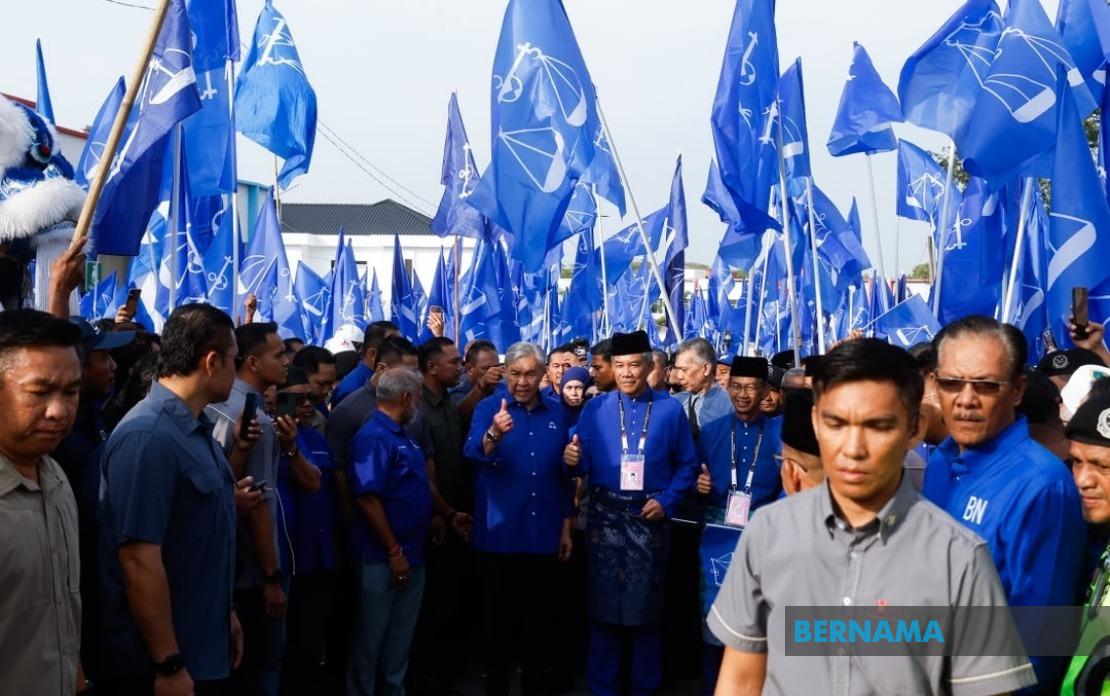
Senior Barisan Nasional figures made a coordinated show of support for party candidates across Negeri Sembilan on Thursday, with BN chairman Datuk Seri Dr Ahmad Zahid Hamidi personally escorting his deputy to submit nomination papers at the Rembau nomination centre. The symbolic gesture underscored leadership alignment within the coalition as it gears up for the 16th state election, with voting scheduled for August 1 and early voting on July 28.
Ahmad Zahid, who also serves as UMNO president, arrived at the Dewan Seri Rembau centre at 8.40 am alongside Datuk Seri Mohamad Hasan to witness the submission of nomination papers for the Rantau state seat. Mohamad Hasan has represented this constituency since 2004, establishing himself as a significant figure in Negeri Sembilan politics. The visible collaboration between the two senior figures—one leading the federal coalition and the other its deputy—projected an image of internal BN stability, particularly important as the party seeks to consolidate its position in a state where traditional political alignments have occasionally proven volatile.
All eight nomination centres across Negeri Sembilan began receiving candidate applications simultaneously at 9 am, concluding their operations one hour later. This synchronized approach ensured equitable access and prevented logistical advantages for any single contestant. The compressed timeframe reflected the Election Commission's structured management of the nomination process, a critical juncture where candidates formally declare their candidacy and submit required documentation.
Beyond Rembau, the leadership visibility extended strategically to other parliamentary constituencies. Datuk Seri Dr Zambry Abd Kadir, serving as BN secretary-general, accompanied Datuk Mohd Faizal Ramli's submission for the Linggi state seat in Port Dickson. In the same parliamentary zone, UMNO vice-president Datuk Seri Johari Ghani lent his presence to Suhaimizan Bizar's candidacy for the Gemencheh state seat. The deliberate distribution of senior party officials across different nomination centres amplified BN's campaign apparatus while demonstrating organizational depth.
Within Jempol parliamentary constituency, UMNO secretary-general Datuk Dr Asyraf Wajdi Dusuki supervised the nomination submissions of three BN candidates simultaneously. Datuk Mustapha Nagoor filed for Palong, Datuk Mohd Zaidy Abdul Kadir for Jeram Padang, and Chong Fui Ming for Bahau. This concentration of leadership attention in a single parliamentary zone suggested party strategists viewed Jempol as a critical battleground where retaining all three seats would significantly influence overall state election outcomes.
The coalition's broader composition received recognition through component party participation. Parti Islam SeMalaysia's president, Tan Sri Abdul Hadi Awang, personally accompanied PAS candidate Mohd Fairuz Mohd Isa in filing papers for the Serting state seat, signalling the continuing importance of PAS within the BN framework despite ongoing political tensions at the national level. The visible presence of PAS leadership demonstrated the coalition's attempt to project unity despite occasional strains between component parties at federal level. This regional focus allowed PAS to highlight its relevance within BN's structure and reinforce its standing among Negeri Sembilan voters.
Partisan diversity extended further with Parti Orang Asli Malaysia's involvement in the electoral process. ASLI president Rashid Ka accompanied party candidate Dayana Dal in submitting nomination papers for the Jeram Padang state seat, also within Jempol parliamentary constituency. ASLI's participation, albeit with a single candidate, demonstrated the coalition's efforts to represent Malaysia's indigenous communities and secure representation for constituencies with significant Orang Asli populations.
The Negeri Sembilan State Legislative Assembly's official dissolution on June 5, following approval from the Yang Dipertuan Besar Tuanku Muhriz Tuanku Munawir, initiated the electoral calendar that culminated in Thursday's nomination submissions. The constitutional process respects the institution's ceremonial head while facilitating democratic procedures—a balance particularly important in a state with strong royal tradition and institutional sensitivity.
For Malaysian and Southeast Asian political observers, the event demonstrated how regional elections in federal systems often serve as important gauges of national political health. Negeri Sembilan, as a smaller state, typically experiences less international media attention than Selangor or Perak, yet its results carry significance for understanding BN's grassroots resilience. The concerted leadership turnout suggested party strategists anticipated a competitive contest, warranting investment of high-profile figures' time and political capital. The visible unity contrasts with occasional BN factionalism elsewhere, potentially indicating successful management of intra-coalition tensions at the state level.
The coordination across nomination centres also reflected modern campaign strategies where media opportunities multiply through distributed leadership engagement. By stationing senior figures across different locations simultaneously, BN maximized news coverage and social media amplification—each nomination submission becoming a separate news event while collectively projecting party strength and organizational sophistication.
Polling day on August 1 would determine whether BN's displayed unity translated into electoral success. Early voting on July 28 would provide preliminary indicators of voter sentiment before the main contest, offering both campaigns initial momentum assessments. For Negeri Sembilan residents and broader Malaysian observers, the state election represented an opportunity to evaluate how national political dynamics—BN's federal coalition positioning, UMNO's intra-party developments, and PAS's continued role within the coalition—manifested in regional electoral competition and governance priorities.

