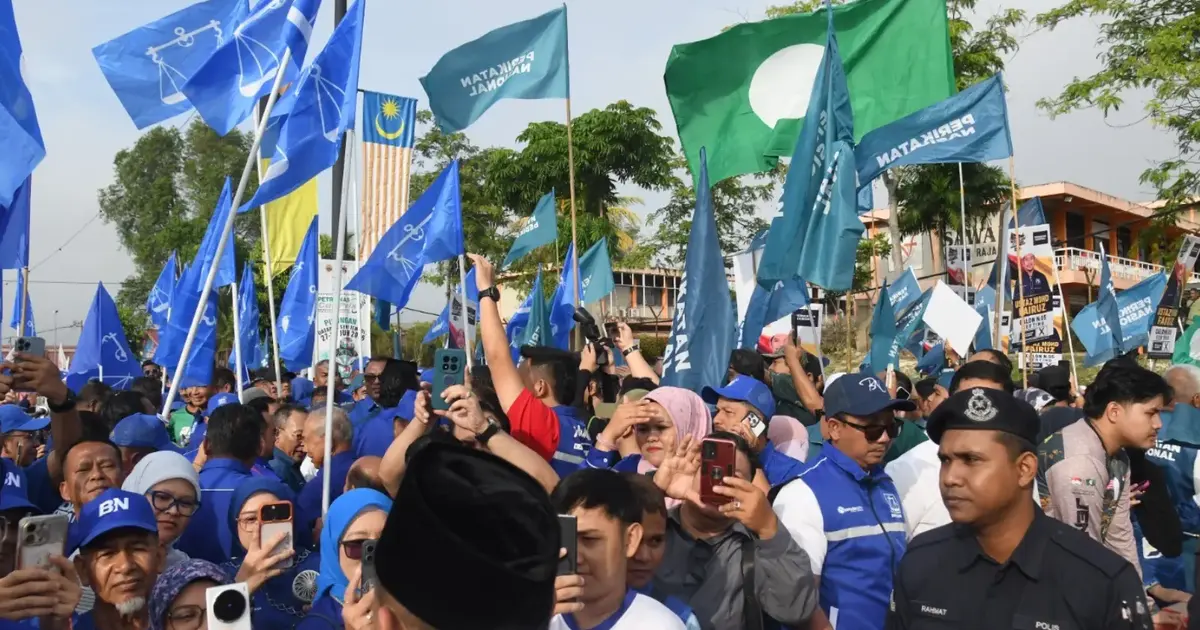
Political analyst Azmi Hassan has cast doubt on Barisan Nasional's ability to bolster PAS's electoral performance in Selangor, arguing that the coalition partner cannot replicate the organisational contributions Bersatu delivered during the previous state election cycle. The assessment underscores deepening concerns about the structural vulnerabilities facing Perikatan Nasional's efforts to consolidate support across Malaysia's most urbanised and economically significant state.
Bersatu's departure from Perikatan Nasional has left a substantial organisational vacuum that Hassan contends BN cannot meaningfully fill. The timing of this reconfiguration carries particular significance given Selangor's pivotal position in Malaysian politics. The state, which encompasses Kuala Lumpur's suburban sprawl and represents roughly one-fifth of the national electorate, remains a persistent electoral battleground where marginal shifts in voter behaviour cascade into consequential outcomes. Previous contests have demonstrated that victory margins often hinge on performance across a handful of constituencies where voter sentiment fluctuates based on local governance perceptions, development promises, and community engagement.
During the previous state election, Bersatu functioned as more than a nominal coalition partner within the Perikatan framework. The party deployed its organisational networks, membership structures, and localised campaign infrastructure across multiple constituencies, mobilising supporters and facilitating grassroots mobilisation efforts that complemented PAS's electoral machinery. This collaborative arrangement yielded tangible results, enabling Perikatan to make measurable inroads in constituencies previously considered strongholds for competing coalitions. The cumulative effect of coordinated campaigning, shared resources, and complementary voter outreach programmes substantially enhanced Perikatan's competitive positioning throughout the state.
Barisan Nasional's integration into the Perikatan framework presents a qualitatively different dynamic from Bersatu's participation. The older coalition maintains its own internal hierarchies, constituent party interests, and established territorial arrangements that have evolved over decades. UMNO, the dominant force within BN, operates through institutional structures and patronage networks that frequently prioritise internal coalition harmony over aggressive pursuit of new electoral territory. MIC and MCA, the Indian and Chinese components respectively, have experienced decades of membership decline and organisational atrophy, leaving them with considerably diminished mobilisation capacity compared to their historical influence. Their participation in Selangor contests therefore generates qualified electoral value, constrained by erosion of their traditional voter bases and weakened grassroots presence across many constituencies.
The analyst's assessment reflects broader structural realities confronting multiparty coalitions in Malaysian electoral politics. When new partnerships form, expectations frequently exceed tangible contributions. Coalition members often harbour competing interests regarding candidate selection, campaign resource allocation, and post-election seat distribution. These internal tensions, while manageable during initial courtships, frequently materialise as substantive impediments during actual election campaigns. BN components may prioritise protecting their existing strongholds or preserving their reserved seats within the broader coalition arrangement rather than concentrating fully on expanding Perikatan's overall electoral footprint in contested territories.
Selangor's demographic complexity compounds these challenges. The state encompasses diverse constituencies ranging from affluent urban areas to industrial zones, agricultural regions, and rapidly urbanising satellite towns. Each constituency exhibits distinct voter preferences, economic anxieties, and governance priorities. Effective electoral competition requires tailored messaging, local candidate credibility, and sustained community engagement—elements demanding substantial organisational resources and deep-rooted presence. BN's capacity to deliver across this heterogeneous terrain remains questionable, particularly when its component parties have progressively ceded ground to other coalitions across multiple electoral cycles.
The implications extend beyond immediate electoral mathematics. Hassan's analysis implicitly challenges assumptions that coalition restructuring inherently strengthens all participating parties equally. In Malaysian politics, coalition realignments frequently generate uneven benefits. While one partner may gain access to new constituencies or enhanced campaign resources, others may inherit territorial vulnerabilities or integration challenges. PAS's situation illustrates this dynamic—the party may discover that BN's participation, while conferring certain advantages, simultaneously imposes constraints on campaign autonomy and strategic decision-making that offset marginal electoral gains.
For Malaysian voters and regional observers, this recalibration carries significance beyond Selangor's boundaries. Selangor outcomes historically influence national political trajectories, investor confidence, and policy directions across multiple sectors. A Perikatan advance in the state would signal strengthening of Islamist political influence and restructured coalition politics at the federal level. Conversely, consolidation of existing opposition control would reinforce pluralistic governance models and ideological diversity in Malaysia's most critical economic zone. Hassan's scepticism regarding Perikatan's Selangor prospects therefore touches upon consequential questions regarding Malaysia's political evolution and governance character.
The analyst's commentary also reflects frustration among political observers regarding superficial coalition mathematics that ignore organisational realities. Malaysian politics frequently examines elections through the lens of seat arithmetic and numerical superiority without adequately accounting for the institutional quality, grassroots mobilisation capacity, and voter mobilisation discipline that separate effective political machines from nominally larger but functionally weaker combinations. Hassan's intervention redirects attention toward these neglected dimensions, emphasising that coalition strength ultimately derives from demonstrable capacity to connect with voters, manage campaigns, and sustain organisational coherence under electoral pressure.
Looking forward, PAS faces the challenge of maximising benefits from BN partnership while minimising constraints on its campaign message and resource deployment. The party must articulate a compelling vision for Selangor governance that resonates beyond its traditional supporter base—a formidable task in a state where urban voters, business communities, and minority populations maintain reservations toward religiously-inflected political platforms. Whether BN's participation strengthens or complicates this outreach effort remains contested. Hassan's assessment suggests that the latter scenario carries greater probability, implying that PAS's Selangor ambitions may encounter more substantial obstacles than coalition leaders publicly acknowledge.

